Snowflake vs. Databricks
Snowflake is enterprise-ready. Databricks is not.
99.99%
Service-level agreement (SLA) commitment from Snowflake
2x
Faster performance for core analytics on Snowflake
No lock-in
Snowflake is open and interoperable
Over 12,000 Companies Power their AI, Apps and Data on Snowflake’s AI Data Cloud


Snowflake vs. Databricks
at a glance
As data and AI introduce new challenges across security, governance and resiliency, customers demand greater trust, flexibility and scale.
Snowflake is enterprise-ready by design. Databricks is missing vital capabilities in areas such as business continuity/disaster recovery, security, governance, open standards, cost management and performance optimization.*
|
Snowflake |
Databricks |
|
|---|---|---|
|
Business-Critical Capabilities |
Faster performance at enterprise scale |
No simple, out-of-the-box disaster recovery; complex cross-cloud; Unity Catalog gaps |
|
Open Platform |
True open source commitment |
Not open where it matters |
|
Cost and Performance |
Faster performance at enterprise scale |
Slower and higher cost |
* As of November 5, 2025
Snowflake offers built-in governance and reliability, with a 99.99% SLA commitment.

“When we did the final failover, it was almost instantaneous to users, making the whole migration process rather seamless."
Senior Architect, HD Supply

Snowflake has a truly open, interoperable platform.

“Many teams at Indeed were eager to get data into Snowflake as quickly as possible...Snowflake’s native support for Iceberg tables provides the performance, security and scalable compute needed to make that happen.”
Daniel DeMara
Staff Software Engineer, Indeed
- 43–74% cost reduction compared to previous analytical tools

Snowflake is double the speed at half the cost.
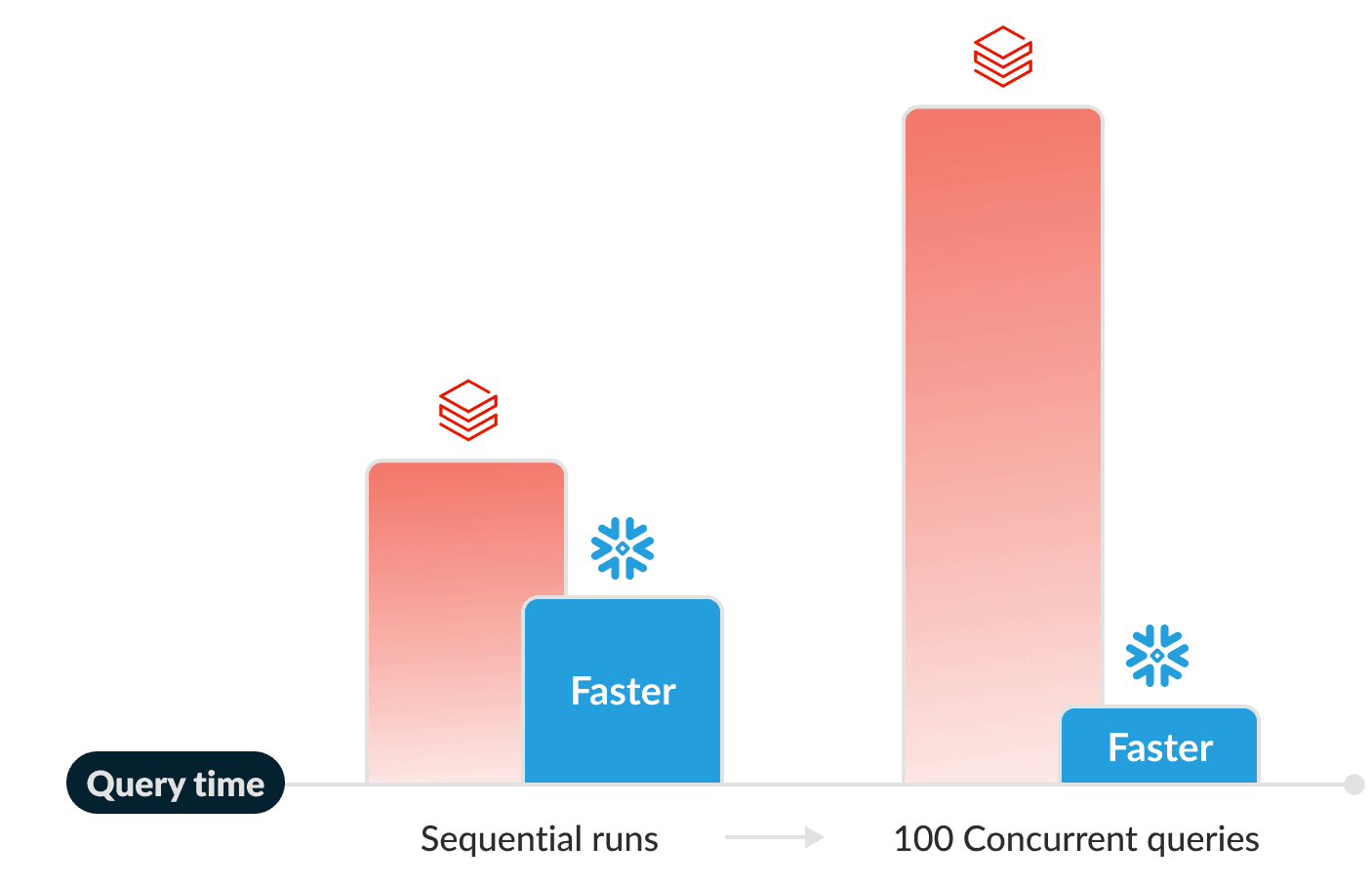
Based on customer POCs and third-party testing; actual performance may vary

“Snowflake was pitched as a partnership — and it is a partnership. We have been so happy we made the switch”
David Webb
Data Architect, Travelpass
65%Cost savings by switching from Databricks to Snowflake
350% More efficient data delivery to business units

Why premier organizations choose Snowflake
50% latency improvement
Improved performance and reduced latency by moving from Databricks to Snowflake and Snowpark data frames, delivering greater operational efficiency.

Millions of dollars saved
Achieved ROI equivalent to millions of dollars in cost savings by empowering users to focus on analytics, not manual data retrieval.

70% cost savings
Saved 70% in costs by eliminating redundant services and reducing cloud resource usage upon moving from Databricks to Snowflake.

75% cost savings
Slashed costs by 75% by moving the training of forecasting models in Databricks to a unified model in Snowflake.

The Snowflake AI Data Cloud
Frequently Asked Questions
Snowflake provides a 99.99% uptime SLA, offering high reliability to customers.
Snowflake includes BCDR as a standard, managed feature that provides replication and seamless failover across regions and clouds. For Databricks, implementing BCDR requires a significant "do-it-yourself" effort that could take months to implement, while still lacking comprehensive disaster readiness.
Unity Catalog is not a fully enterprise-ready catalog, as certain foundational controls are missing or deficient:
Out-of-the-box, simple business continuity/disaster recovery does not exist.*
There are gaps in Unity Catalog fine-grained access controls.
Advanced privacy features, including differential privacy, aggregation and projection policies are lacking, though such capabilities have been standard in Snowflake Horizon Catalog for years.
Unity Catalog has overly complex cross-cloud management, such as complex sharing and administration across clouds and regions. These capabilities are foundational to Snowflake Horizon Catalog.
Most critically, Databricks Unity Catalog is not open source and offers no officially documented migration path to Unity Catalog OSS. Unity OSS itself lacks robust governance or security capabilities (see roadmap).
In addition to the above, Databricks does not provide proactive cyber defense, threat prevention and recovery, unlike Snowflake, which delivers native threat prevention (malicious IP protection), compliance-grade immutable backups and more.
Snowflake Data Sharing provides secure cross-cloud, cross-region sharing with role-based access control and policies. It is cost-effective due to capabilities such as the Egress Cost Optimizer and Data Sharing Rebate Program. Snowflake supports sharing AI models and all types of AI-ready data, including data in open table formats such as Apache Iceberg and Delta Lake, and AI assets. All of this is available out of the box to Snowflake and non-Snowflake customers alike.
Databricks Delta Sharing can be cost-prohibitive. The more consumers use Delta Share from remote regions, the more a provider pays in CSP egress. Delta Sharing open source has several limitations around data security and governance, and customers are required to use the proprietary Unity Catalog for any meaningful sharing. Lastly, Databricks customers currently can’t share agents, Unity Catalog Metric Views or search services. This means customers are left with engineering complexity when getting data ready for agents and AI.
Snowflake's open data philosophy is that "Your architecture should belong to you, not your vendor." This is demonstrated by our ongoing contributions to the OSS projects, such as Apache Iceberg™, Apache Polaris™, Apache Nifi™, and, most recently Open Semantic Interchange (OSI), which promotes vendor-neutral governance and development. This gives customers the freedom to choose the best tools without the fear of vendor lock-in.
On the other hand, Databricks starts with an open source promise, though critical enterprise capabilities remain proprietary. For example, the open source version of Unity Catalog (Unity OSS) lacks core security features, meaning customers must adopt the proprietary Databricks Unity Catalog for security and governance capabilities, and their architecture becomes dependent on Databricks’ roadmap and priorities.
Fully managed and serverless, Snowflake helps customers deliver faster value through built-in optimizations, including Automatic Clustering and the Query Acceleration Service. Snowflake transparently controls and optimizes costs with an out-of-the-box Cost Management Interface that includes an Account & Org Overview for spend, budgets and cost insights to optimize spend.
Based on customer POCs and third-party testing, Databricks costs increase and performance slows as data becomes more complex, concurrency increases and data volumes increase. Databricks also lags in native cost governance with no enforcement of spending limits and limited out-of-the-box, query-level cost attribution.
