
OCT 02, 2025|5 min read

For years, we’ve steered Snowflake under a simple principle: Performance should improve on its own. As workloads grow and evolve, engineers shouldn’t need to reconfigure storage, manage compute or rewrite queries just to keep up with increased demand. That’s what legacy platforms may require. A modern platform should automatically observe, learn and optimize.
Now more than ever, performance has to be autonomous. Our vision is that it should be easy to run optimally and impossible to run inefficiently on Snowflake. A modern workflow can generate thousands of unique query shapes in minutes. Filters shift, joins change and access patterns drift. Add AI agents into the mix, and predictability disappears entirely. Optimization becomes a moving target that’s impossible to chase with manual tuning.
In 2025, we pushed autonomous intelligence deeper into the core of Snowflake. These were not isolated feature improvements. They represent additional pillars for a self-optimizing platform designed to thrive under today’s BI dashboards, data engineering pipelines, application backends, and increasingly agentic and autonomous systems. This gives customers more headroom to innovate, derive deeper insights from petabytes of data they manage in Snowflake, and efficiently scale workloads from experimentation to production.
Some of the most striking improvements came from intelligent optimizations we applied to at-scale workloads. Customers didn’t have to rearchitect or rewrite code. The platform simply became more efficient.
Below, we detail the sweeping improvements we delivered last year to further strengthen Snowflake as a leading foundation for your data and AI success.
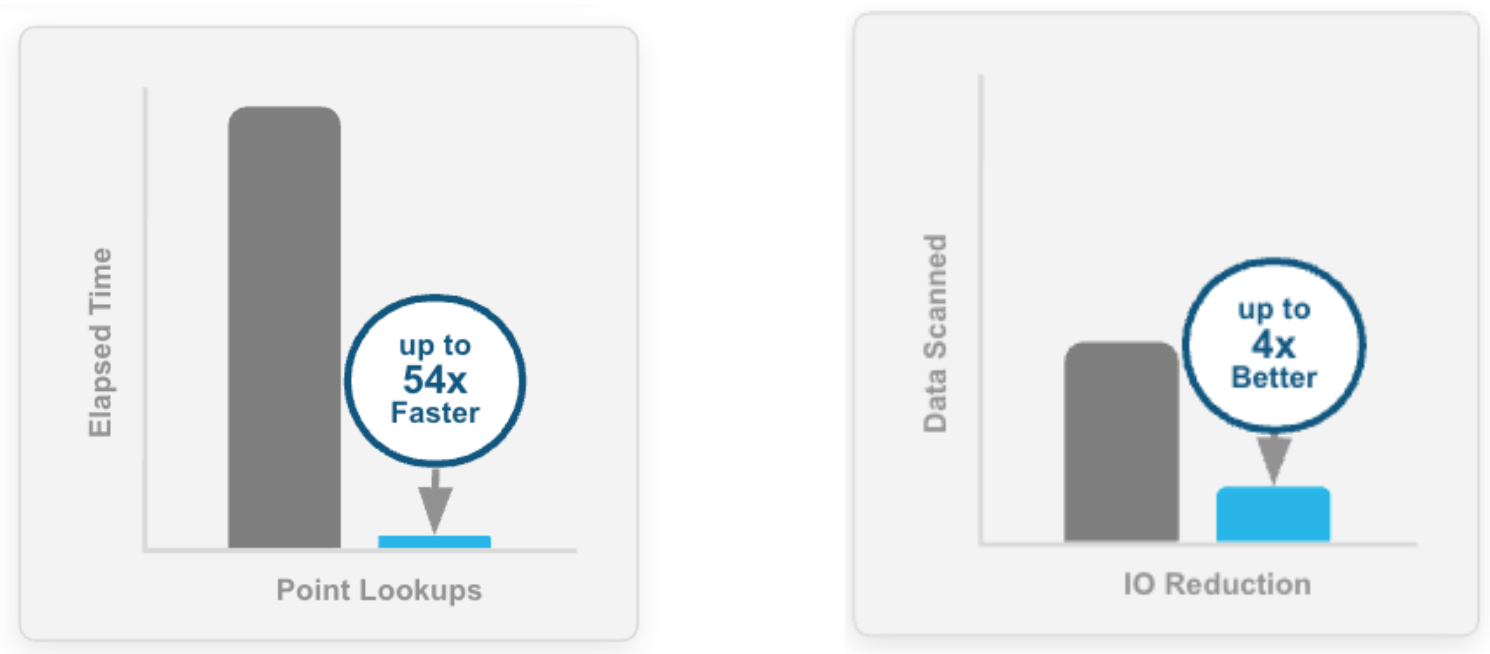
Snowflake Optima (generally available, as of August 2025) represents a major step forward for our autonomous vision. It is a continuous optimization engine that monitors workload patterns in real time to improve performance. You can think of Optima as a “virtual database administrator” who’s always on the lookout for optimization opportunities across your Snowflake deployment.
Because the best query plan is useless if the underlying data is fragmented, our first goal for Optima is to help you optimize your data layer, starting with Optima Indexing and Optima Metadata. Instead of asking you to figure out how to tune your tables, Snowflake Optima identifies repeated access patterns and applies hidden indexes and custom metadata in the background, helping your data layer evolve in lockstep with your workloads.
The results of this "virtual database administrator" are stark. Snowflake Optima Indexing has automatically accelerated workloads by up to 54x for hundreds of customers using Gen2 warehouses, seamlessly pruning billions of micro-partitions per day for point-lookup queries. In one recent production example, an automotive customer saw an immediate acceleration of frequent point-lookup queries, with latencies dropping from 17 seconds to just over 1 second. Optima Indexing automatically generated a hidden search index that increased micropartition pruning from 30% to 96%, eliminating the vast majority of I/O without a single manual ALTER TABLE command. Similarly, a Fortune 500 healthcare enterprise saw significant gains in its threat detection workload from Optima Metadata, which automatically creates custom metadata to accelerate queries with common predicate patterns. They got faster threat detection, with security rules executing 10% faster with 74% less data scanned, a 4x I/O reduction from over 20 TB/day down to about 5 TB/day.
We believe this zero-maintenance philosophy shouldn't be restricted to proprietary formats. In 2025, we erased the operational distinction between "internal" and "external" storage by bringing our native background maintenance engines directly to Apache Iceberg™. All of our pruning features, including Search Optimization and Snowflake Optima, work seamlessly for both native Snowflake and Iceberg tables. And we launched the new Table Optimization Service groups compaction and Automatic Clustering into a single background process, treating your Iceberg tables with the exact same rigor as native Snowflake storage. Coupled with other new optimizations detailed below, these managed capabilities allowed us to reduce the execution time on our internal TPC-DS 10TB benchmark on Iceberg format by 35%.
Efficiency isn’t just about raw compute and infrastructure: It’s about how the engine consumes it. We are on a journey to dismantle the static compute model in two phases: radically optimizing the runtime, then revolutionizing compute consumption.
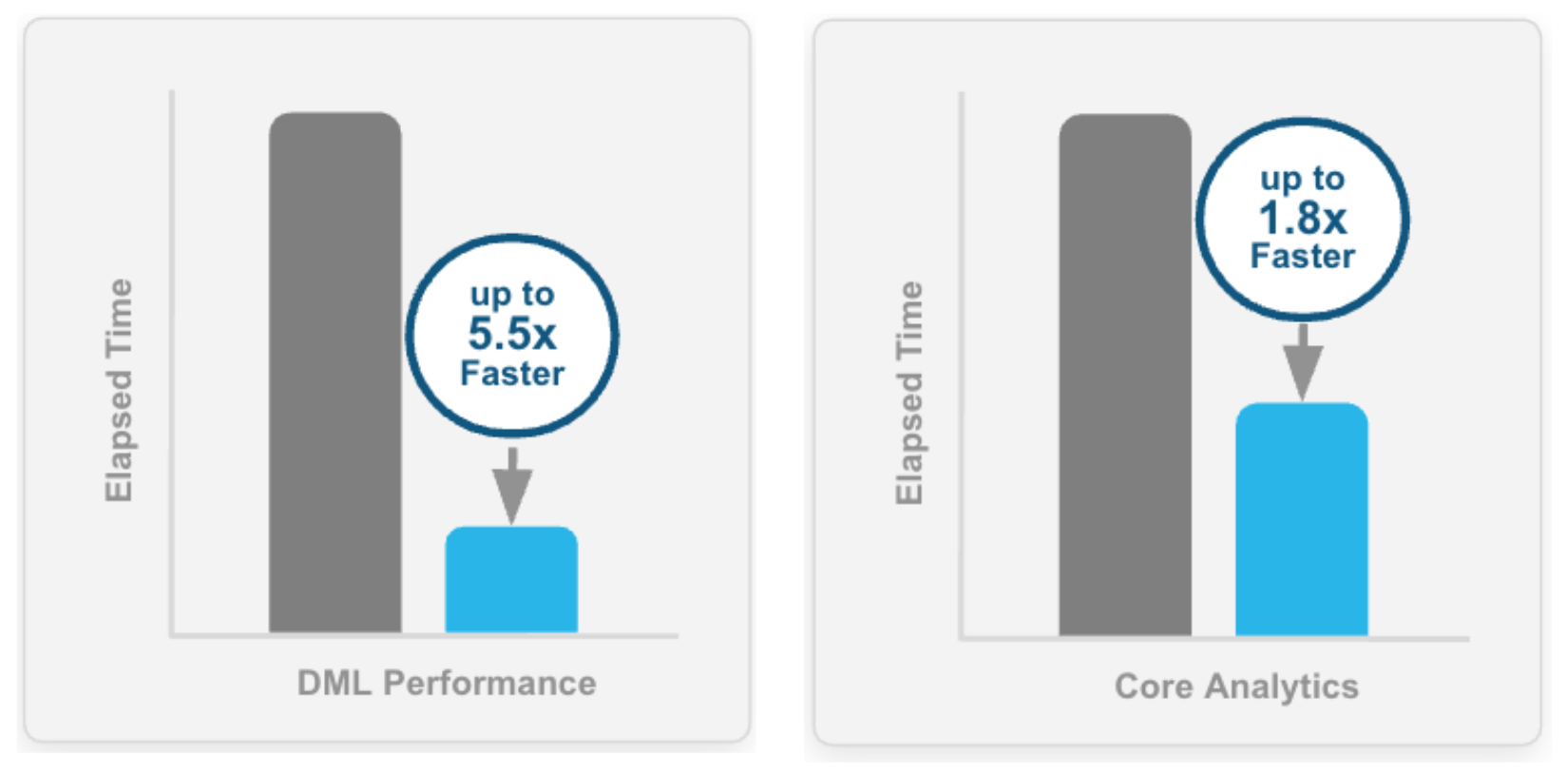
Gen2 represents a fundamental evolution of the Snowflake query runtime, delivering massive gains “out of the box” when comparing February 2025 to February 2026:
DELETE, UPDATE, and MERGE to massively reduce write amplification. This shrinks execution runtimes for heavy change data capture (CDC) pipelines and high-churn tables.As you can see, Gen2 significantly increases how efficiently work is executed. Next, we will be doubling down on the evolution of our compute model and will continue with innovations like the upcoming Adaptive Compute that takes away the undifferentiated heavy lifting of making infrastructure choices.
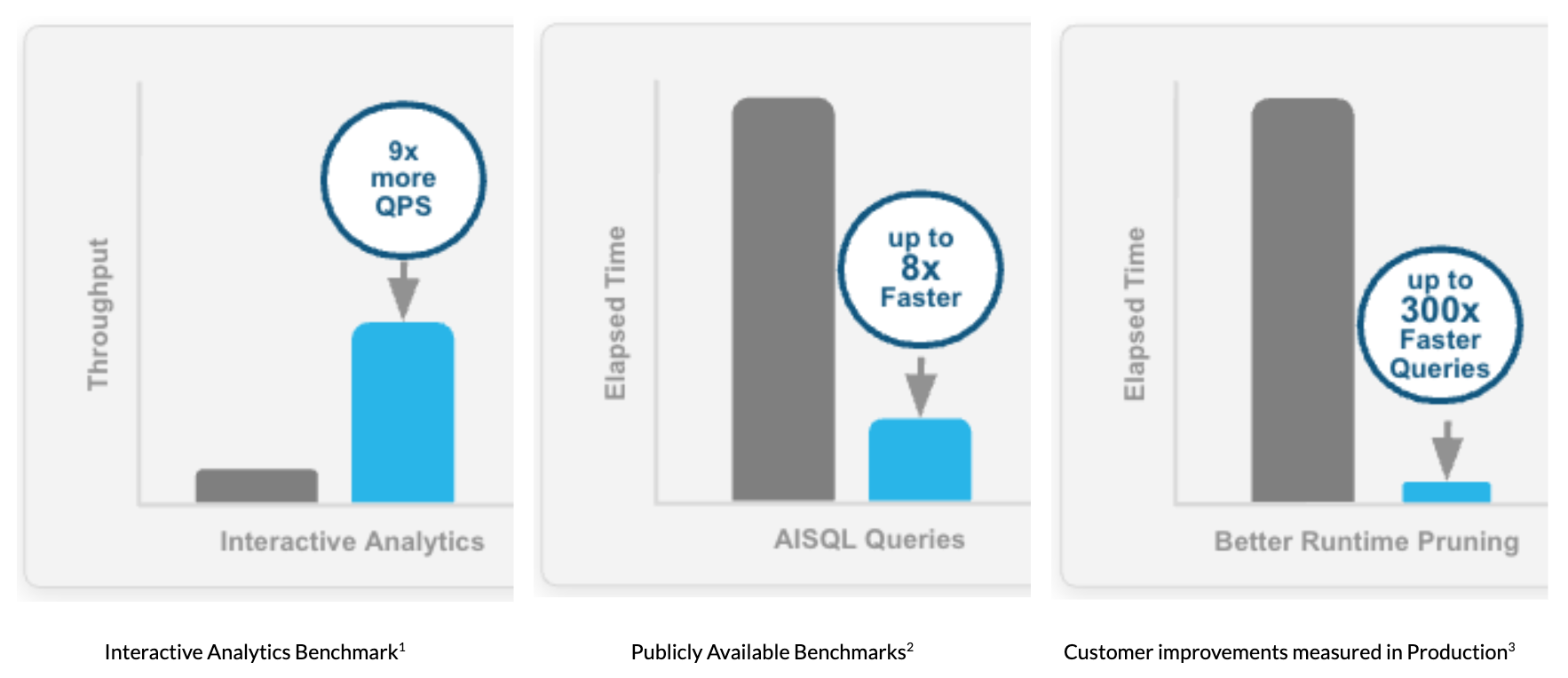
Modern analytics and data engineering patterns introduce skew, correlation and unpredictability that challenge even well-optimized systems. Every database engineer knows that compile-time estimates alone are often insufficient to help the engine deliver optimal results.
Last year, we released more than 50 workload-intelligent performance improvements under the hood to make the core query engine run even more efficiently, even in the face of changing or incomplete statistics. Notably, we introduced:
In 2026, the stakes have changed. We are entering an era where machines and AI agents will access data at a scale, frequency and complexity that far outpaces human oversight. In this environment, relying on a human to manually optimize infrastructure is a critical liability.
Our vision and engineering focus remains unchanged and bears repeating: It should be easy to run optimally and impossible to run inefficiently on Snowflake. The architectural answer for the data stack of the future is autonomy. And the future is already here.
1 Based on high-concurrency/low-latency Interactive Analytics Benchmark. (Jan. 2026)
2 Based on testing against six publicly available benchmarks, described in further detail here. (Nov. 2025)
3 Based on observed query performance in production environments. (Oct. 2025)


