DEC 10, 2025|7 min read

Modern enterprises ingest documents in every imaginable form: born-digital PDFs, scanned contracts, financial statements packed with tables and multilingual reports. Extracting reliable structure and content from diverse documents is a foundational requirement for analytics, search and AI-driven workflows.
At enterprise scale, document intelligence must also be cost effective, predictable and robust under real-world conditions. Small differences in price performance compound dramatically when processing millions of pages per year.
Many solutions in the market optimize for benchmarks using “ideal data sets,” which do not reflect the messy, heterogeneous documents that organizations actually encounter. This is why we built the AI Parse Document, engineered for this operating reality. It reconstructs logical reading order, preserves document hierarchy, extracts tables with structural precision and maintains visual context. The output is not merely text; it is a structured representation designed for deterministic downstream processing.
Our evaluations prioritize realistic enterprise conditions and measure performance based on usability: table reconstruction fidelity, structured extraction accuracy, OCR (Optical Character Recognition) robustness and LLM readiness. The results demonstrate top-tier accuracy combined with compelling price efficiency, positioning Snowflake in the enterprise sweet spot for scalable document AI.
To evaluate how well AI Parse Document handles the messiness of real-world enterprise documents and images, we assembled a deliberately challenging, multilingual data set. The goal was not to optimize for ideal conditions but to reflect the high-variance reality our customers encounter at scale.
The data set included documents with:
Dense text split across multiple columns
Embedded tables and charts interleaved with narrative text
Extremely small font sizes
Sideways slides and rotated pages
Scans containing multiple pages merged into a single image (“two pages in one”)
Other artifacts commonly introduced during digitization
Each document was manually reviewed by comparing the original source document with the extracted output. Reviewers scored performance across the following four dimensions that directly affect downstream usability:
OCR quality: Accuracy of text transcription relative to the source
Reading order: Correctness of the logical sequence compared to the original layout
Document structure: Fidelity of reconstructed headers, sections and paragraphs
Image handling: Accuracy of detecting and positioning nontext elements
Across these scenarios, AI Parse Document layout mode consistently produced well-structured outputs. Even for the documents with heavy rotation, multicolumn layouts or mixed visual content, the output text flowed in the expected order, and structural boundaries were preserved. It also correctly identified images in their proper context rather than flattening them into noise.
This qualitative robustness is critical as layout errors compound exponentially once documents are fed into search indexes, retrieval pipelines or LLM-based reasoning systems. The results demonstrate that AI Parse Document layout mode provides a reliable structural foundation before any higher-level analysis begins.
Tables remain one of the hardest problems in document understanding, as even subtle differences in row alignment, merged cells or header placement can break downstream logic regardless of OCR accuracy. To rigorously assess table extraction quality, we ran a controlled benchmark across multiple document intelligence systems.
The evaluation used a set of PDF documents with complex financial tables. Ground truth was established by manually annotating 50 financial documents, all normalized into markdown format to enable consistent comparison.
Rather than relying on a single metric, the benchmark applied a three-layer evaluation strategy:
Exact structural and content matches, measured by converting extracted tables into pandas DataFrames and checking for perfect equivalence
Shape-level matches, comparing table dimensions (row and column counts) even when cell content differed
Cell-level similarity, using the Ratcliff-Obershelp algorithm to align partially mismatched tables and quantify textual overlap
Standardized plaintext normalization was applied across all systems to avoid penalizing formatting differences unrelated to extraction quality.
The first table in the results section summarizes exact matches and shape matches across evaluated systems. In this table, Snowflake’s AI Parse Document layout mode shows the highest number of exact matches, correctly reconstructing nearly 40% of tables end to end. While shape matches are more forgiving, layout mode also performs strongly here, matching table dimensions in over 70% of cases.
The second table drills deeper into cell-level match quality, reporting average similarity as well as distribution percentiles (25th, median and 75th). These statistics are especially important for understanding consistency, not just peak performance.
Across all reported percentiles, Snowflake maintains high and stable cell-level accuracy, with median similarity approaching near-perfect alignment. This indicates that even when tables are not reconstructed perfectly, the extracted content remains highly usable for analytics and downstream processing.
Taken together, these results highlight that layout mode is not merely identifying tables — it is reconstructing them with a level of structural fidelity that holds up under strict, datacentric evaluation.
| Metric | Snowflake | Databricks | AWS Textract | Azure Document Intelligence | GCP Document AI |
|---|---|---|---|---|---|
| Evaluated settings | AI_PARSE_DOCUMENT layout mode | FeatureTypes= ['TABLES', "LAYOUT", "FORMS"] |
prebuilt-layout | pretrained-layout-parser-v1.0-2024-06-03 | |
| Exact matches | 39.58% | 4.17% | 32.00% | 4.00% | 8.00% |
| Shape matches | 70.83% | 62.50% | 68% | 54.00% | 26.00% |
CELL MATCHES |
|||||
| Average | 95.84% | 85.68% | 91.95% | 88.07% | 70.70% |
| 25th percentile | 92.14% | 80.25% | 89.62% | 83.33% | 44.81% |
| Median | 97.96% | 92.19% | 97.16% | 94.24% | 83.67% |
| 75th percentile | 100.00% | 96.43% | 100.00% | 97.71% | 94.44% |
While layout and structure are essential, they rest on a foundation of reliable text recognition. To evaluate OCR performance independently, we measured layout mode using the chrF (CHaRacter-level F-score) metric, which captures character-level similarity and is well suited for multilingual evaluations.
OCR was evaluated across three distinct document categories, each designed to stress a different failure mode:
Synthetic born-digital documents: Automatically generated using OSCAR-derived lexicons and the SynthTiger and text_renderer frameworks. These documents simulate high-quality digital sources while preserving linguistic diversity through curated fonts, layouts and backgrounds.
Nonstandard documents: A collection of visually complex real-world assets such as posters, book covers and presentation slides. These emphasize unconventional typography, decorative layouts and irregular spacing.
Scanned and distorted documents: Documents augmented with realistic degradation effects, including ink bleed, broken strokes, paper textures, brightness variation, geometric distortion, JPEG artifacts, shadows, bleed-through and folding. The goal was to replicate the failure modes seen in real scanning pipelines.
The OCR results are summarized in a single comparative table that reports CHRF scores across all three data set types. Snowflake’s layout mode demonstrates consistently strong performance, particularly on synthetic and distorted documents, where character-level accuracy remains high despite noise and degradation.
While different systems show strengths in specific subsets, layout mode maintains a balanced profile across all categories, reinforcing its suitability for heterogeneous enterprise document collections rather than narrow, single-format use cases.
| Type | Model | Synthetic documents | Nonstandard documents (en) | Distorted documents |
|---|---|---|---|---|
| AI_PARSE_DOCUMENT layout mode |
Snowflake | 0.9684 | 0.8685 | 0.9045 |
| Databricks | 0.9168 | 0.868 | 0.8527 |
High-quality LLM extraction is ultimately constrained by the quality and structure of the input it receives. In enterprise document workflows, failures in OCR, reading order or layout reconstruction propagate directly into downstream extraction errors such as missing fields, misattributed values or hallucinated structure. Hence, LLM extraction performance should be evaluated not in isolation but in the context of the document understanding pipeline that precedes it.
AI Parse Document in layout mode preserves logical reading order and section boundaries and serves as a reliable substrate for LLM-based extraction. By preserving logical reading order, section boundaries and table structure, the model produces representations that closely match how humans interpret documents, reducing the need for complex prompt engineering or postprocessing heuristics.
This design principle aligns with recent industry benchmarks that evaluate OCR systems based on their impact on structured extraction accuracy rather than raw text similarity alone. In the OmniAI OCR benchmark, OCR outputs are fed into a structured extraction pipeline, and the final extracted JSON is compared against ground truth, with accuracy judged holistically rather than character by character. This methodology reflects real enterprise usage, where the objective is not perfect transcription in isolation but correct, machine-usable structure downstream.
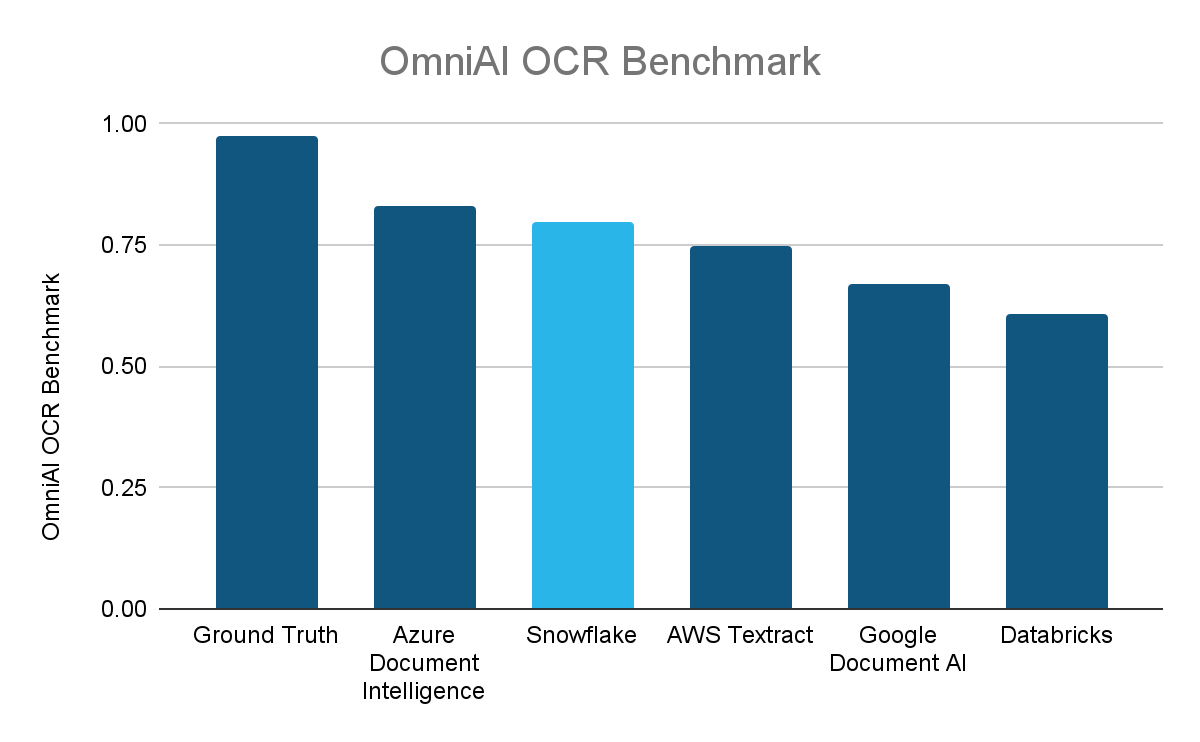
The benchmark’s results, visualized in the accompanying chart (Figure 1), show Snowflake performing in the top tier of evaluated systems on structured extraction accuracy. While no OCR system reaches the theoretical maximum — partly due to judge variability and the inherent ambiguity of real documents — Snowflake’s results indicate strong alignment between layout-aware extraction and LLM consumption. The gap between perfect ground truth and real-world systems underscores the importance of preserving structure and context early in the pipeline.
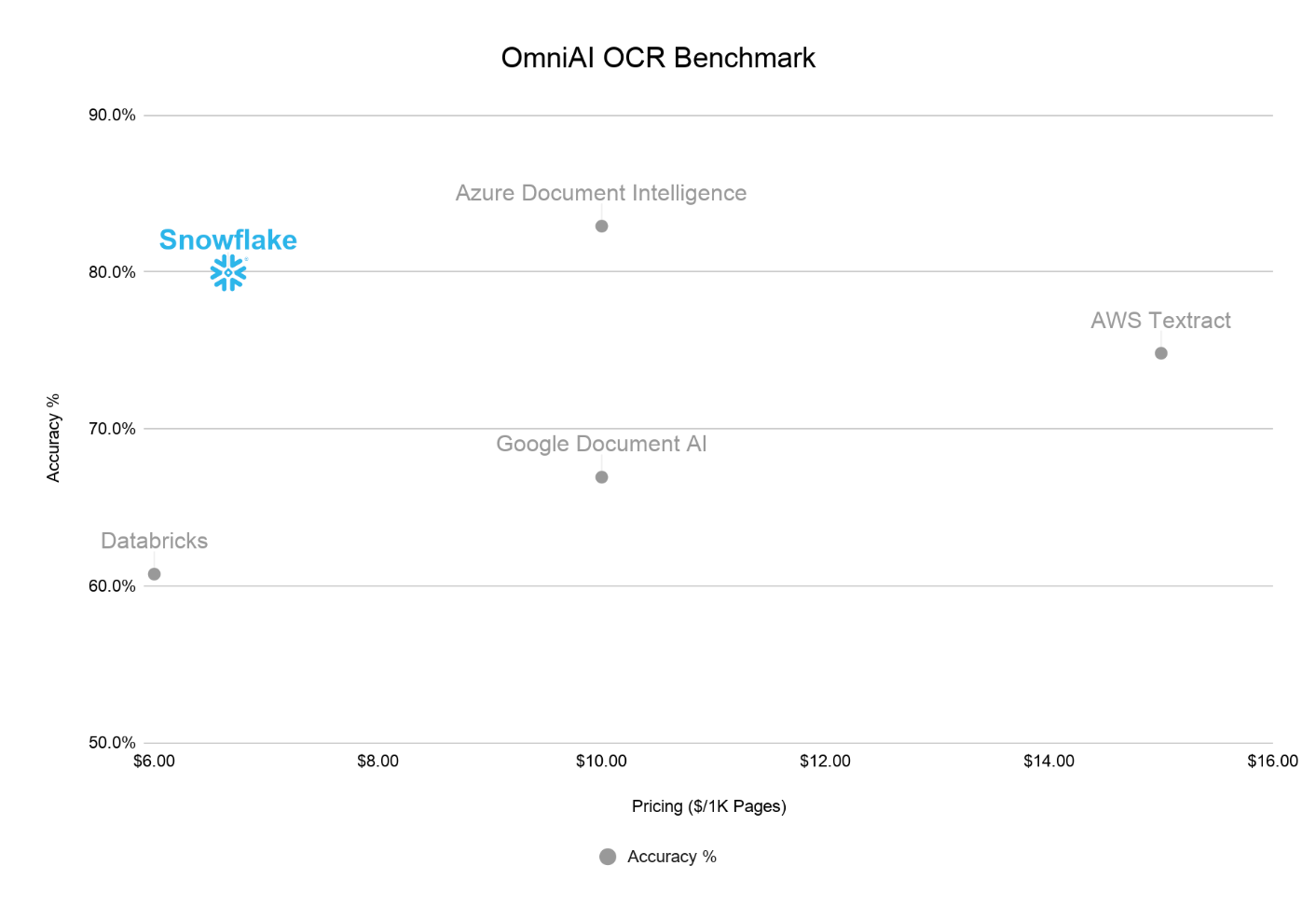
Snowflake is in the enterprise sweet spot (as seen in Figure 2): high, production-grade accuracy without premium pricing. Snowflake delivers top-tier structured extraction accuracy (~80%) while operating at a lower price point (~$6.66 per 1,000 pages assuming Standard Edition) than several long-established leading systems from Azure Document Intelligence, AWS Textract and Google Document AI. More emerging document systems are trying to differentiate on price but at materially lower extraction accuracy. For organizations processing millions of pages annually, this balance translates directly into lower total cost of ownership while preserving downstream LLM extraction quality.
For builders, this means LLMs operating on Snowflake’s AI Parse Document output can focus on semantic reasoning rather than compensating for broken layout, interleaved columns or malformed tables. Section-level extraction, field normalization and table-to-JSON conversion become more deterministic, more auditable and easier to scale across heterogeneous document collections.
As LLMs increasingly power enterprise document workflows, the role of layout-aware document understanding becomes foundational. Reliable LLM extraction is not achieved by prompting alone — it depends on a document representation that is already structured, ordered and faithful to the original source.
Document intelligence is a multilayer system. OCR accuracy influences layout reconstruction. Layout fidelity determines table integrity. Structural correctness governs downstream LLM extraction reliability.
The evaluations presented here show that AI Parse Document layout mode demonstrates consistently strong performance. Qualitative evaluations confirm robustness under complex, real-world document conditions. Quantitative benchmarks show high exact-match rates in table reconstruction, strong cell-level similarity metrics and competitive CHRF OCR scores across synthetic, nonstandard and distorted data sets. Independent structured extraction benchmarking further validates near top-tier accuracy under realistic enterprise evaluation conditions.
Importantly, these results are measured on heterogeneous, layout-intensive documents rather than optimized academic subsets. Performance is assessed based on structural correctness and downstream usability, not text similarity alone.
The outcome is a document understanding layer that combines leading accuracy with scalable price efficiency and production-grade enterprise deployment.