JUN 09, 2025|6 min read
When the idea of open data format began to take hold, we all envisioned a future where customers wouldn’t have to choose between performance and portability. But for too long, “open” became a marketing term used to disguise proprietary control. Data should move as freely as the ideas it fuels. In practice, though, it remained handcuffed by vendors who claimed to back these standards.
Apache Iceberg™ has categorically changed that. Grounded in interoperability and fueled by a fervent community of innovative minds, Iceberg has become the table format choice for every data practitioner who values data autonomy. That includes us at Snowflake.
Snowflake began work on the Polaris catalog in 2024 and then donated the project to the Apache Software Foundation in August of the same year, knowing that the “open” promise could only be fulfilled by letting the OSS community take the lead. Apache Polaris™ is an open source, vendor-neutral Iceberg catalog service that implements the Iceberg REST Catalog API, enabling any engine to discover and manage Iceberg tables across environments.
To their credit? They absolutely ran with it. Over the last year, Apache Polaris saw incredible growth in terms of community engagement. With contributions from hundreds of people and dozens of companies, Polaris has rapidly emerged as one of the strongest open source catalog projects in the ecosystem.
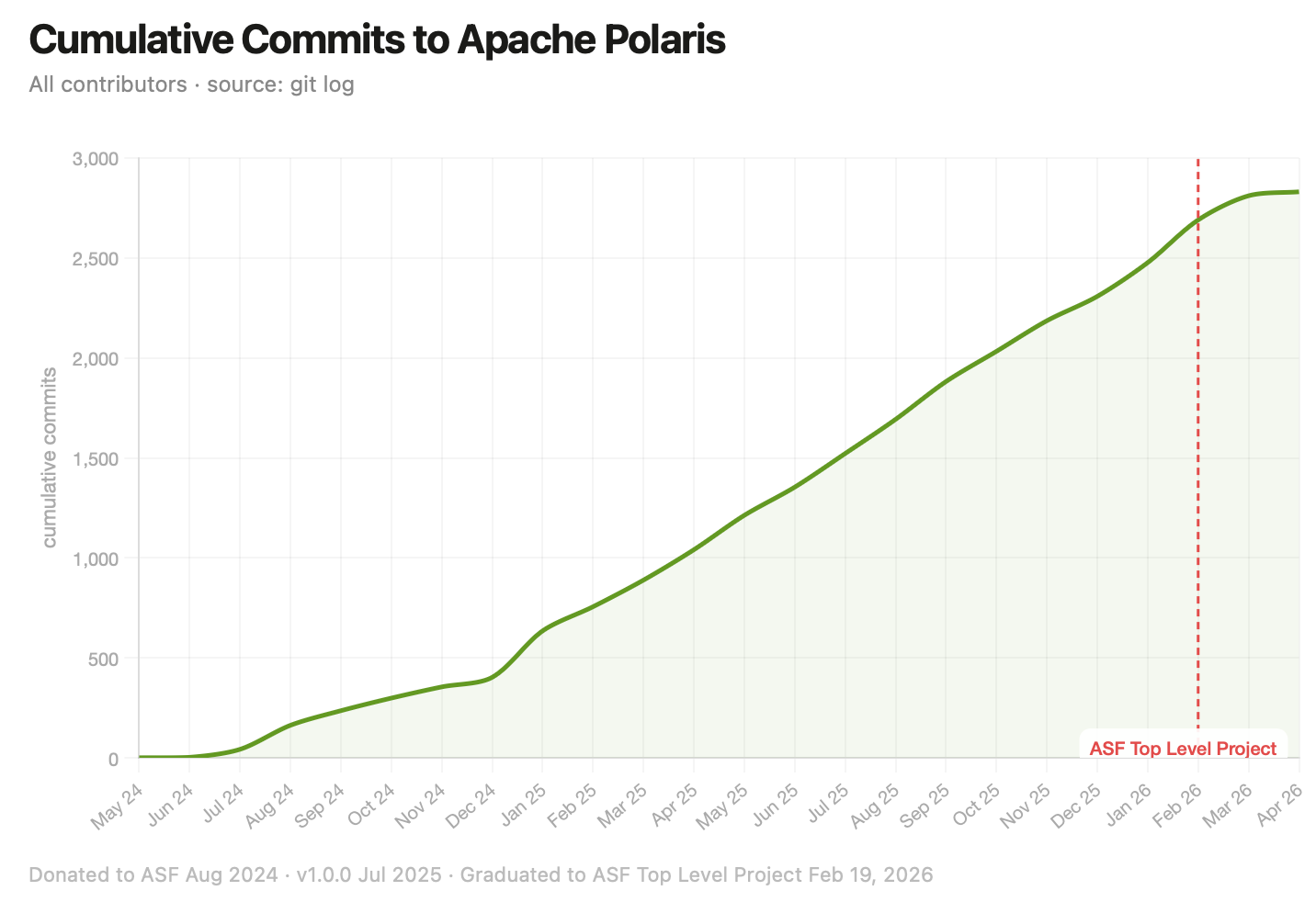
Most of those contributions come from individuals and organizations beyond Snowflake, though we continue to invest because we believe in its direction.
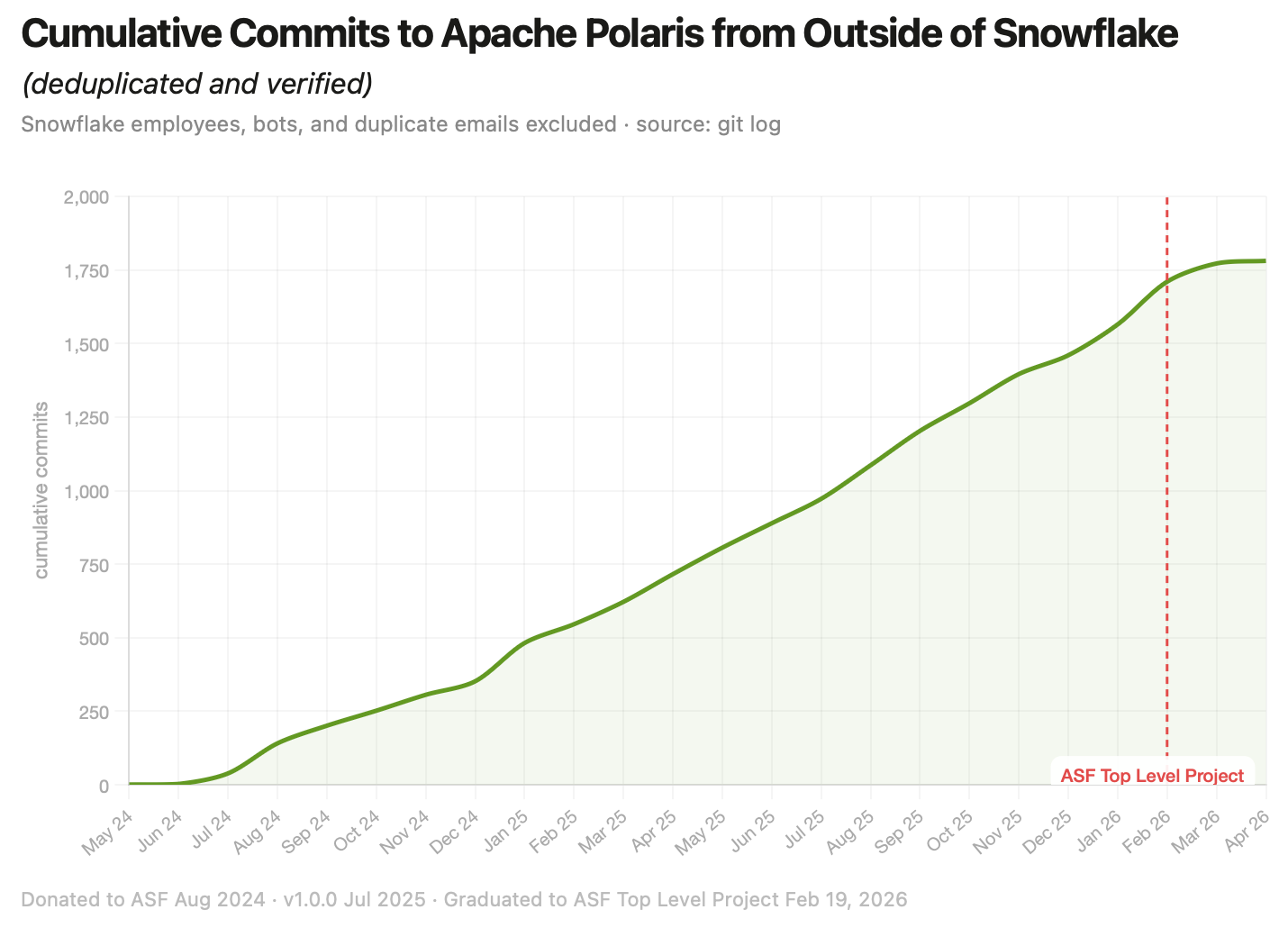
This acceleration in adoption led to a turning point for Apache Polaris and arguably the broader data ecosystem. With its graduation to a Top-Level Project at the Apache Software Foundation on February 18, 2026, Polaris now stands as a self-governing, vendor-neutral standard for the industry.
The Horizon Catalog’s interoperability layer is built on Apache Polaris, a truly open source catalog designed for interoperability from day one, not a production system later stripped down and repackaged as open source. Polaris powers Horizon Catalog behind the scenes, ensuring the same open APIs that the community relies on also underpin how data is discovered and governed inside Snowflake.
Snowflake's approach is straightforward: Horizon Catalog uses Apache Polaris as its catalog engine, the same open source project anyone can download and operate themselves. We are not shipping a separate "community edition" that behaves differently from what we run in production. The open source project and the managed service share the same backbone. By contrast, approaches that are "open-ish" publish an open source software branded catalog that diverges from the vendor's real control plane, creating subtle incompatibilities and making it harder for customers to treat that catalog as a true, interchangeable standard.
An interoperable catalog, however, only delivers on its promise when paired with a data format that is truly open.
Apache Iceberg itself is an open table format for huge analytic tables, designed so multiple engines can safely write and read the same data. The Apache Iceberg REST Catalog specification sits alongside that table format as a standard HTTP-based API that catalogs use to discover, create, and manage those Iceberg tables across any engine. The community has spoken: the Apache Iceberg REST catalog specification is the definitive language for data exchange.
Unlike platforms where a single company controls the roadmap behind closed doors and calls it open source, Iceberg was architected around community governance from day one. No single vendor holds veto power over its direction or its catalog. When any one company has outsized control over a “standard,” it often leads to practical problems for customers: slower interoperability, more friction moving workloads, and a higher risk of being locked into one vendor’s stack.
The Apache Iceberg REST catalog specification emerged not from a single vendor's engineering organization, but from a community of practitioners solving a shared problem. For Snowflake, adopting that standard wasn't a strategic hedge or a checkbox; it was a commitment. We implemented bidirectional Iceberg REST Catalog access with no proprietary extensions, no capability gates, and no fine print that trades interoperability for stickiness. Standards only work when participants adopt them fully, and that's what we chose to do
Snowflake also took another massive leap by announcing support for the Apache Iceberg v3 specification (generally available soon). This brings advanced features like row-level lineage, nanosecond precision and optimized deletion vectors directly to customers.
When there’s community momentum behind Apache Polaris, that's when the magic happens. Measure Apache Polaris by its impact and widespread adoption:
This important milestone for Polaris, its graduation to an Apache Top-Level Project, belongs to the broad coalition of contributors and customers who believe in it. Individuals across the community, including independent contributors and those from Dremio, Google Cloud, Microsoft, Confluent and AWS, helped turn the vision of a vendor-neutral catalog into a production-grade reality.
Apache Polaris graduating to a Top-Level Apache project isn't a finish line, it's proof of what happens when the community leads and vendors follow.
The next chapter of the data ecosystem will be written in meetup rooms, in pull requests, and in the standards we hold each other accountable to. Join a Polaris or Iceberg meetup. Contribute to the spec. Push us and everyone in this space to keep earning the trust the community placed in this standard.
We’re entering a new era of open data, driven by open formats and open catalog standards. We’re excited to be part of it, and we encourage everyone in the community to contribute and help shape what comes next. Join us at Iceberg and Polaris meetups: Learn, share and connect with others building in this space. If you see us there, come say hello. We’d love your feedback on how Snowflake can do more, and do better.