SEP 05, 2025|3 min read

As renowned AI thought leader Andrew Ng puts it, the old paradigm of software development involved lengthy spec docs, static wireframes and slow feedback loops. This traditional process was linear and rigid: An idea would be translated into a detailed document, which designers would turn into visual mockups, and only then would developers begin the long process of writing code line by line.
Generative AI has changed that; it has altered how we can bring ideas to life. Instead of just describing an app in a document, we can now build a functional prototype almost instantly by describing it in natural language to an AI.
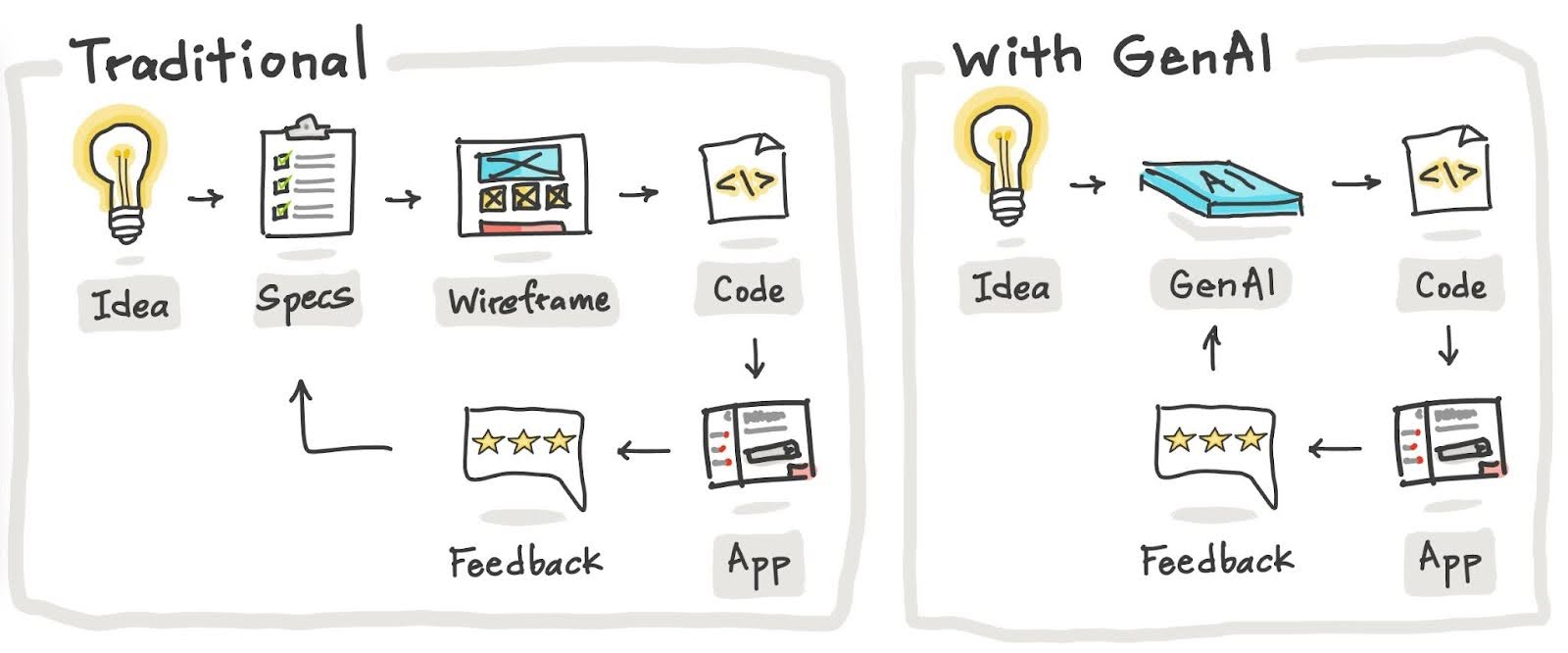
After all, showing your vision with a prototype beats telling people about your idea every time.
The most immediate change we'll see is that the speed for each iteration cycle will become much faster. Previously, a single cycle of coding, deploying, gathering feedback and revising could take weeks or months. With gen AI, this loop is tightened up dramatically. We'll be able to achieve cycles of coding and feedback in a single day,thereby speeding up app completion and, more importantly, faster product market fit.
This shift moves us from a “waterfall” or even a standard “agile” model to conversational development through a process known as “vibe coding.” You can ask an AI to “add a user login button,” see the results instantly, and then refine it with follow-up prompts like, “Now, connect it to Google authentication and make the button purple.” This interactive dialogue collapses the entire design-code-test-feedback loop into a conversation session.
Recently, I’ve created a course together with the DeepLearning.AI team, Fast Prototyping of Gen AI Apps with Streamlit, to help turn that app idea to a prototype — fast!
| Development Aspect | Waterfall | Agile | Fast prototyping |
|---|---|---|---|
| Structure | Linear and sequential | Iterative and incremental | MVP-first framework with rapid, iterative loop harnessing vibe coding |
| Flexibility | Rigid and resistant to change | Highly adaptable to change | Highly adaptable via feedback loops |
| User involvement | Primarily at the beginning and end | Continuous throughout the project | Central for rapid validation |
| Planning | Detailed upfront planning | Continuous planning and feedback | MVP scope, then intuitive sprints |
| Documentation | Extensive and formal | Minimal and focused on essentials | Minimal; demo-focused |
| Delivery | One final product at the end | Small, frequent deliveries of working software | Frequent, interactive prototypes |
| Speed | Slow to deliver initial value | Fast to deliver initial value | Rapid via guided intuition |
| Maintenance | A separate phase after delivery | Integrated into the ongoing development cycles | Goal is to validate and iterate toward production |
The impact of gen AI extends far beyond just accelerating timelines. It’s also democratizing app creation to a wider user base aside from developers, while shifting the roles and responsibilities of developers to high-level tasks.
Let’s break it down:
Accessibility for non-coders: Product managers, designers and entrepreneurs can now create minimum viable products (MVPs) without writing a single line of code. This allows for testing ideas directly with users, ensuring that what gets built is what the market actually wants.
Rapid prototyping: Developers can explore multiple architectural approaches or UI designs in minutes. Instead of committing to one path early on, teams can generate several working prototypes, compare them, and choose the most promising direction, leading to more innovative and robust final products.
Focus on high-level logic: Gen AI excels at handling boilerplate code, writing unit tests and managing complex configurations. This frees up human developers to focus on what they do best: architecting systems, solving complex business problems and overseeing the overall vision. The developer's role essentially shifts from being a "bricklayer" to being an "architect."
However, this newfound power and speed come with their own set of challenges.
While this new paradigm is incredibly powerful, it also introduces its fair share of complexities. Therefore, a developer's mindset must evolve to navigate these new risks effectively.
The first challenge is to ensure the quality and maintainability of code. AI generates functional code at lightning speed, but that code isn't always clean, efficient or maintainable. This shifts the developer's primary role from creator to curator. Like a senior engineer reviewing a junior developer's work, the main task becomes enforcing high standards for quality, readability and structure. Neglecting this curation is how technical debt accumulates, as prototypes built for speed must eventually be refactored for production.
Secondly, the code output generated by AI may be viewed as a "black box" where even the developer doesn't fully understand its inner workings. This makes debugging difficult and security a major concern. The new mindset must be one of "zero trust," where developers rigorously test and review code, assuming vulnerabilities may exist. Strong debugging skills become paramount.
Finally, there's a long-term risk of skill atrophy (i.e., essentially being a “use it or lose it” situation). If junior developers overly rely on AI for fundamental tasks, they may not build the foundational knowledge needed to become senior engineers. The industry will need new mentorship models to teach core principles in a world where AI does the heavy lifting. That way, the next generation of developers don't just prompt; they truly understand.
Mitigating these risks requires not only a shift in mindset but also the right tools, which means embracing those that make the prototyping phase as frictionless as possible.
Bringing new ideas to life quickly and efficiently is crucial for innovation. This new approach to fast prototyping with Snowflake relies on two key components:
Cortex AI: Powerful AI models on the backend that act as the "brains" of an app. Snowflake Cortex AI provides robust LLM services that are integral to gen AI use cases. This enables not only LLM inference in chatbots but also various data processing tasks through its multi-modality, supporting text, audio and image input. In practice, Cortex allows both data analysts (using SQL) and Python developers (using Snowpark) to easily integrate AI into their work. Briefly, Cortex works very much like querying data, but instead of providing data tables, prompts and model parameters are used as input arguments.
Streamlit: Robust frontend framework for building interactive web apps. Streamlit, which is an open source web framework, allows developers to turn scripts into interactive web apps with surprisingly little code. Instead of spending weeks on traditional frontend development, you can build a user interface for your data or gen AI models in minutes. Streamlit handles the complexity of rendering UI components like text boxes, buttons and charts, with guessable syntax, allowing you to focus purely on what your app should do. It enables rapid creation of AI-powered apps where users can input information, the AI processes it, and the results are displayed instantly.
The possibilities are endless. This powerful combination of Cortex and Streamlit can change how we develop apps, shifting the focus from intricate coding to high-level design and problem-solving. This allows teams to quickly visualize, interact and, in essence, talk to their data and AI, leading to faster innovation and better products. It also perfectly aligns with the shift from "bricklayer" to "architect" by enabling real-time, conversational iteration that defines modern gen AI development.
Vibe coding is a conversation, and the quality of the outcome depends on how well you communicate. Here are a few tips from the Streamlit team on how to guide your AI coding partner and set it up for success:
Act like a product manager, not just a user. The more specific your instructions, the better the result. Instead of a vague prompt like, “Make me a dashboard app,” be explicit and describe exactly what you want, as if you were writing a spec document. For example: “Create a Streamlit app with three columns. The first column should have a bar chart of sales data, the second a line chart for user growth, and the third a pie chart for demographic breakdown.”
Let the AI interrogate you. You don't have to have everything figured out from the start. Give the AI a high-level objective and ask it to help you flesh out the details. You can prompt it with something like, “I want to build a dashboard for marketing analytics. Ask me clarifying questions to help define the key features and layout.” This turns the process into a guided brainstorming session, where the AI helps you zoom in from a broad idea to specific areas to focus on.
Collaborate on the plan before the code. For more complex tasks, ask the AI to propose a plan first. For instance, you could say, “My objective is to build an app that helps users analyze customer feedback. Propose a set of rules and a structure for this app.” You can then iterate on that plan with the AI before it writes a single line of code. This ensures that the final product is much closer to what you have in mind.
Gen AI isn't just changing the rules of app development. It's rewriting the entire playbook. But this shift isn't about replacing humans; it's about augmenting our own potential.
As a recent Harvard Business Review article pointed out, AI won’t replace humans, but humans who use AI will replace humans who don’t. A developer's value is no longer tied to writing code line by line. When AI handles the routine tasks, it frees up our cognitive bandwidth.
This allows us to tackle bigger, more complex problems, and to do so effectively, we must learn how to guide a powerful AI as our coding partner. The big challenge and opportunity is mastering this new way of working with computers. As our tools get smarter, we need to get smarter right along with them.
This new world requires a new mindset where success isn't measured by the sheer volume of code anymore. Instead, it’s about how well you guide and review the AI's output — particularly, how effectively you can prompt it and knowing when to trust the machine versus when to step in. The developer of tomorrow is part architect, part quality assessor and part product manager. It's all about balancing the big picture (the problem) with the technical details (the solution).
If you're ready to put these ideas into practice, I’ve created a course to help you embrace this new developer mindset. You can learn more about this in the Fast Prototyping of Gen AI Apps with Streamlit course on Coursera. This month we’re kicking off the 30 Days of AI (#30DaysOfAI) learning challenge (GitHub repo) where participants can incrementally learn to build AI-powered apps through daily bite-sized lessons!
Happy Streamlit-ing!