Quickstart
Supply chain network optimization using Linear Programming
Brett Klein
Overview
The solution architecture shows how to optimize supply chain networks by solving for production planning, inbound purchasing, outbound selling, and transportation logistics decisions using Linear Programming.
- Use Faker() library to create datasets for Factory, Distributor, and Customer entities
- Leverage Snowpark dataframes to create views for shipments, distributor_rates and so on
- Invoke Snowflake Cortex LLM SQL functions to enrich the dataset with additional fields
- Using the PuLP package (a Linear Programming modeler) and CBC solver for minimizing distance, minimizing freight costs and minimizing total fulfillment costs
- Build a Streamlit application to serve as a web interface for supply chain decision makers to use this solution
Solution Architecture: Supply Chain Network Optimization using Snowpark
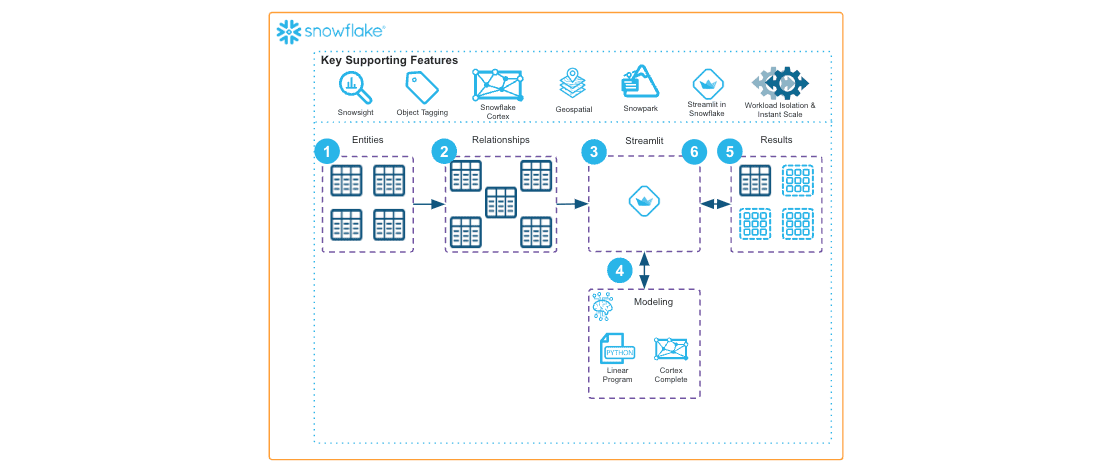
- Demonstrates Supply Chain Network Optimization entirely on Snowflake
- Explains linear programming and how it can benefit customers
- Demonstrates using Snowflake Cortex LLM functions to enrich supply chain data
- Includes geospatial analytics and Streamlit UI
Get Started
Updated May 23, 2026
This content is provided as is, and is not maintained on an ongoing basis. It may be out of date with current Snowflake instances
