Supply Chain Risk Intelligence for Manufacturing: Achieve N-Tier Visibility with Snowflake
Overview
Procurement and supply chain teams believe they have diversified sourcing because their Enterprise Resource Planning (ERP) system shows multiple Tier-1 suppliers across different countries. But that data is incomplete: visibility ends at the first tier. When a disruption occurs at Tier-3, organizations are blindsided months later by sudden shortages, leaving no time to qualify alternatives.
This solution fuses internal ERP data with external trade intelligence into a heterogeneous knowledge graph, then trains a GraphSAGE model to infer common Tier-2+ supplier relationships, propagate risk scores through the network, and surface concentration risks in an interactive Streamlit dashboard. A Cortex Agent with a semantic model enables natural language risk queries through Snowflake Intelligence, all built and deployed entirely on Snowflake.
The Business Challenge
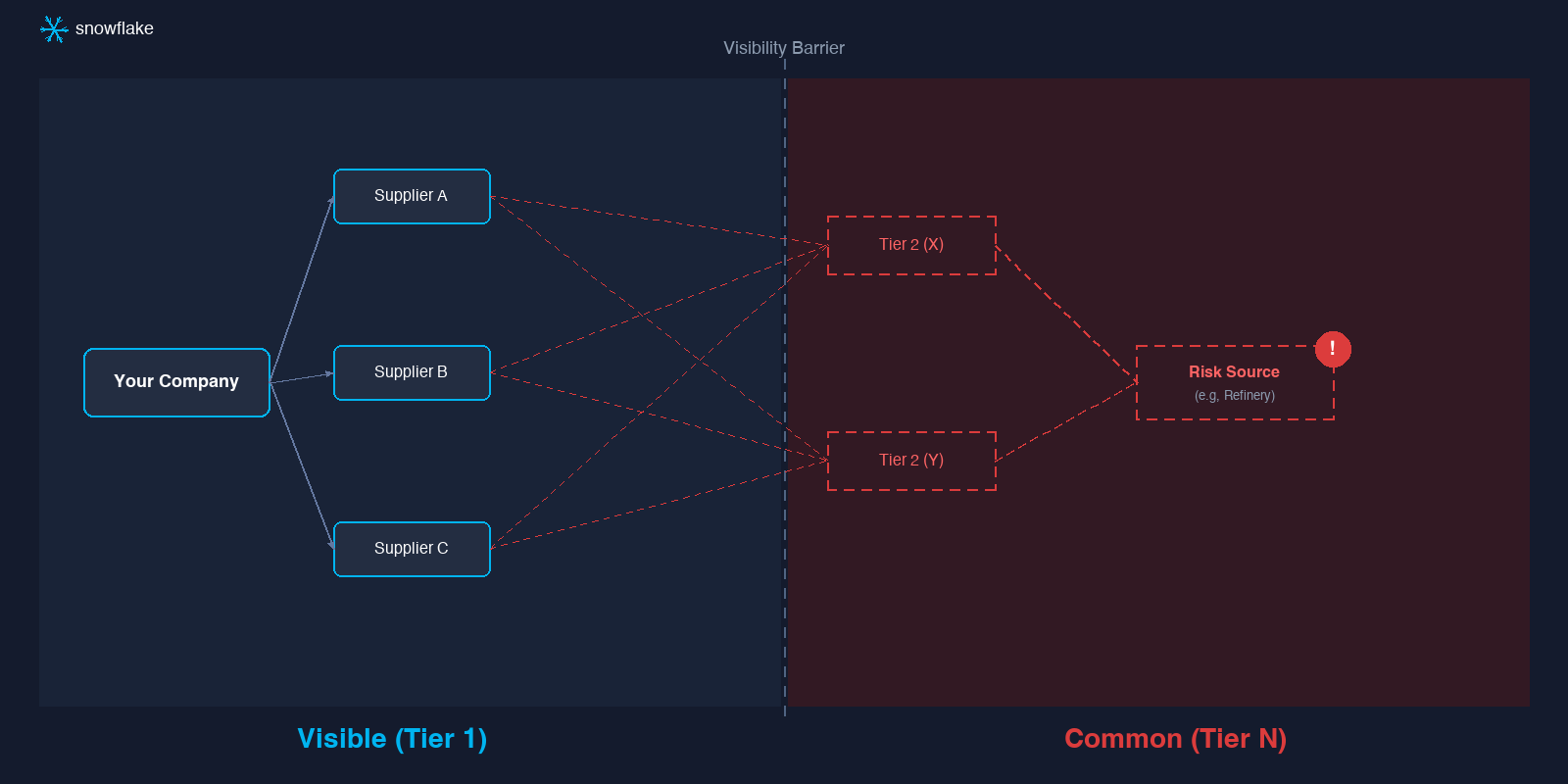
Traditional ERP visibility ends at Tier-1. Risks fester unseen in deeper layers of the supply network, creating costly blind spots for procurement teams.
-
Tier-N blindness costs time and money. When a disruption occurs at Tier-3, organizations are blindsided months later by sudden shortages, leaving no time to qualify alternatives.
-
Single points of failure hide in plain sight. Three Tier-1 vendors across three countries may source raw materials from the same refinery in a geologically unstable region.
-
Reactive firefighting replaces strategic planning. Without predictive risk signals, procurement teams spend time managing crises instead of building resilient supply networks.
-
Compliance and audit gaps create exposure. Regulations like the Uyghur Forced Labor Prevention Act (UFLPA) require traceability beyond Tier-1, but current systems cannot provide that visibility.
The Solution
This solution transforms supply chain management from reactive response to proactive resilience by fusing internal ERP data with external trade intelligence (customs-based shipment records, trade flow data, and geopolitical risk signals) into a knowledge graph that reveals what your ERP cannot see. The demo uses synthetic data generated in Snowflake; in production, this external intelligence would come from Snowflake Marketplace providers.
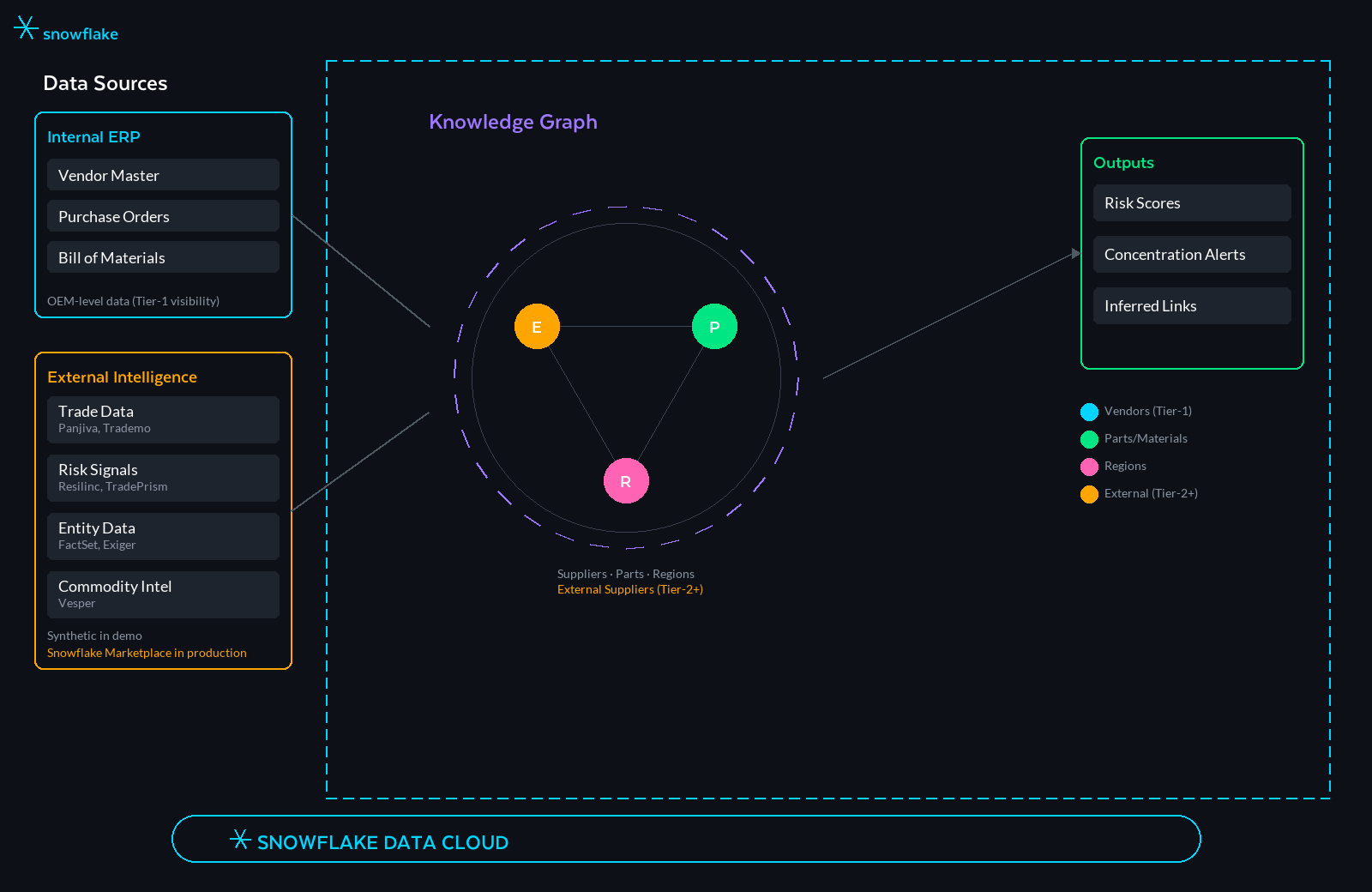
The platform constructs a heterogeneous knowledge graph with suppliers, parts, and regions as nodes and transactions and trade flows as edges. A GraphSAGE model trained on trade patterns infers likely Tier-2+ supplier relationships, then propagates risk scores through the network so that a shock at Tier-3 surfaces its impact on Tier-1 and final products.

-
Ingest. Integrate ERP data (vendors, materials, purchase orders, Bills of Materials) and external trade intelligence into Snowflake tables. The demo generates all six tables synthetically via a stored procedure.
-
Build the Graph. Construct a heterogeneous knowledge graph with suppliers, parts, and regions as nodes; transactions and trade flows as edges.
-
Infer Common Links. Train a GraphSAGE model on trade patterns to infer likely common Tier-2+ supplier relationships with probability scores.
-
Propagate Risk. Calculate risk scores that flow through the network so that a shock at Tier-3 surfaces its impact on Tier-1 and final products.
-
Visualize and Act. Explore the supply network graph, analyze concentration points, and prioritize mitigation actions in an interactive 8-page Streamlit dashboard.
-
Query with Natural Language. A Cortex Agent backed by a semantic model lets users ask risk questions in plain English through Snowflake Intelligence or the in-app Command Center.
The solution provides two notebook options: a GPU notebook using PyTorch Geometric on container runtime for full GNN training, and a NetworkX notebook running on standard warehouse compute (no compute pool or External Access Integration required) for trial accounts and environments where GPU is unavailable. Both produce compatible output for the dashboard.
Business Value
-
Predictive risk scoring. Alerts for latent risks before they manifest. For example, identifying that a part has a high risk score because its estimated Tier-2 source is in a sanction zone.
-
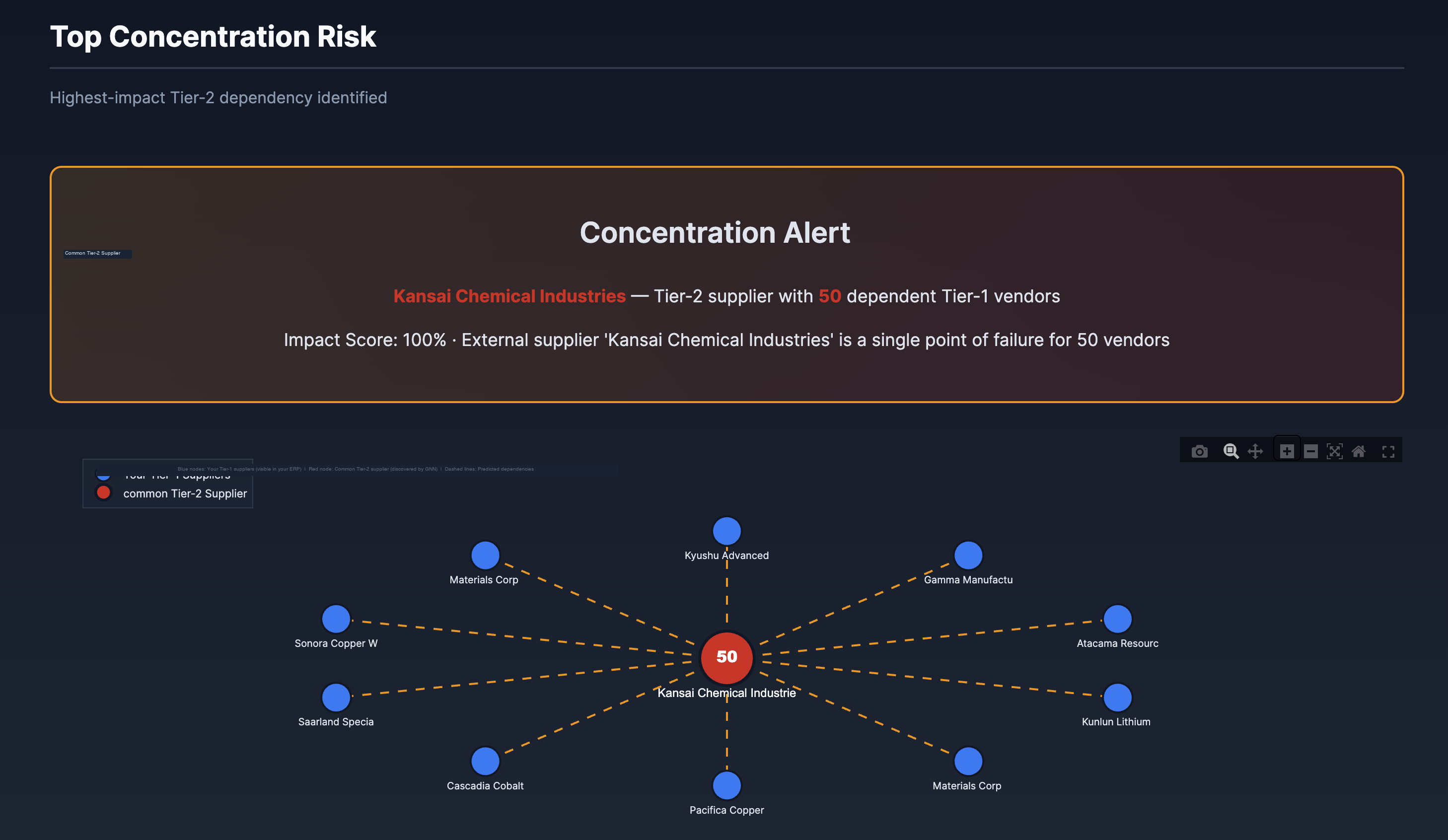
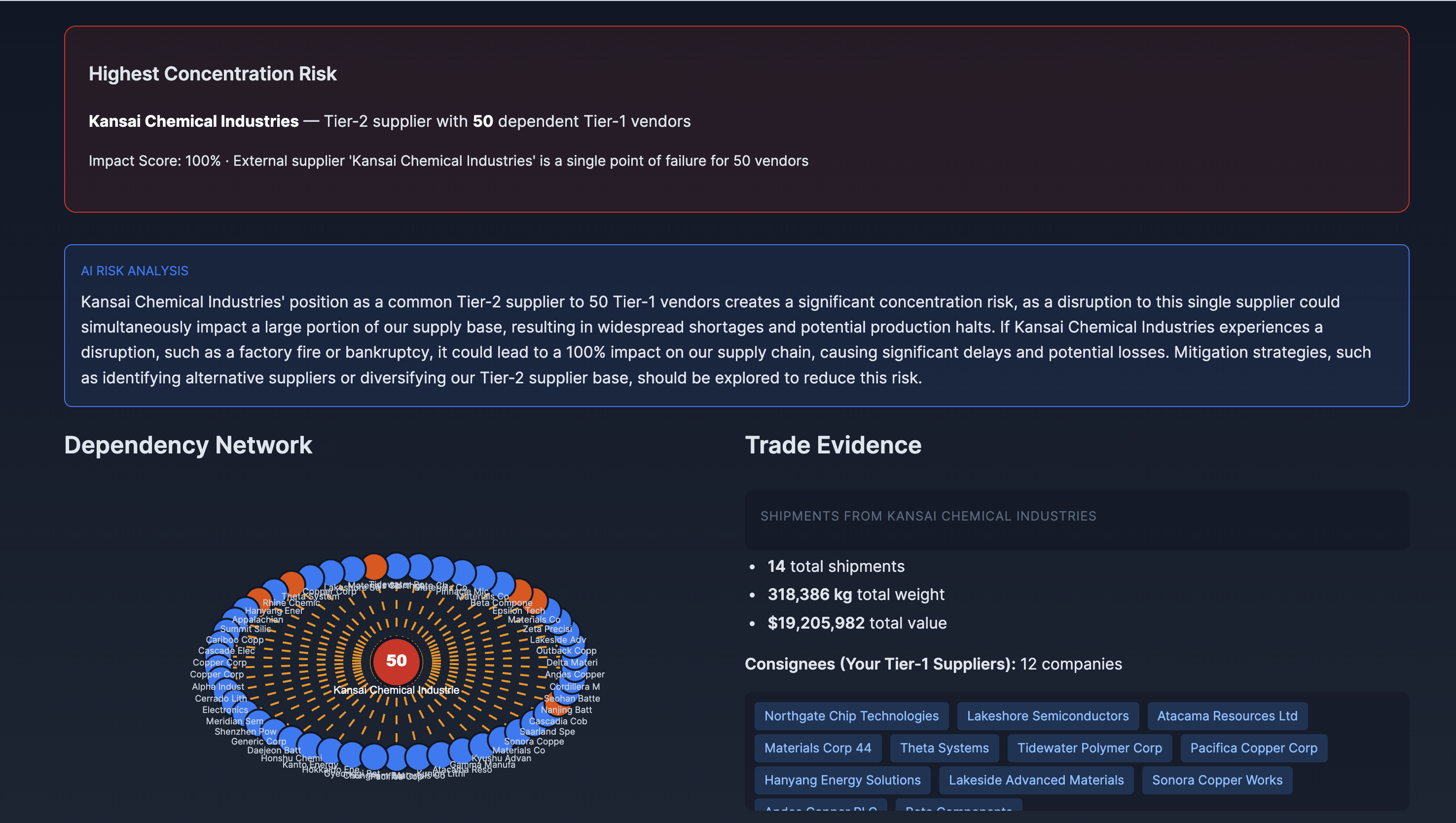
Automatic concentration discovery. Identify common bottlenecks where multiple Tier-1 suppliers converge on the same Tier-2+ source.
-
Proactive supplier qualification. Find and qualify backup suppliers months before a crisis, not during one.
-
From reactive to prepared. Most organizations lack multi-tier visibility entirely and are always reacting to disruptions after they hit. This solution enables proactive risk identification and alternative sourcing that, in many cases, simply was not possible before.
The Discovery Moment
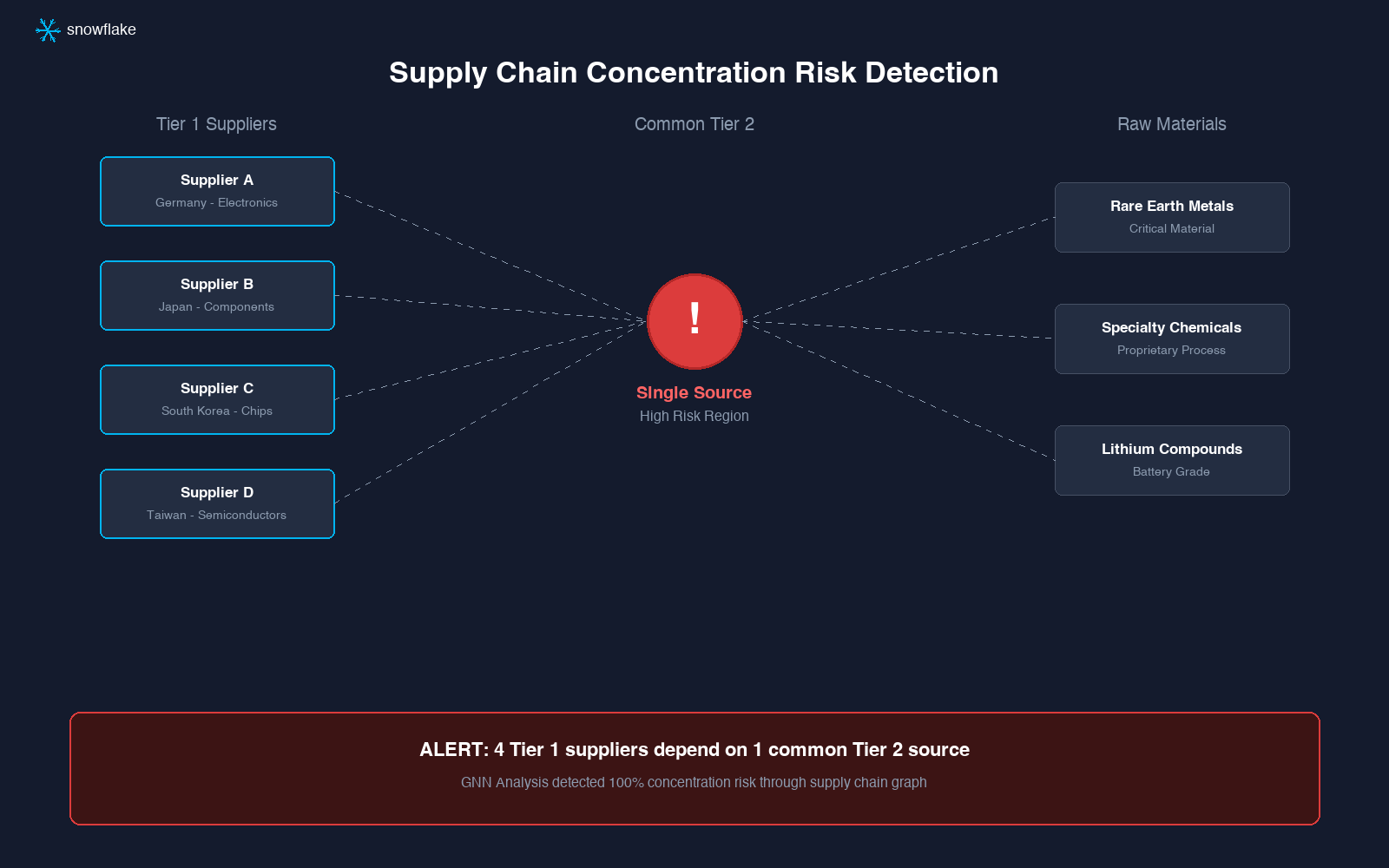
Traditional analytics show a diversified supply base. Graph intelligence reveals the convergence: multiple seemingly independent Tier-1 suppliers may all depend on the same common Tier-2 refinery.
Before: "We're safe. We source from three different vendors in three countries."
After: "All three vendors rely on one Tier-2 supplier in a high-risk region. We need to qualify alternatives now."
Why Snowflake
Unified Data Foundation: Internal ERP data and external trade intelligence join seamlessly in a governed platform, with no data movement or pipeline complexity.
Performance That Scales: GPU-enabled notebooks train graph neural networks on millions of trade records without infrastructure friction.
Collaboration Without Compromise: Share risk insights with sourcing partners and internal teams while maintaining data governance and access controls.
Built-in AI/ML and Apps: From PyTorch Geometric models to interactive Streamlit dashboards, build and deploy intelligence closer to where decisions happen.
The Data
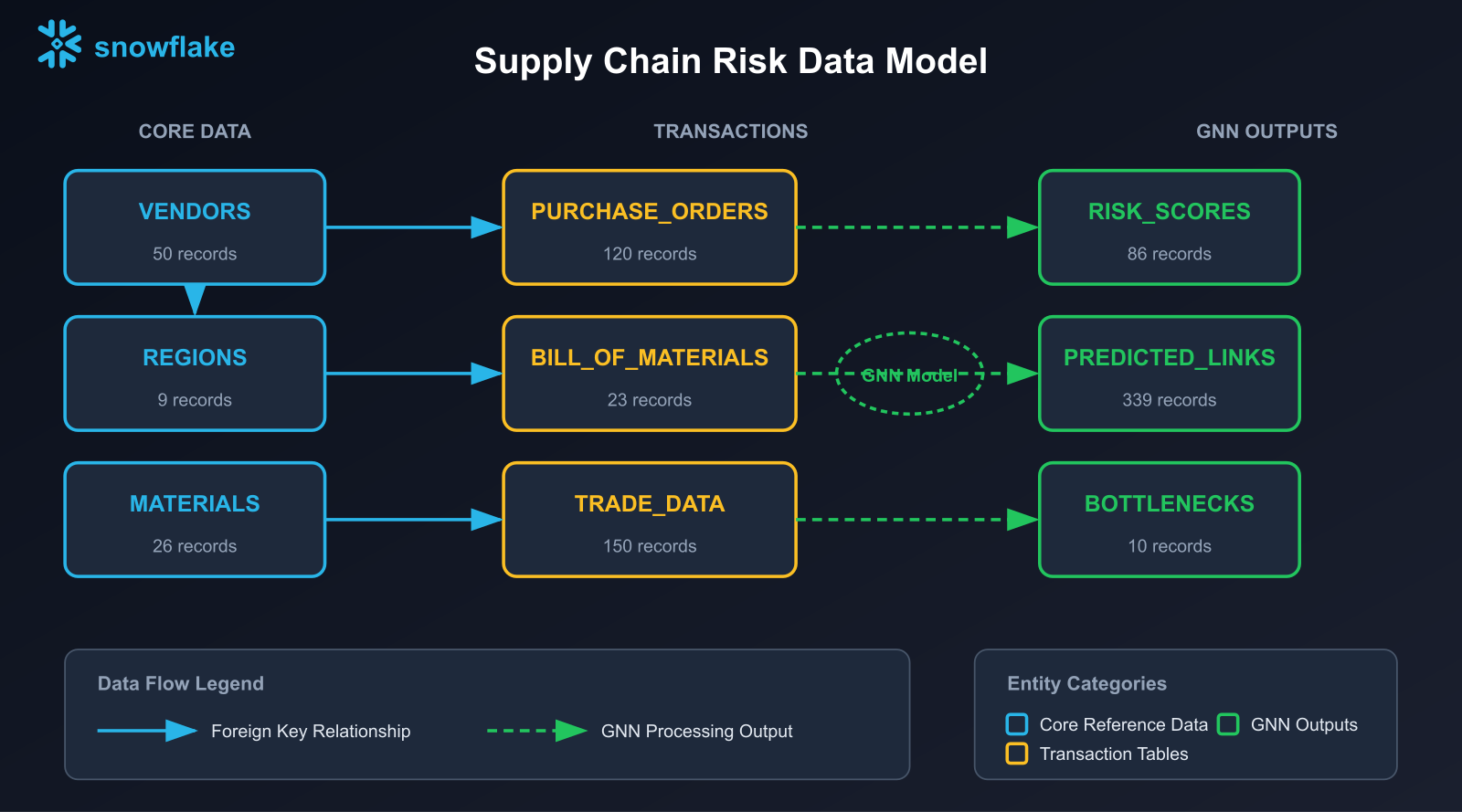
The solution fuses internal ERP data with external trade intelligence into a knowledge graph that reveals what your ERP cannot see. The following data represents the demo environment and is representative of production supply chain data.
| Data Source | Type | Purpose |
|---|---|---|
| Vendor Master (ERP) | Internal | Known Tier-1 supplier nodes |
| Purchase Orders (ERP) | Internal | Supplier-to-material transaction edges |
| Bill of Materials (ERP) | Internal | OEM product assembly hierarchy (Tier-1 level) |
| Trade Data | External (synthetic in demo) | Common Tier-2+ relationship inference |
| Regional Risk | External (synthetic in demo) | Geopolitical and disaster risk factors |
- Domains: Vendors (Tier-1 suppliers), Materials (parts and BOMs), Regions (geographic risk factors), Trade Data (bills of lading linking shippers to consignees to infer Tier-2+ relationships). All six tables are generated by the
GENERATE_SYNTHETIC_DATAstored procedure in the demo. - Freshness: In the demo, all data is generated synthetically. In production, trade intelligence would come from Snowflake Marketplace providers (see below) with continuous refresh via zero-copy shares.
- Trust: All data stays within Snowflake's governance boundary with role-based access controls.
From Demo to Production: Snowflake Marketplace
The demo uses synthetic data to demonstrate the architecture end-to-end. Moving to production requires replacing synthetic tables with high-quality external data. These Snowflake Marketplace providers deliver the trade intelligence and entity data needed to operationalize N-tier visibility, with no data pipelines to build or contracts to negotiate outside your Snowflake account.
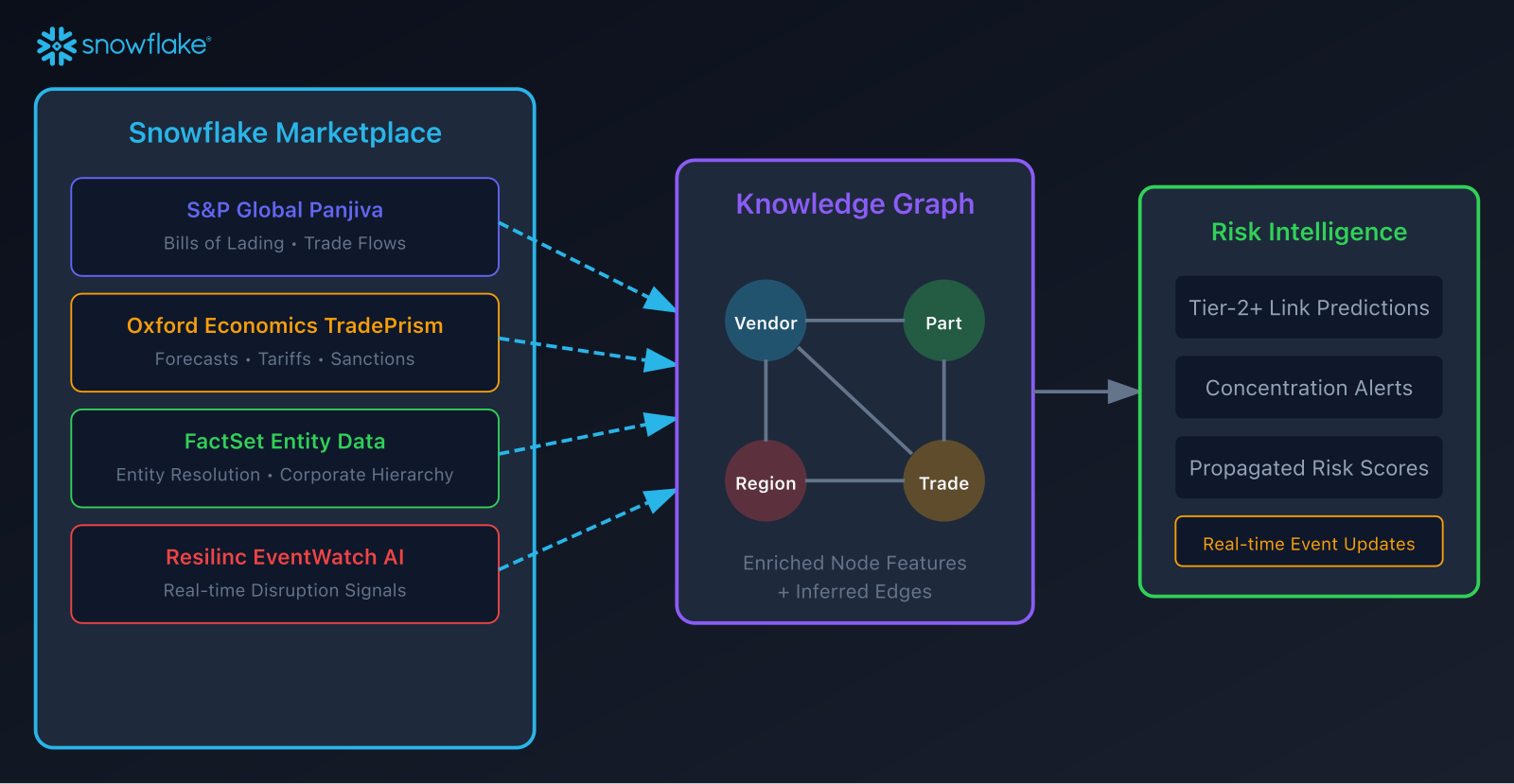
S&P Global Market Intelligence — Panjiva Supply Chain Intelligence: The gold standard for inferring common Tier-2+ relationships. Customs-based bill-of-lading shipment records with shipper/consignee entities, HS codes, origin/destination ports, volumes, and values. When your Tier-1 supplier appears as a consignee, Panjiva reveals who shipped to them, exposing your likely Tier-2 suppliers. Panjiva Supply Chain Intelligence | All S&P Global Listings
Oxford Economics — TradePrism: Forward-looking trade forecasts and scenario modeling. Global trade forecasts at HS4 level across ~170 economies, including tariff scenarios, sanction impacts, and trade rerouting projections. Combine historical shipment data with TradePrism forecasts to answer: "If sanctions expand to Region X, which of my supply chains are exposed?" TradePrism Full Dataset
FactSet — Supply Chain Linkages & Entity Data: Entity resolution and corporate relationship mapping. Map shipper/consignee names from trade data to actual vendor entities in your ERP and build supplier/geo exposure roll-ups at the corporate parent level. FactSet on Snowflake Marketplace
Resilinc — EventWatch AI: Real-time disruption monitoring and supplier risk signals. AI-powered monitoring of global events (natural disasters, geopolitical incidents, factory fires, labor actions) mapped to supplier locations and impact zones. Resilinc EventWatch AI
Exiger — Supply Chain Risk Management: End-to-end supply chain risk visibility and compliance monitoring. Exiger maintains one of the largest databases for multi-tier supplier mapping, providing validated Tier-2+ relationships, sanctions screening, and regulatory compliance signals.
Trademo — Global Trade Intelligence: Comprehensive import/export shipment data with buyer-supplier linkages across global trade corridors. Useful for validating GNN-inferred relationships against actual trade flow evidence.
Vesper — Commodity Intelligence: Real-time commodity market intelligence and supply-demand analytics. Enriches risk models with upstream commodity exposure and price volatility signals.
| Marketplace Provider | Graph Node/Edge Type | Integration Point |
|---|---|---|
| Panjiva | Trade flow edges (shipper → consignee) | GNN link prediction training |
| TradePrism | Region risk attributes | Node feature enrichment |
| FactSet | Entity resolution, corporate hierarchy | Supplier node canonicalization |
| Resilinc | Real-time event signals | Dynamic risk score updates |
| Exiger | Validated multi-tier supplier maps | Tier-2+ relationship validation |
| Trademo | Import/export shipment data | Trade flow edge enrichment |
| Vesper | Commodity market intelligence | Upstream exposure signals |
Why Marketplace Data Matters:
- Zero ETL. Data lives in Snowflake. Join to your tables with SQL, no data movement required.
- Always current. Providers update their datasets; you automatically get fresh intelligence.
- Governed access. Marketplace shares respect your Snowflake RBAC; sensitive enrichments stay protected.
- Rapid time-to-value. Skip months of data licensing negotiations and pipeline engineering. Most Marketplace providers can be accessed using Snowflake credits. Check individual listing terms for pricing details.
Personas and Value
| Persona | Key Need | How This Solution Helps |
|---|---|---|
| VP of Procurement | Reduce supplier-driven production disruptions | See concentration risks before they cause shortages; make proactive qualification investments |
| Supply Chain Manager | Faster risk assessment for critical materials | Propagated risk scores highlight which parts need attention, without manual tracing |
| Supplier Quality Engineer | Identify high-risk suppliers for audit | Filter by risk category; prioritize reviews based on network position, not just financials |
| Data Scientist | Build and iterate on risk models | PyTorch Geometric runs in Snowflake Notebooks with GPU; experiment close to governed data |
How It Comes Together

| Component | Role |
|---|---|
| Snowflake Tables | Store ERP data, trade intelligence, and model outputs (all synthetic in demo) |
| Snowflake Notebooks (GPU) | Execute GNN training with PyTorch Geometric and GPU acceleration |
| Snowflake Notebooks (Warehouse) | NetworkX alternative running on standard warehouse compute, no compute pool or EAI required |
| PyTorch Geometric | GraphSAGE model for link prediction and risk propagation |
| Cortex Agent | Natural language risk queries via semantic model |
| Snowflake Intelligence | Conversational interface for the Cortex Agent |
| Cortex Analyst | Semantic model for structured supply chain data queries |
| Risk Analysis UDF | ANALYZE_RISK_SCENARIO for What-If disruption simulation |
| Streamlit in Snowflake | 8-page interactive dashboard for exploration and action planning |
Key Visualizations
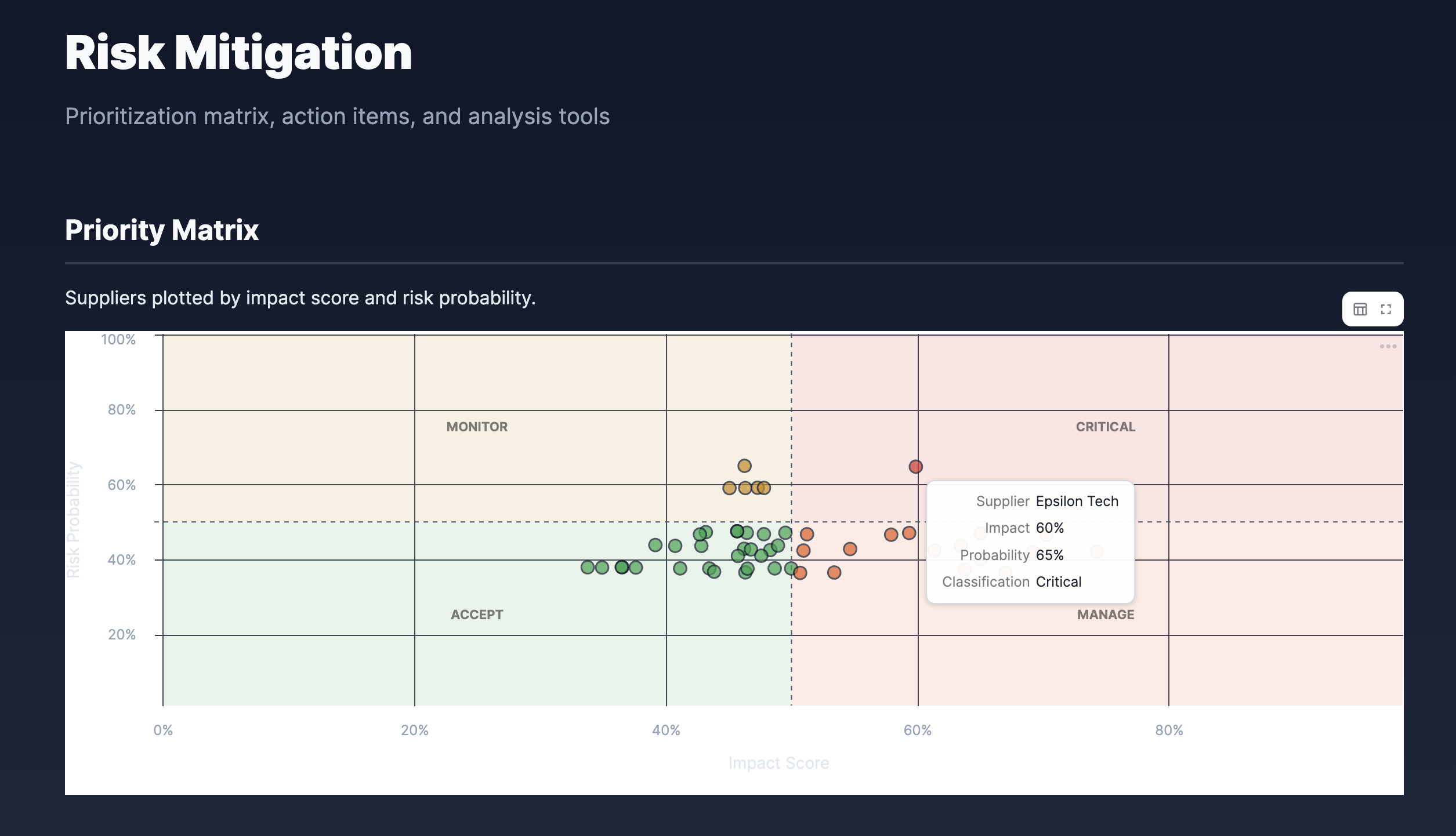
The 8-page Streamlit application guides users from executive summary to prioritized actions.
| View | What You See |
|---|---|
| Executive Summary | High-level risk overview with KPIs and health score |
| Exploratory Analysis | Deep-dive into vendor and material risk distributions |
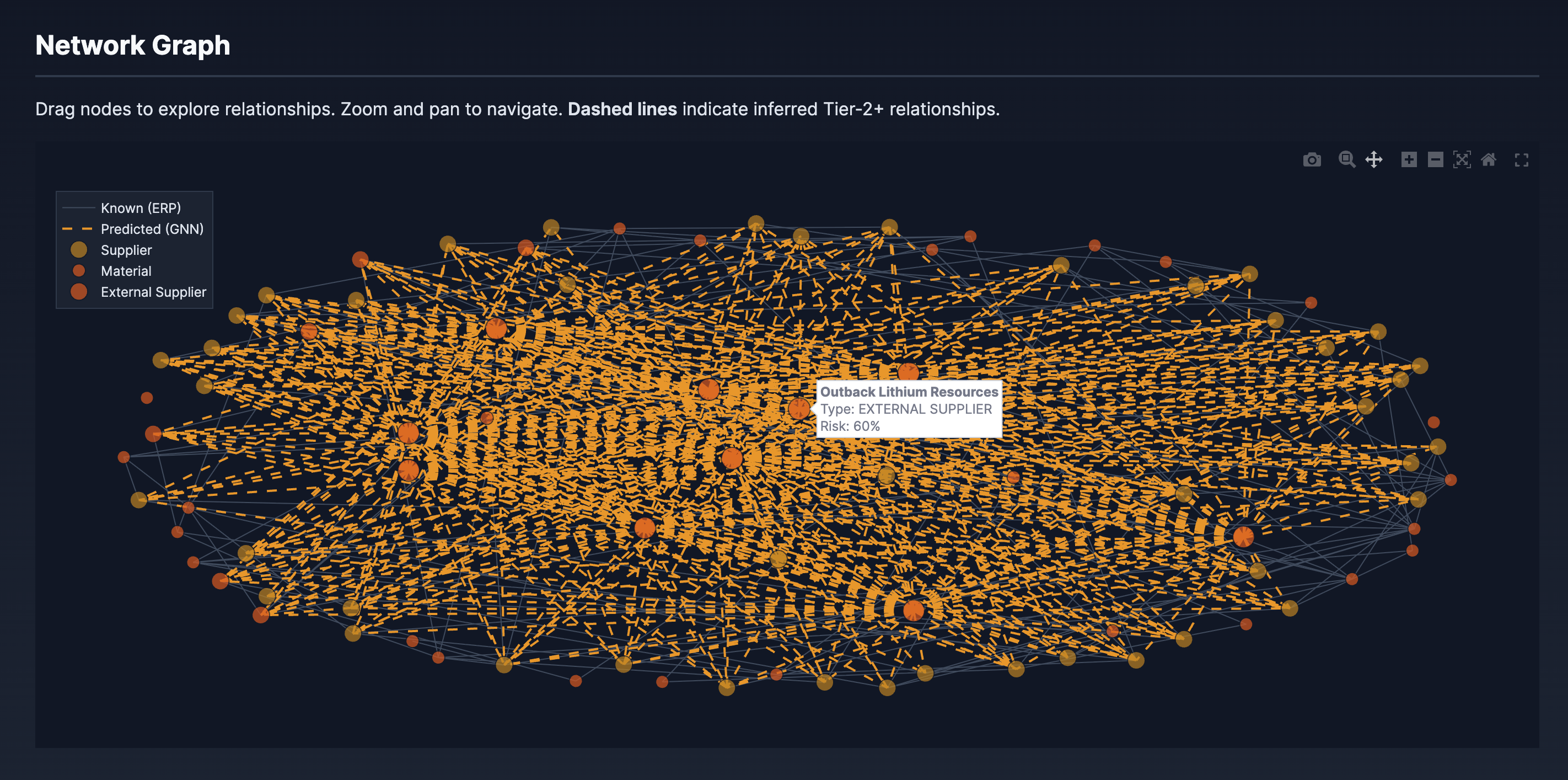
| Supply Network | Interactive graph visualization to filter, zoom, and trace dependency paths |
| Tier-2 Analysis | Inferred common dependencies, probability scores, and concentration impacts |
| Scenario Simulator | What-If analysis for regional disruptions and vendor failures |
| Command Center | Cortex Agent chat for natural language risk queries |
| Risk Mitigation | Prioritized action items ranked by impact with mitigation strategies |
| About | Architecture and methodology documentation |
Get Started
Ready to uncover common supplier dependencies and concentration risks in your supply chain? This guide includes everything you need to get up and running quickly.
The repository contains the SQL setup script, two notebook options (GPU with PyTorch Geometric on container runtime, or warehouse-based with NetworkX), an 8-page Streamlit dashboard, a Cortex Agent with semantic model, and a teardown script for deploying the full solution.
Resources
This content is provided as is, and is not maintained on an ongoing basis. It may be out of date with current Snowflake instances
