

Scaling AI in Healthcare: Use Cases, Data Foundations and Governance
Explore how healthcare organizations are applying AI across clinical care, operations, access and research — and what it takes to scale those efforts responsibly.
Healthcare organizations are now managing tighter margins, changing reimbursement models, increased workforce pressure and growing expectations around access, outcomes and operational efficiency.
Against that backdrop, teams are moving quickly to put newer forms of AI to work. In Snowflake and Hakkoda’s 2026 survey of 183 senior U.S. healthcare leaders, 77% said their organizations had invested or planned to invest in generative AI or agentic AI, with clinical documentation, administrative workflow automation and revenue cycle operations among the priorities. Those investments extend a capability landscape that already includes predictive machine learning, natural language processing and computer vision.
Healthcare use cases place particular demands on every form of AI, however. Protected patient information is distributed across systems and organizations, clinical meaning can change with timing and care setting, and an incomplete or incorrect result may have serious consequences.
As Jesse Cugliotta, Global Head of Healthcare and Life Sciences at Snowflake, puts it, “Across healthcare, AI is moving into operational environments and leaders are holding it to a higher standard.” Healthcare AI depends on how data, models, people and controls work together.
How AI supports clinical care
Clinical AI can help care teams interpret large volumes of patient information, identify patterns that warrant attention and reduce the work required to assemble relevant context. The level of human involvement remains high, particularly when an output could influence diagnosis or treatment.
Medical imaging and diagnostic support
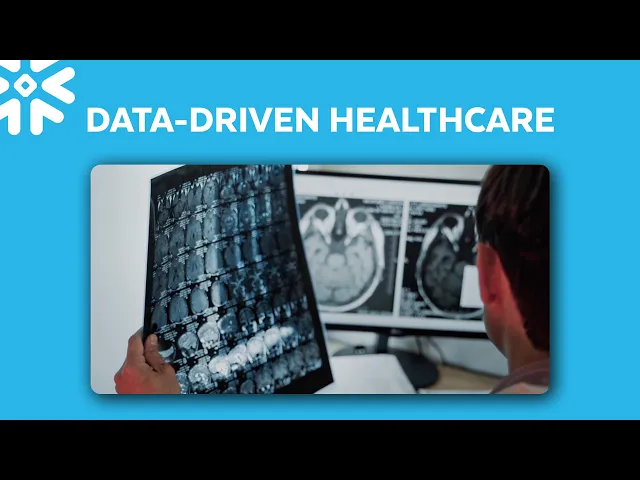
Computer vision models can assist with the analysis of X-rays, CT scans, MRI studies, ultrasound images and digital pathology slides. Depending on the application, AI may flag a suspected finding, outline an area of interest, compare images or help prioritize studies that may require urgent review.
These tools operate in the context of the broader clinical record. A finding on an image needs to be interpreted alongside symptoms, laboratory values, prior studies, medications and medical history. Multimodal models are beginning to support this type of wider analysis, combining medical images with text and structured clinical data.
AI can also help manage imaging workloads. By identifying studies with potential acute findings, a system can move them forward in the reading queue, while routine cases remain available for review in their normal order. The radiologist or other licensed clinician still interprets the study and determines the clinical significance of the result.
Clinical decision support and risk prediction
Predictive machine learning models estimate the likelihood of an event using information already present in the clinical record. Common applications include identifying patients at risk of deterioration, readmission, sepsis, medication-related harm or disease progression.
The score itself is only one input. A patient classified as high risk may require closer monitoring, a clinician review or additional testing, depending on the condition and setting. To support that decision, the system may need current observations, prior encounters, active medications and the timing of recent interventions — not simply a diagnosis code or historical claim.
Calibration is especially important. Two patients assigned the same risk score should have a similar likelihood of the predicted outcome, while performance should remain reliable across demographic groups, care settings and clinical subpopulations. Without that calibration, a model can appear accurate in aggregate while performing poorly for individual patients.
Personalized and precision care
AI can help clinicians analyze the many factors that influence treatment response, including diagnoses, laboratory results, medications, medical history, biomarkers and genomic information. In oncology, for example, models can assist with treatment stratification by identifying patterns across tumor characteristics and prior outcomes. For chronic conditions, AI can help surface changes in risk or adherence that suggest a care plan should be reviewed.
Personalization also depends on a longitudinal record. Information from an isolated encounter rarely captures the full course of a condition, particularly when a patient receives care from several organizations. Connecting clinical, pharmacy, claims and patient-generated data gives models a more complete view of prior treatment and outcomes.
The resulting recommendation still requires clinical judgment. Patient preferences, contraindications and circumstances may not be fully represented in the data, even when the model has access to a detailed history.
Clinical documentation and ambient AI
Clinical documentation consumes time that clinicians could otherwise spend with patients or on other care responsibilities. Ambient documentation systems use speech recognition, natural language processing and generative AI to capture a clinician-patient conversation and prepare a draft note.
A well-designed system can organize the encounter into relevant sections, extract medications or follow-up actions and connect the draft with information already in the electronic health record (EHR). The clinician then reviews, edits and approves the note before it enters the medical record.
Generative AI can support related documentation tasks, including summarizing a long patient history, preparing a discharge summary or drafting a handoff. In each case, the system should distinguish source information from generated language and make it straightforward for clinicians to verify the result.
How AI supports patient access and care management
Many barriers to care appear before or between clinical encounters. Patients may struggle to find the right provider, schedule an appointment, understand coverage or follow a care plan, while staff coordinate referrals and outreach across several disconnected systems.
Patient access and navigation
AI can support appointment scheduling, provider matching, referral routing, eligibility questions and wait-list management. A patient seeking an appointment, for example, may need a provider with the right specialty, network status, location and availability. An AI system can assemble those constraints and narrow the available options.
Agentic AI can coordinate more of the workflow. With access to approved tools, an agent might review a referral, identify missing information, check benefits and locate an appointment that meets the patient’s needs. Steps involving clinical urgency, unusual coverage rules or exceptions can be routed to an employee.
Care management and population health
Care management teams work across panels of patients, identifying who may need outreach and coordinating services across providers and settings. Predictive models can help identify rising-risk patients, gaps in preventive care, missed follow-up or patterns associated with avoidable utilization.
At the population level, AI can help organizations stratify risk, evaluate program outcomes and identify disparities among patient groups. These analyses may incorporate clinical records, claims, pharmacy data and social determinants of health.
The definitions underneath the model affect who appears in each group. A care-gap measure, for example, depends on the eligible population, exclusion criteria, measurement period and evidence considered sufficient to close the gap. Shared clinical and semantic context keeps those rules consistent when they are used in analytics, conversational interfaces or agent workflows.
How AI supports healthcare operations and administration
Administrative work shapes the cost, capacity and accessibility of care. Much of it involves gathering information, applying complex rules and coordinating handoffs across systems — conditions that make healthcare operations a prominent area for generative and agentic AI.
Capacity, staffing and patient flow
Hospitals and health systems can use predictive models to forecast emergency department demand, inpatient census, discharge volume and appointment no-shows. Those estimates support decisions about staffing, bed capacity, operating room schedules and other constrained resources.
Patient flow depends on events that occur across the care journey. A delayed test can postpone discharge, and the resulting bed constraint can affect emergency department boarding and scheduled admissions. AI can help teams see those dependencies earlier by connecting current clinical activity with operational data.
For workforce planning, models can estimate workload and coverage requirements by unit or time period to align the appropriate skills and capacity with expected patient needs.
Revenue cycle management
Revenue cycle teams translate clinical care into accurate claims and manage the work required to receive payment. AI can assist with clinical coding, charge capture, claim preparation, denial prediction and accounts receivable prioritization.
Natural language processing can extract relevant diagnoses and procedures from clinical documentation, while generative AI can summarize why a claim was denied and retrieve the payer policy associated with the decision. An agent can gather the supporting record, identify missing documentation and prepare an appeal for review.
The source record should remain authoritative. Generated coding or appeal language should always be checked against the clinical documentation and applicable billing rules, particularly when errors could affect reimbursement, compliance or the patient’s financial responsibility.
Prior authorization and utilization management
Prior authorization requires providers and payers to exchange clinical information and evaluate whether a requested service meets coverage criteria. The process often spans EHRs, payer portals, document repositories and communication tools.
AI can extract required details from the record, compare them with published criteria and identify missing information before a submission is sent. An agent could then prepare the request, monitor its status and route a response to the appropriate employee.
Clinical and coverage decisions require clear authority boundaries. AI can help assemble evidence or apply straightforward rules, while cases involving clinical judgment, ambiguous criteria or adverse determinations remain subject to qualified human review.
Claims adjudication and payment integrity
For healthcare payers, AI can help evaluate claims, detect inconsistent information and identify patterns associated with fraud, waste or abuse. Models may flag duplicate billing, unusual utilization, identity issues or provider behavior that departs from an expected pattern.
False positives can delay appropriate payment and create substantial work for providers and members, so investigations should account for the confidence and consequences of the signal. Explainability and review are particularly important when a model affects access to benefits or payment.
How AI supports healthcare research
Healthcare research increasingly draws on real-world data generated through routine care, including EHRs, claims, registries and patient-reported outcomes. AI can help researchers identify relevant cohorts, analyze outcomes and find patterns across data sets that are difficult to examine manually.
Clinical research and trial operations
AI can be used in drug discovery, supporting protocol feasibility, site selection, patient recruitment and trial monitoring. A research team might estimate whether enough eligible patients are available across participating sites, then identify records that appear to meet inclusion criteria for further review.
Natural language processing can extract information from notes and reports that isn’t available in structured fields. Generative AI can assist with literature review or document preparation, while agents may coordinate approved administrative steps across trial systems.
Real-world evidence and pharmacovigilance
Real-world evidence studies examine how treatments perform outside tightly controlled trials. Researchers can use AI to analyze outcomes across clinical records, claims and registries, compare patient cohorts and identify variables associated with effectiveness or safety.
In pharmacovigilance, natural language processing and machine learning can help identify potential adverse events in clinical narratives, safety reports and other sources. The signal then enters an established review process — AI can prioritize evidence, but safety experts evaluate causality and regulatory significance.
Benefits and risks of AI in healthcare
AI can help healthcare organizations identify risk earlier, reduce clinical and administrative burden, improve patient access, use capacity more effectively and accelerate research. By assembling information from several sources, it can also support more coordinated and personalized care.
However, inaccurate outputs, model bias, automation bias and performance changes can affect clinical or financial decisions. Healthcare organizations must also protect PHI, comply with requirements such as HIPAA and GDPR, account for consent and permitted use, and maintain appropriate human oversight. Legacy systems and inconsistent data can add another source of error when an application receives incomplete or poorly contextualized information.
What healthcare organizations need to scale AI
Extending AI across clinical, operational and administrative work requires a broader foundation: interoperable patient and business data; support for predictive, generative and multimodal models; scalable compute; shared clinical context; continuous evaluation; and governance across data, models, tools and actions.
Longitudinal patient and member context
Patient information is distributed across EHRs, claims, laboratories, pharmacies, imaging systems, medical devices and other sources. A longitudinal record connects those events over time, giving AI systems a clearer view of diagnoses, treatment, utilization and outcomes.
Identity resolution is central to that work. Names, addresses, member identifiers and medical record numbers may vary across systems, while duplicate or incorrectly linked records can create significant clinical risk. The foundation must connect records accurately without weakening the privacy controls applied to them.
Timing and provenance add further context. A preliminary laboratory result differs from a final result, and a historical medication differs from one the patient is actively taking. AI needs to know where information came from, when it was recorded and how it should be interpreted within the current use.
Healthcare interoperability
Interoperability allows clinical, administrative and financial information to move between systems in a form that the receiving organization can use. Standards such as HL7 and Fast Healthcare Interoperability Resources (FHIR) provide structures for exchanging health data, while common models such as OMOP support consistent analysis of observational data.
Technical exchange solves only part of the problem, however. Organizations also need consistent terminology for diagnoses, procedures, medications, laboratory results, providers and facilities. Without that semantic alignment, two systems may exchange a record successfully while assigning different meanings to the same field.
For AI, interoperability broadens the context available to a model or agent. It can connect a clinical event with prior care, coverage information and later outcomes, rather than treating each system as a separate view of the patient. This is why interoperability is now central to healthcare AI strategy. Cugliotta explains, “Interoperability is no longer a compliance checkbox — it’s the engine that makes scalable AI possible.”
Multimodal clinical data
Healthcare AI works across structured records, clinical notes, images, audio, waveforms, genomic data and documents. Each format captures a different part of the patient or operational story.
A medical imaging application may need the scan, radiology report and relevant history. Ambient documentation begins with audio and produces text that must align with structured encounter data. A research model may combine laboratory values, genomic features and longitudinal outcomes.
Supporting these combinations requires more than storing several file types. The foundation must preserve the relationships among them — which image belongs to which study, which note describes which encounter and which observation was current when a recommendation was generated.
Clinical and semantic context
A field name rarely captures the full clinical meaning of a value. A diagnosis may be suspected, confirmed, historical or entered for billing. A medication may have been prescribed, dispensed, administered or discontinued. An encounter may represent inpatient admission, observation, emergency care or an outpatient visit.
Semantic context supplies those distinctions through approved definitions, terminology mappings, clinical logic and relationships. It also supports governed metrics such as readmission, length of stay, care gaps and quality measures, whose calculation may depend on detailed inclusion and exclusion rules.
For generative AI and agents, semantic context helps translate questions expressed in familiar healthcare language into the correct data and logic. The system can retrieve the right records while preserving the meaning attached to them.
AI services, compute and evaluation
Healthcare applications place different demands on the AI environment. Predictive models may train on large longitudinal data sets, computer vision requires image processing and GPU compute, and generative AI applications need document parsing, retrieval and inference. Agents add orchestration, tool access and records of multistep activity.
Evaluation should match the use case. A clinical risk model should be assessed for sensitivity, specificity, calibration and performance across patient subgroups. A documentation assistant should be checked for omissions, unsupported additions and coding implications. An agent must be evaluated on whether it selects the right tools, observes permissions and completes the workflow accurately.
Monitoring continues after deployment. Evaluation, lineage and versioning help teams identify those changes and determine whether an update is needed.
Governance across data, models and agents
Healthcare governance begins with access to PHI, but it doesn’t end there. Policies should reflect the user’s role, the purpose of the work and the minimum information required. Consent, contractual restrictions and research approvals may further limit how data can be used.
Models require oversight of training data, intended use, subgroup performance and changes over time. Generative AI applications need source grounding and a way to distinguish retrieved evidence from generated content. For agents, governance extends to tool permissions and actions: reading a claim, drafting an appeal and issuing an adverse determination represent different levels of authority.
Auditability connects those controls. Healthcare organizations should be able to determine which data an AI application accessed, which model and version produced an output, which tools an agent called and where a person reviewed or approved the result.
Governed healthcare collaboration
Care delivery and research span providers, payers, pharmacies, laboratories, public health agencies and life sciences organizations. Many AI use cases therefore depend on data held outside the organization building the application.
Governed data sharing and data clean rooms can support joint analysis while limiting what each participant can view. A payer and provider might evaluate care outcomes, for example, or researchers might analyze a cohort across institutions without exchanging unrestricted raw PHI.
QUICK TIP
A longitudinal patient record isn’t automatically an AI-ready patient context. The system must also preserve when information was recorded, where it came from, how it was defined and whether it’s appropriate for the current clinical, operational or research use.
How Snowflake supports AI in healthcare
Snowflake helps healthcare organizations bring together clinical, claims, imaging, laboratory, operational and research data within Snowflake’s AI Data Cloud for Healthcare & Life Sciences. The platform supports healthcare interoperability patterns and multimodal data, allowing teams to connect information across the patient journey while maintaining governance over sensitive records. Snowflake supports compliance programs relevant to regulated healthcare workloads, including HIPAA and HITRUST, while each organization remains responsible for configuring and operating its environment in accordance with its own obligations.
Snowflake Openflow can ingest batch, streaming, structured and unstructured data from healthcare systems. Developer guides are available for processing HL7 v2 and FHIR messages, helping teams work with widely used healthcare exchange formats.
For predictive machine learning and medical imaging, teams can prepare data and develop models near the governed records they use. Snowflake Notebooks and Container Runtime support advanced data science and GPU-based workloads; Snowflake’s current healthcare resources include a distributed medical image processing workflow built with MONAI.
Cortex AI supports generative and multimodal applications across structured and unstructured healthcare data. Cortex AI Functions can extract, classify and summarize text or images, while Cortex Search retrieves relevant passages from clinical, policy or research documents. Cortex Analyst provides natural-language access to governed structured data through semantic models. Together, these services can ground an application in both the patient or operational record and the documents needed to interpret it.
For workflows involving several steps, Cortex Agents can reason across structured and unstructured data and use approved tools. Clinical and consequential decisions can remain subject to human review, with the agent operating inside defined permissions.
Snowflake CoWork gives healthcare employees a conversational work environment grounded in enterprise context and agents. It can help users investigate questions across records, claims, real-world and other data, then carry approved work into connected applications.
Snowflake Horizon Catalog supplies governance, context and policy enforcement across data and AI. Policies enforced through Snowflake’s query engine apply consistently whether the caller is an analyst, business intelligence tool or AI agent, while lineage and discovery help teams understand how information is being used.
Across the healthcare ecosystem, Snowflake Secure Data Sharing and Snowflake Data Clean Rooms support governed collaboration without relying on repeated exchanges of static data copies. Providers, payers, researchers and life sciences organizations can analyze approved data together while maintaining controls over PHI and other sensitive information.
Healthcare AI spans models that predict risk, systems that interpret images and language, and agents that coordinate work across applications. A shared foundation gives those technologies access to the clinical and operational context they need, while preserving the oversight required when AI informs care, coverage, research or payment.
KEY TAKEAWAY
Healthcare AI delivers the most value when it’s grounded in connected, trusted data and deployed with clear governance. Organizations that combine longitudinal context, interoperability, continuous evaluation and human oversight can scale AI across care, operations and research while managing clinical, financial and privacy risks.
See how AI is being used in other industries >
Explore the AI in Industries Hub:
Frequently Asked Questions
Your common questions about AI in healthcare, answered by Snowflake experts.
What are the benefits of AI in healthcare?
AI can help healthcare organizations identify risk earlier, reduce administrative burden, improve patient access, support more personalized care and make better use of limited capacity. It can also help teams assemble information from fragmented systems, making it easier to understand a patient’s history, coordinate care and analyze outcomes across populations.
What are the risks of AI in healthcare?
The main risks include inaccurate outputs, bias, privacy exposure, lack of transparency, overreliance on automation and performance changes after deployment. These risks are especially important when AI influences clinical care, payment, coverage, access to services or patient communication. Healthcare AI governance experts commonly emphasize validation, implementation controls, monitoring and human oversight as core requirements for safe adoption.
Will AI replace doctors and healthcare workers?
AI is much more likely to support healthcare professionals than replace them. Many healthcare AI systems are designed to summarize information, flag patterns, draft documentation, automate routine steps or prioritize work for review. Licensed clinicians and qualified employees remain essential for interpreting results, making clinical judgments, resolving exceptions and communicating with patients.
How does AI help with medical imaging?
Computer vision models can help analyze X-rays, CT scans, MRI studies, ultrasound images and pathology slides. Depending on the use case, AI may flag a suspected finding, outline an area of interest, compare images or help prioritize urgent studies. The radiologist or other licensed clinician still interprets the study and determines the clinical significance of the result.
How does generative AI help healthcare organizations?
Generative AI can draft clinical notes, summarize patient histories, prepare discharge summaries, support secure-message responses, explain denial reasons, retrieve payer policies and help employees work with large volumes of text. These tools are most useful when they’re grounded in trusted source data and designed so users can verify where information came from.
Explore AI Resources
Explore AI Topics
Deep dives into every aspect of artificial intelligence
