Jun 11, 2026/3 min readHealthcare & Life Sciences
3 Takeaways from Snowflake Summit for Healthcare and Life Sciences Organizations


EXECUTIVE SUMMARY
New Agentic AI Blueprint for Biopharma: Sanofi moves to a unified, AI-ready foundation that powers faster decisions across research and development, manufacturing and commercial, including an agent that gives sales reps in-depth, AI-generated pre-call insights and plans in seconds.
Snowflake CoWork’s (formerly Snowflake Intelligence) new capabilities deliver personalized, proactive intelligence and agentic workflows across the organization.
Enterprise agentic workflows have four key components, including governed enterprise data and context, AI models, applications and an agentic control plane.
The AI conversation has shifted from pilots to what is ready to scale for leaders in the healthcare and life sciences industry.
Leading organizations have long had the essential components for transformation: vast volumes of data, deep scientific and clinical expertise, and a clear mandate to improve outcomes, efficiency and accelerate innovation. But this year’s Snowflake Summit made one thing clear: The next era of AI will be defined not by isolated use cases, but by thoughtful, governed execution across the enterprise.
Throughout Snowflake Summit, leaders emphasized the evolution of the AI Data Cloud and its AI capabilities as a foundation for enterprise AI, applications, agents and governed collaboration.
For healthcare providers, payers, pharmaceutical companies, medtech organizations and research institutions, the message was direct: AI innovations have advanced rapidly, enabling secure reasoning across enterprise data, supporting better decisions, and scaling across highly regulated processes.
Here are three key takeaways for healthcare and life sciences executives and line-of-business leaders.
1. The industry’s future is agentic
Agentic AI is quickly becoming more than a future-state vision for healthcare and life sciences. It is emerging as a practical path to solving some of the industry’s most persistent challenges, such as administrative complexity, fragmented workflows, rising costs and the need to deliver more personalized, timely and efficient care.
“Nobody gets into medicine because they love paperwork. Agentic AI is one of the first technology waves that allows clinicians to get closer to operating at the top of their license,” says Jesse Cugliotta, Global Head, Healthcare & Life Sciences at Snowflake.
Snowflake’s own "The Future of AI + Interoperability in Healthcare Report" spotlighted this trend earlier this year, finding that 64.5% of healthcare organizations and public health agencies surveyed have either adopted agentic AI, are experimenting with it, or plan to implement it in the next six to 12 months. Their top use cases range from improving the member and provider experience and reducing costs to optimizing operations and advancing population health.
That shift was already visible at Snowflake Summit, where customers showed how agentic workflows can move from concept to operational impact.
“Nobody gets into medicine because they love paperwork. Agentic AI is one of the first technology waves that allows clinicians to get closer to operating at the top of their license,” says Jesse Cugliotta, Global Head, Healthcare & Life Sciences at Snowflake.
Inderpreet Kambo, Co-Founder and CEO at Improzo, also said at the event, “As agentic AI moves from concept to deployment, life sciences companies are discovering that the real unlock isn't a new solution — it's activating the data and systems they already own in the Snowflake AI Data Cloud. At Snowflake Summit, leaders across pharma and biotech are here to explore how unified data infrastructure, Snowflake Cortex AI and agentic frameworks are converging to close the gap between insight and execution.”
Sanofi’s transformation to an agentic enterprise
One customer demonstrating what this agentic transformation looks like in practice is Sanofi, one of the world’s leading biopharmaceutical companies. Like many global organizations, Sanofi’s early data investments produced thousands of dashboards, but left much of the underlying data underused. The shift came when Sanofi unified its data on Snowflake and began working with Elementum, an AI-native alternative to legacy SaaS, to build deterministic and agentic workflows directly on its enterprise data.
For Sanofi, the goal is not simply to add AI to existing systems, but to reinvent how the company runs across research and development, manufacturing, commercial operations, procurement, IT support, HR and sales. AI workflows built with Elementum run directly on Snowflake, helping reduce the friction, cost and lock-in associated with traditional enterprise software. The same unified data foundation already supports Sanofi’s research teams, who use Snowflake to process real-world clinical data at scale and accelerate the analysis that informs drug development decisions. Sanofi has also launched “Concierge for Field,” an AI agent built with Snowflake Cortex AI that prepares global sales representatives for every physician or provider visit.
2. Four new CoWork capabilities move the industry from passive AI to proactive intelligence
Organizations across the industry run on some of the most complex, regulated data in the world. Snowflake CoWork (formerly Snowflake Intelligence), Snowflake's AI work companion that announced new capabilities at Summit, is built to handle that complexity — turning fragmented enterprise data into governed, actionable intelligence for every knowledge worker.
CoWork is a personal work agent for every business user. It can reason deeply, automate routine tasks and accelerate the path from ideas to decisions to action. By combining deep understanding, automation and enterprise context, CoWork helps organizations turn AI into measurable business outcomes.
CoWork’s newest capabilities, the majority of which are in public preview, public preview soon or generally available soon, include:
Understands your organization deeply and provides accurate answers from your most complex data: CoWork’s new capability Cortex Sense automatically learns relationships across siloed data — EHRs, claims, real-world data and clinical trial data — establishing a trusted context layer that grounds AI responses, with 83% accuracy in internal benchmarking. It investigates complex questions across structured and unstructured data, returning fully cited reports in minutes.
Proactive, not just reactive: The Snowflake agent runs continuously in the background — monitoring conditions, detecting anomalies and coordinating multi-step regulated tasks — so your teams are informed and moving before a problem becomes a crisis. This is made possible by the Async Agent API feature.
Personalized workflows and governed action across existing tools: CoWork adapts to each worker's role, captures repeatable workflows for reuse across the organization and takes action directly inside the tools teams already use — all within defined compliance boundaries. Multiple CoWork capabilities make this possible, including multi-agent orchestration, memory and user skills.
Built-in enterprise governance and security: The agent is backed by Snowflake Horizon — a unified governance framework that protects all AI surfaces out of the box, with runtime prompt injection detection, zero-day security against system-prompt overrides and role-based access control (RBAC)-enforced audit trails that support HIPAA and good practice (GxP) requirements without additional configuration.
Get the details: Read our CoWork capabilities blog.
3. The four components for successful enterprise agentic workflows
Deploying AI agents that healthcare and life sciences organizations can trust requires a complete architecture. Here are the five components that separate transformative AI from unsuccessful pilots.
1. Enterprise data and context
The foundation is unified, trusted data since AI outputs are only as good as the data behind them. For the industry, this means bringing together data driving clinical, commercial and operational decisions, including:
EHR and claims data
Revenue cycle metrics
Therapeutic pipelines
Supply chain data
Beyond data, AI needs business context — KPIs, clinical terminology and team-specific logic. An agent that understands the difference between a prior authorization workflow and a formulary exception is one your teams will actually adopt, driving tangible value across your organization.
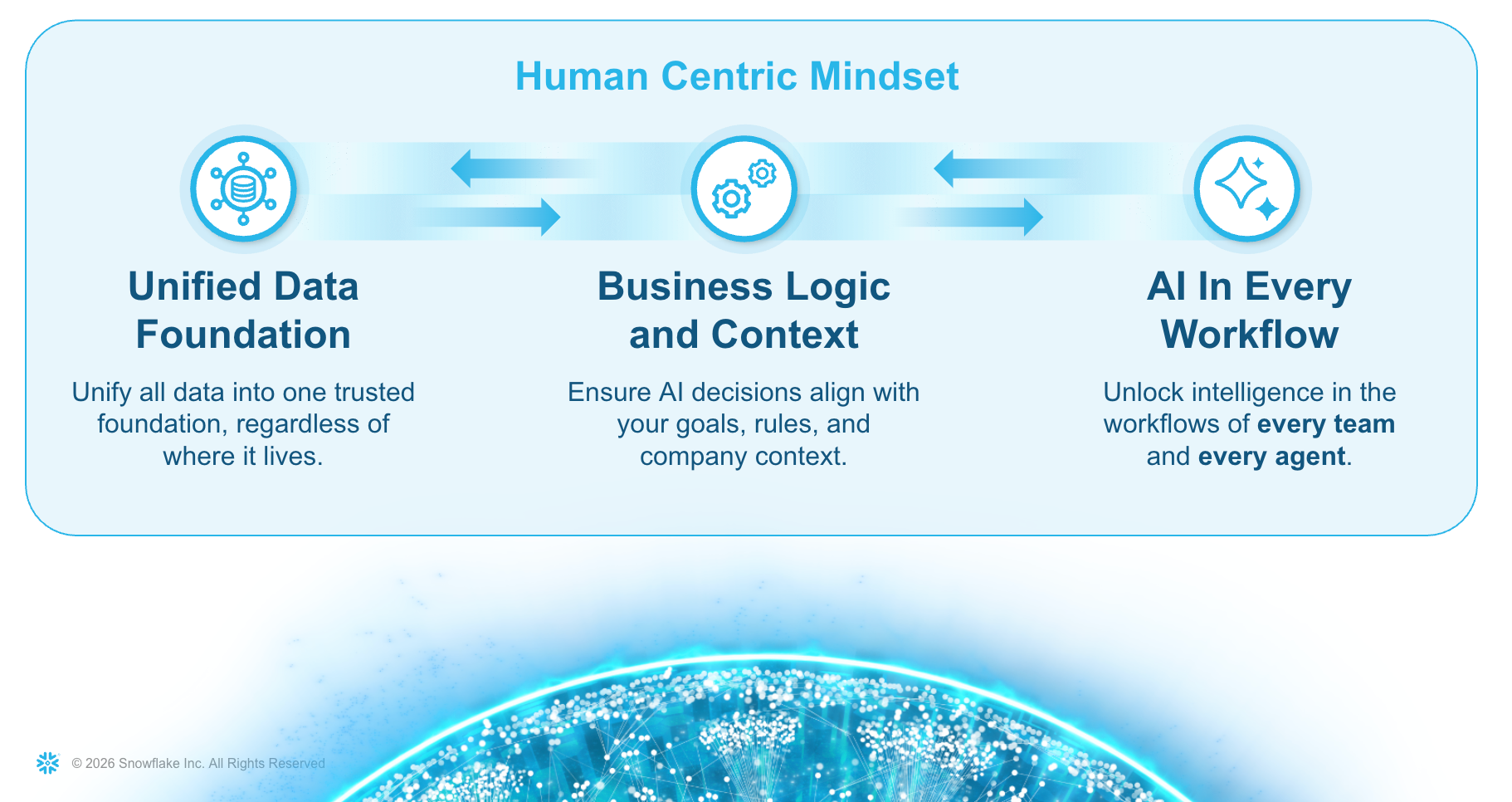
“Collectively, successful AI has a human-centric mindset behind it. It needs to address a real business challenge designed for the real people who use it, and that means meeting people where they are,” says Cugliotta.
2. AI models
At the center is the model that reasons across enterprise data. Leading models (Claude Opus, Gemini and ChatGPT) bring strengths in reasoning and domain knowledge. What matters for your organization is the flexibility to:
Use the right model for each task
Switch models as the landscape evolves
Preserve the workflows, governance controls and data connections underneath
3. Applications
Effective agentic AI meets teams where they work — in tools like Gmail, Salesforce and Slack. This turns insights into actions without context switching. In a single governed workflow, an agent can:
Push provider outreach lists to Salesforce
Log follow-up tasks in Jira
Draft care summaries in Outlook
4. An agentic control plane
As agents multiply — handling prior authorizations, adverse events or supply chains — fragmentation risks rise. The agentic control plane is the mission control center that prevents this. It coordinates data, models and applications to ensure agents work toward shared objectives. For complex, interdependent workflows, this layer is nonnegotiable to mitigate operational risk.
Snowflake delivers agentic workflows at scale
Snowflake is purpose-built to serve the agentic enterprise: a single platform where all your data, leading AI models, enterprise-grade governance, application integrations and an agentic control plane converge, so every agent across your organization works from the same trusted foundation.
The future of the industry is undeniably agentic, and the innovations showcased at Snowflake Summit 2026 provide the foundation to turn that vision into reality. By unifying trusted, governed data with agentic workflows, organizations can move beyond fragmented pilots to achieve meaningful outcomes in clinical operations, commercial impact and regulatory compliance.
If you're ready to learn more, watch our "The Future of Healthcare and Life Sciences: Modern Strategies for Interoperability and Agentic AI" session from Snowflake Summit.
