Quickstart
Build a Real-Time Fraud Detection Model with Natural Language in Snowflake ML
Public SectorAIState & Local GovernmentFederal Government
Detect improper payments, reduce fraud, waste and abuse, and improve payment accuracy across government programs with unified data analytics and AI.
Overview
Unify claims, payments and provider data to detect anomalies, prevent improper disbursements and recover overpayments.

Consolidate payment data across programs and apply anomaly detection to flag duplicate, erroneous or fraudulent disbursements before payment.

Build ML-driven risk scores for providers and beneficiaries by joining claims data, behavioral patterns and watch list databases on a single platform.

Maintain end-to-end lineage and access logs for payment decisions, giving auditors a clear trail from raw data through model output to final action.
CUSTOMER OUTCOMES
Providers supported with improved performance and cost

Employers served at one of the largest state-run insurance systems
HOW IT WORKS
Unify siloed payment streams, run automated anomaly detection at scale and accelerate overpayment recovery workflows on a single secure platform.
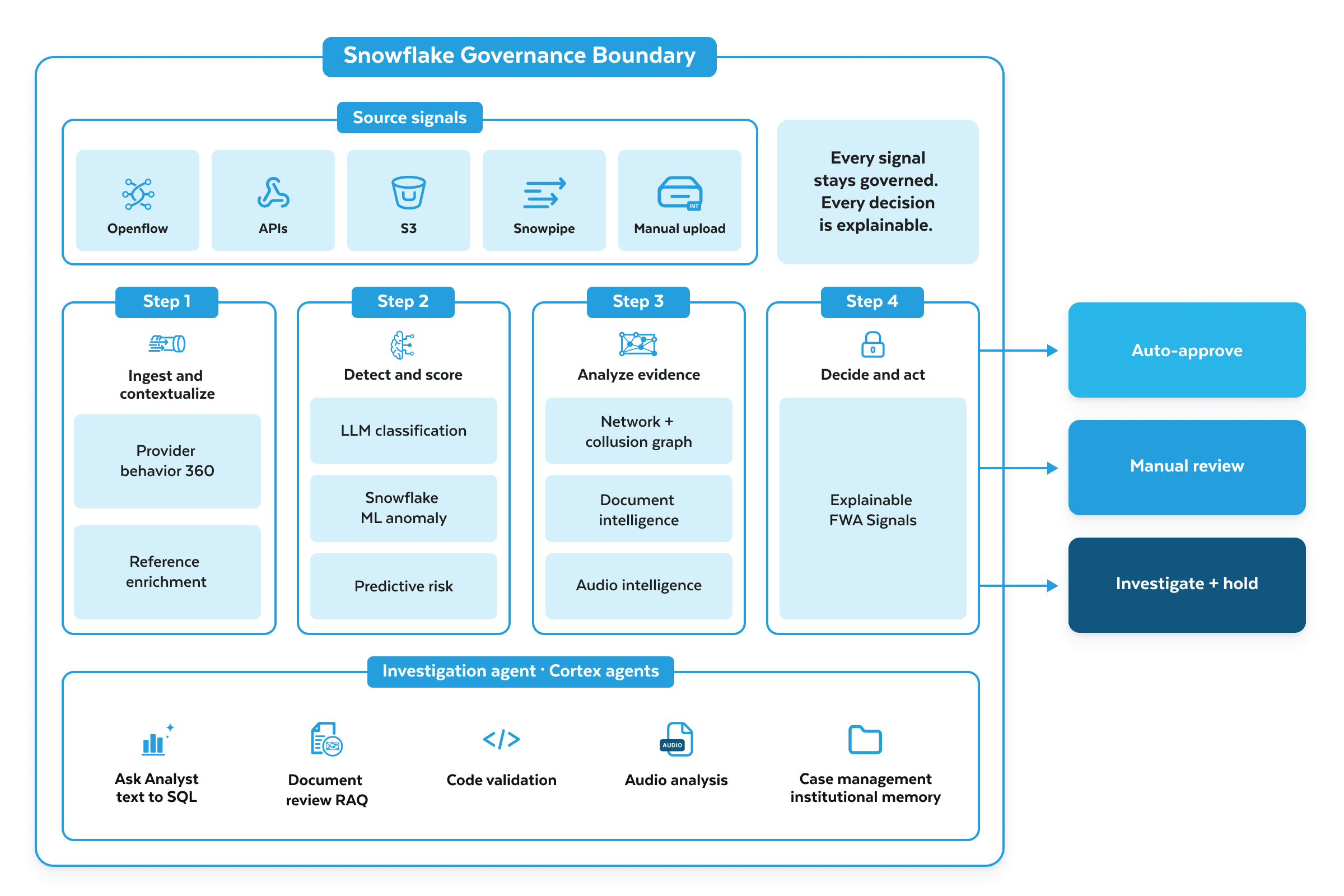

Ingest payment, provider and beneficiary data from disparate program systems into a single source of truth without complex ETL.
Train and deploy ML models with Snowpark and Snowflake Cortex AI. Score transactions against behavioral baselines, peer groups and known fraud patterns.

Create recovery cases, produce OMB-mandated metrics and feed case management systems with near real-time visibility into improper payment rates.
DEMO
Ravi Kumar from Snowflake builds a fraud, waste and abuse (FWA) detection platform for a fictitious state Medicaid agency. It unifies claims, provider, beneficiary and clinical data, then uses AI and ML to flag suspicious claims before payment.
Why Snowflake

Break down data silos across programs to uncover complex, cross-agency payment fraud schemes in near real time.

Run anomaly detection models where your data lives using Snowpark and Cortex AI, without the need for external tools.

Maintain end-to-end lineage and automated compliance reporting with FedRAMP High-level data security on select deployments.


RESOURCES
Discover technical quickstarts and guides to build scalable fraud, waste and abuse detection architectures on Snowflake.
GET STARTED
Snowflake for Program Integrity and Payment Accuracy
Snowflake unifies claims, payment, provider and beneficiary data on a single platform. Using built-in ML and AI models via Snowpark and Cortex AI, agencies can run near real-time anomaly detection and risk scoring across massive data sets without moving sensitive data.
Yes, Snowflake supports FedRAMP High on AWS GovCloud and Azure Government, as well as DoD Impact Level 4 (IL4) and Level 5 (IL5) requirements on AWS GovCloud, helping government agencies meet data protection and governance standards.
Yes, Snowflake integrates with legacy databases, modern case management platforms and downstream analytics tools using native connectors, REST APIs and zero-copy data sharing.
Snowflake Cortex AI allows agencies to process and analyze unstructured text, scanned PDFs and audio recordings natively using LLMs and natural language processing to surface hidden FWA patterns.
Snowflake provides end-to-end data lineage and access logging, so model inputs, decisions and record changes are traceable and audit-ready for OMB compliance.
Snowflake operates on a consumption-based pricing model, allowing agencies to scale compute up or down as needed so they pay only for the exact query and training processing power used.