


Webinar
Zero-ETL Secure AI and Data Sharing Across Clouds and Regions
Learn how to share across clouds and regions while maintaining security and governance controls.
Feature
Easily share governed, interoperable data, apps and AI assets, or use simple natural language to package them into data products that unlock AI and analytics.

Overview
Break down barriers with enterprise-ready AI and data sharing that is simple, secure and cost-effective. Govern and share data more easily with teams and partners, without extra ETL or integration work.

Reduce complexity with zero-copy sharing to anyone inside or outside your organization, decreasing the need for new pipelines and lowering egress costs when sharing across clouds and regions.

Enhance enterprise-grade trust with built-in governance capabilities for AI and data sharing, including fine-grained access controls and encryption. Increase resilience for mission-critical data products with business continuity and disaster recovery.

Achieve a connected data foundation that powers AI — without vendor lock-in — thanks to Snowflake’s expansive sharing ecosystem, which is open to everyone and supports open table formats, external catalogs, agents and semantic views.


Benefits
Accelerate time to value
Reduce manual effort and data duplication with automated global sharing capabilities that expand data delivery and access — without increasing spend.

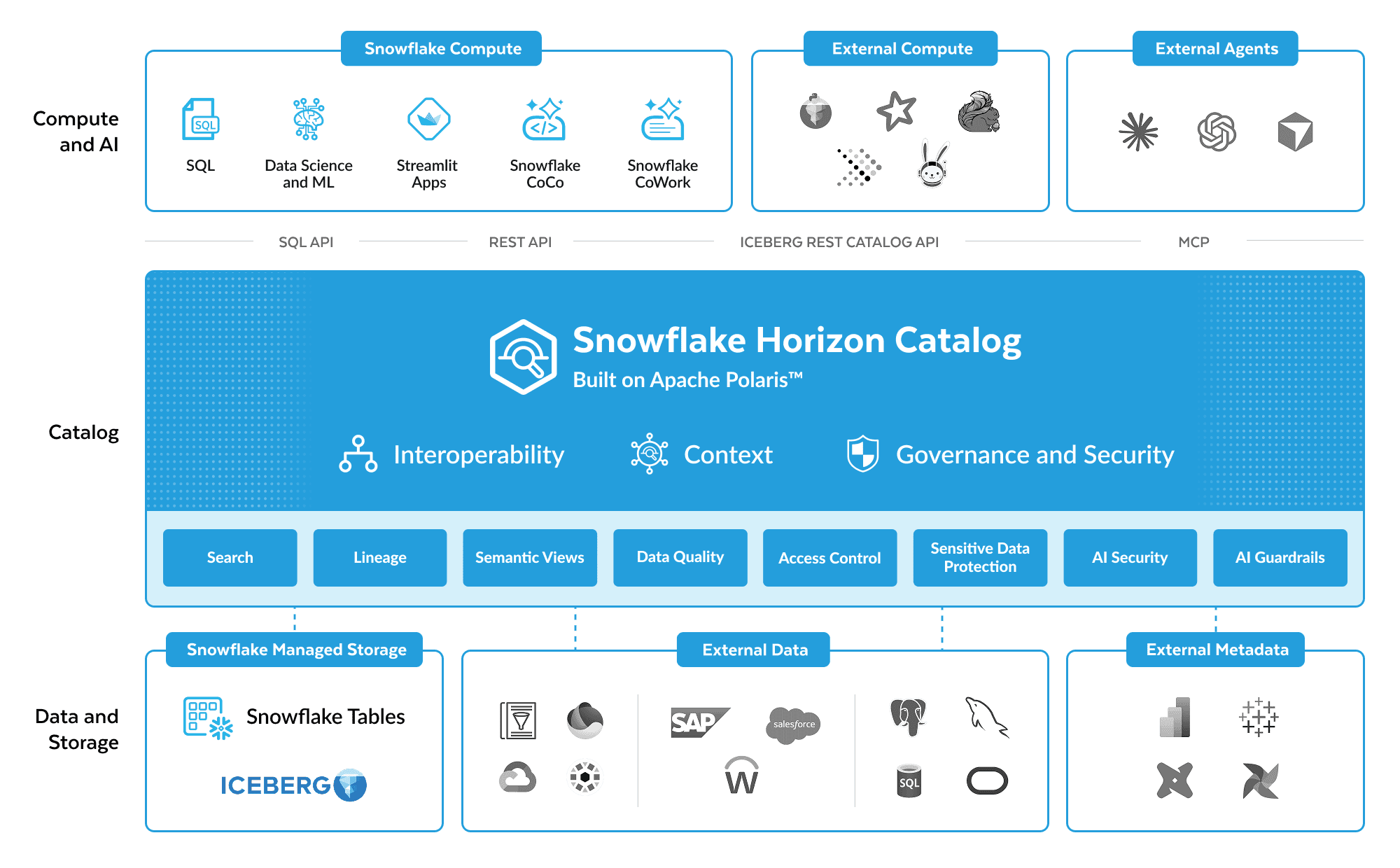
Control sharing & discovery
Provide the right people — across teams and outside your organization — the right access to your data and AI assets with Snowflake Horizon Catalog’s built-in discovery and governance features.

Petco Unleashes New Revenue Opportunities and Savings with Data Sharing
With Snowflake, Petco has further deepened its understanding of customers to continue evolving and personalizing shopping experiences


“We've been able to leverage Snowflake's datashare offerings to better serve our clients by delivering more robust solutions that allow us to better collaborate with clients in ways to share our data and insights that were impossible with our old design."
Gregory Shoemaker,
SR Manager Engineering, Luminate

Enjoy flexibility and interoperability
Share AI and data with anyone internally or outside your organization with support for all data types and formats, allowing you to build a comprehensive foundation to fuel AI initiatives.
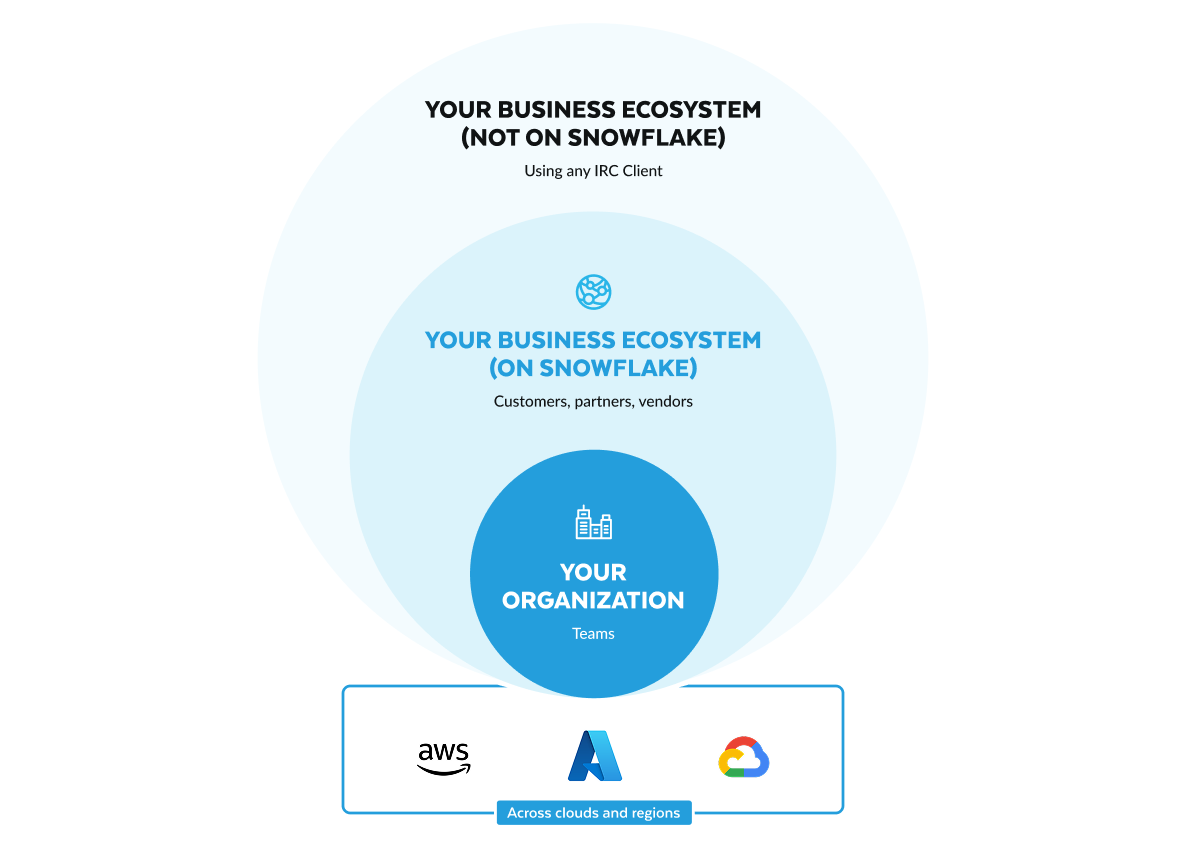

Work together with ease
Unlock the value of your most confidential data with advanced privacy policies and Snowflake Data Clean Rooms, enabling secure data sharing between organizations and deep insights without impacting compliance.
Resources
Get Started

Zero-ETL Data Sharing
This FAQ covers how to share across clouds and regions, what it costs, what can be shared, and how Snowflake supports governance and interoperability.
Zero-ETL AI and Data Sharing lets organizations provide governed access to live data and AI assets without building a separate ETL pipeline or creating a copy for every consumer. Snowflake supports sharing data, applications and AI ready assets with teams, partners, customers and other consumers.
Snowflake provides automated sharing capabilities for delivering data across clouds and regions, reducing the need to build and maintain a separate pipeline for every destination. Cross-Cloud Auto-Fulfillment and related cost-management capabilities help providers expand access while controlling operational and data-transfer complexity.
A Share provides read-only access to live data without copying or moving the shared data out of the provider’s account. For cross-region, cross-cloud and open-table-format scenarios, the delivery path depends on the share type, listing and table format. Snowflake manages the supported fulfillment and distribution mechanisms.
Snowflake can reduce sharing costs by avoiding unnecessary data movement and by using Egress Cost Optimizer for eligible distribution scenarios. Customers can get up to 96% potential egress cost savings, assuming replication from AWS US West to all Snowflake commercial and government regions. Actual results vary by workload, cloud, region and sharing pattern.
Snowflake sharing can extend beyond data tables to applications, functions, notebooks, semantic views, models, agents and other AI ready assets. This lets providers package the data and context consumers need instead of distributing raw data alone.
Snowflake supports open table formats such as Apache Iceberg and Delta Lake, enabling governed data sharing across clouds, regions and platforms. For Apache Iceberg, Snowflake supports both Snowflake-managed and externally managed tables, including tables connected to external catalogs. Open table format sharing helps organizations extend Snowflake governance and distribution capabilities while allowing consumers to work with data in the formats and environments they already use.
Open Data Sharing powered by Apache Polaris™ extends governed access to non-Snowflake consumers through Iceberg REST Catalog-compatible clients and engines, such as Spark, Databricks, Trino and Dremio.
A Share is a direct container that grants read-only access to selected database objects for specific Snowflake accounts. A Listing packages shared data as a more discoverable data product and can add metadata, broader distribution, Marketplace reach or monetization options.
Snowflake AI and Data Sharing supports governed access through capabilities such as role-based access control, secure views and functions, encryption, auditability, revocable access, classification, access history and lineage. For business-critical data products, Snowflake also provides observability, business continuity and disaster recovery controls.
For data providers: There are no direct costs for creating shares or listings. You continue to pay for the storage of the data in your account.
For data consumers: Consumers pay for the compute resources (their virtual warehouses) they use to query the shared data. There are no charges for accessing the data itself through a share. If a listing on the Snowflake Marketplace is monetized, specific pricing terms set by the provider would apply.
Snowflake helps organizations share live data together with semantic context, models, agents, applications, and other AI ready assets — powering governed, trusted AI results. For example, business users can generate insights on shared data through natural language conversations with CoCo or CoWork, and operators can combine shared data, tools, and agents to move from an insight to a governed action. Snowflake AI and Data Sharing provides the durable, governed foundation for analytical workloads and Snowflake-managed MCP adds the agent interface for connecting this data to tools and live systems.


