Use Case
Autonomous Data Engineering
Transform how you build and maintain data products with autonomous agents.
Approach
Agents take on more responsibility for pipeline development and maintenance as they prove they can handle it. Your engineers keep the final say on changes and oversight.
Most teams already run git-based pipelines and automated tests. Snowflake adds agents that author and repair those pipelines under the same roles and audit trail your engineers work in.

A declarative foundation
Your pipelines become code a colleague can review and an agent can understand, with version control and testing through dbt projects and DCM Projects.

Self-healing pipelines
Autonomously identify failures, diagnose the problem and create a pull request your team reviews.

All the context agents need
Agents access your schemas, query history and compute directly, so they reason with the right business intelligence.
Benefits
Autonomous agents understand your data and your work norms
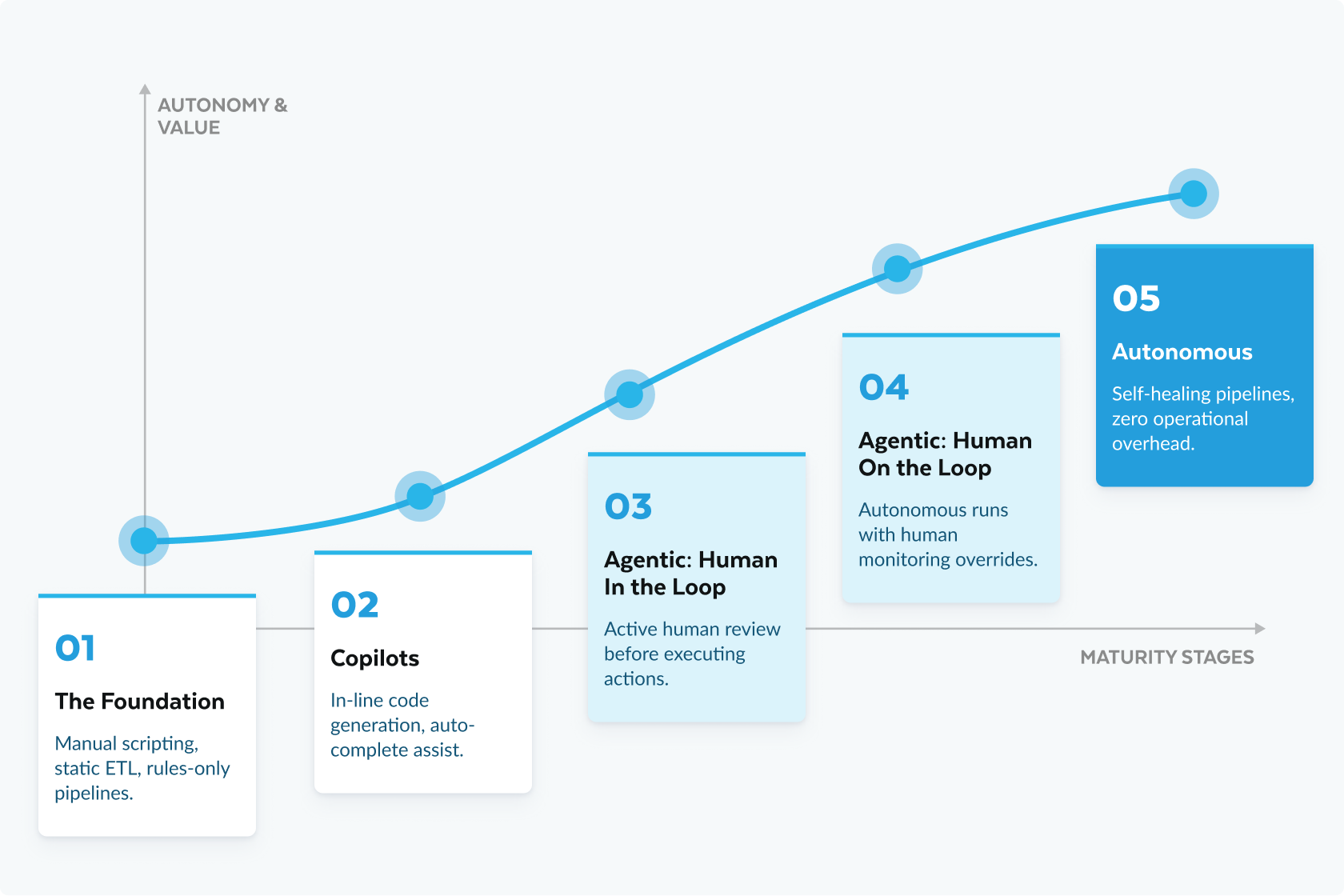
Maturity curve
Create a strong foundation for autonomy
Your path may already be underway. Modern data engineering best practices lay the groundwork for moving from manual pipelines to agent-assisted work and, ultimately, a self-healing data estate.
A data-native AI harness
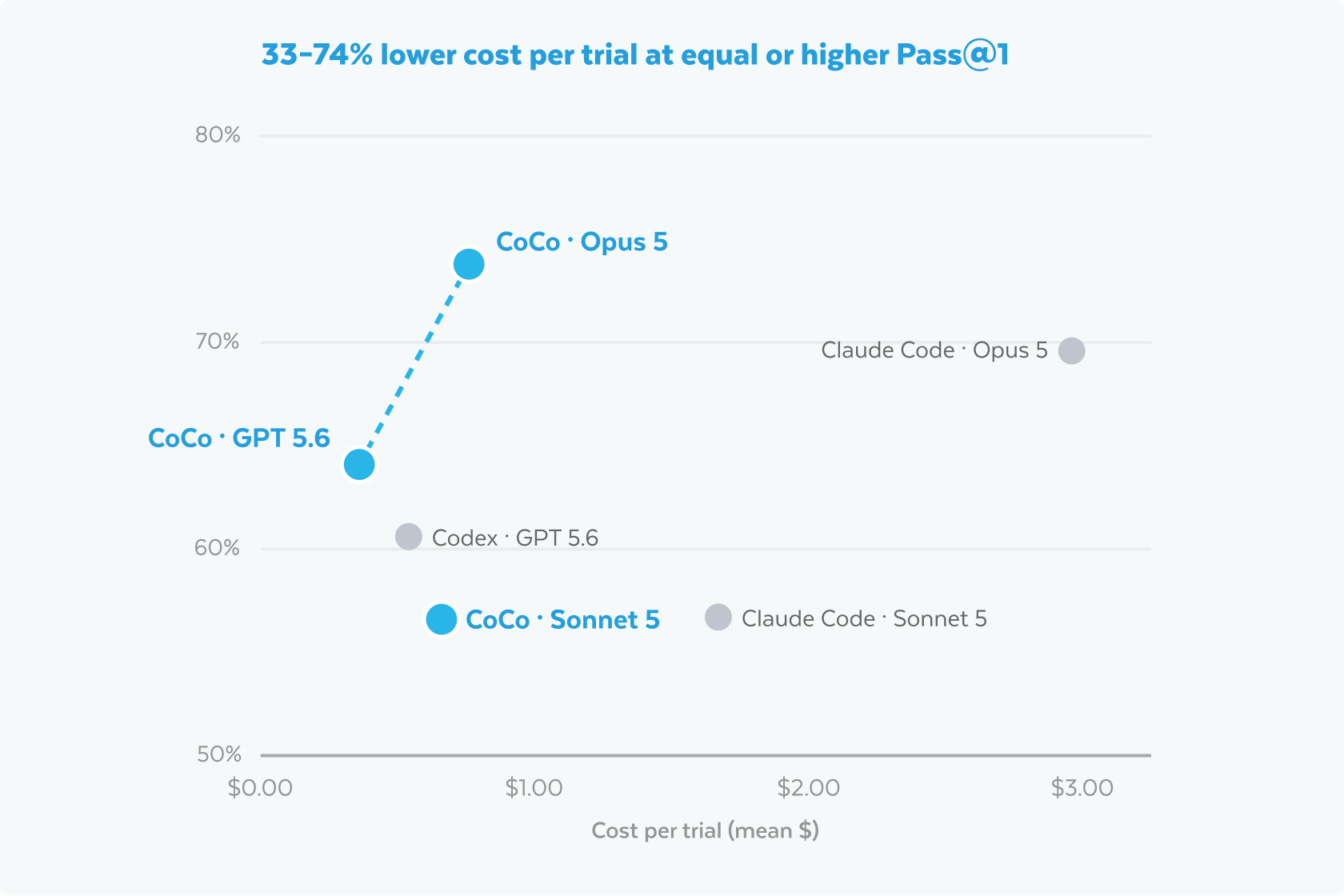
Better data engineering output with fewer tokens
Higher-quality output and more efficient token use start with agents built for data engineering. Snowflake CoCo is a data-native harness designed to deliver both.
Trusted Context for Autonomous Work
Agents inherit the definitions your business already agreed on
Turn metadata across your data estate into trusted business context with Snowflake Horizon Catalog. AI agents can deliver better outputs, and built-in governance capabilities help you give agents autonomy without giving up control.

Features
The features powering autonomous data engineering


Get Started
Take the next step with Snowflake
Start your 30-day Snowflake trial today
- $400 in free credits
- Immediate access to the AI Data Cloud
- Enable your most critical data workloads




Autonomous Data Engineering
Frequently Asked Questions
Common questions about building autonomous, self-healing data pipelines with Snowflake.
Autonomous data engineering is an approach in which AI agents build, maintain and optimize pipelines within boundaries set by people. The goal is to spend less time managing pipelines and more time delivering trusted data products for business decisions and AI.
At full maturity, agents detect failures, diagnose root causes, apply fixes and validate results. Data engineers define the policies, architecture and business context, with high-impact changes still requiring human review.
Snowflake’s maturity model describes an incremental path from manual work to autonomy:
Foundation: Engineers build and maintain pipelines manually while establishing sound engineering practices.
Copilots: AI assists with code generation, but engineers still own every decision.
Agentic, human in the loop: Agents propose pipeline changes and fixes. People approve changes before they run.
Agentic, human on the loop: Agents perform clearly defined tasks independently. Engineers monitor their actions and can intervene.
Autonomous data engineering: Pipelines detect, diagnose and resolve failures within human-defined policies, routing high-impact changes for review.
Each stage helps teams build confidence in what they can safely automate.
AI-assisted coding helps engineers write code faster. Autonomous data engineering changes who performs the work across the pipeline lifecycle.
A coding copilot suggests code while an engineer directs each step. As autonomy increases, agents take on broader responsibilities, such as investigating failures, testing fixes and optimizing pipelines. The shift goes beyond generating code to managing outcomes under human-defined rules.
Snowflake CoCo runs inside Snowflake with native access to your schemas, lineage and query history. That context lets it explore less and fix more, which shows up as higher pass rates and lower token usage on data engineering benchmarks.
Data engineers remain the key decision-makers. Their focus shifts from writing and repairing pipelines to defining business priorities, guiding architecture and setting standards for data quality and governance.
They also decide which actions agents can take independently and which require approval. That gives engineers more time to partner with business teams while retaining control over consequential changes.
Agents need more than raw data. They need its business meaning, quality expectations and context to produce useful results.
A data product brings those elements together. For example, a customer loyalty data product could combine account activity with a shared definition of “at risk” and documented quality checks. Analysts and agents then work from the same definitions.
Starting with the business problem helps teams build data products, and the pipelines behind them, around the outcome they need.
