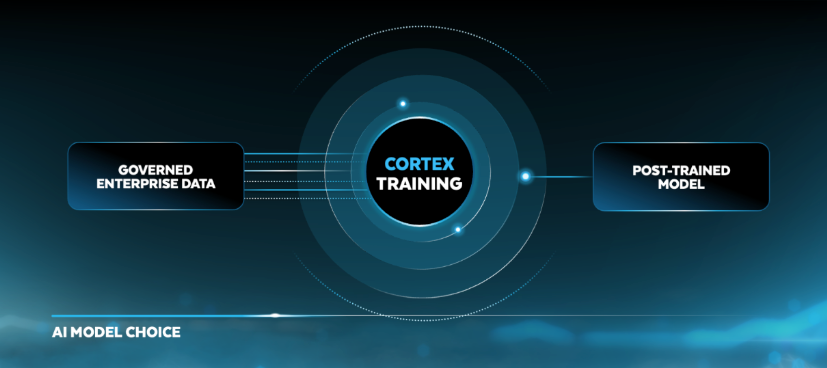
Every production AI application generates millions of valuable data points about your business, including customer preferences, usage patterns and outcomes, but most enterprises never take advantage of it. Many default to building agents on closed foundation models that can be costly and lack the detailed understanding of your business. As open-weight models become increasingly competitive with frontier models, enterprises have an opportunity to customize AI using their own data and context. Doing so, however, has traditionally required managing complex, expensive GPU infrastructure or relying on managed APIs that offer limited flexibility and control.
Today, we are excited to announce the public preview of Cortex Training, Snowflake’s serverless offering for customizing and deploying open-weight LLMs. With Cortex Training, teams can use familiar training frameworks, or build advanced custom training loops with low-level serverless APIs — all without managing the complexities of GPU provisioning, scheduling, checkpointing and distributed execution.
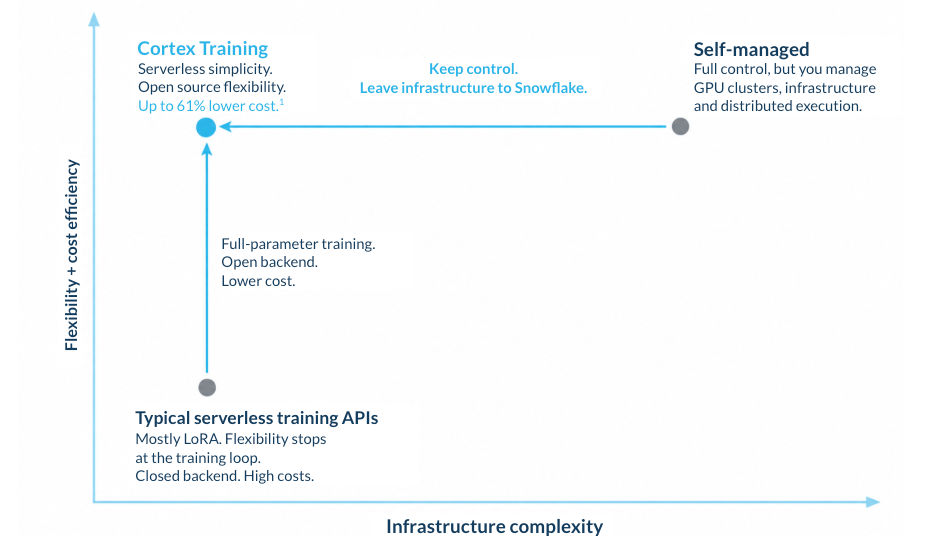
Cortex Training is built on top of a highly customizable and optimized open source backend to bring the flexibility and efficiency of a complex, self-managed bare-metal training cluster to a simplified serverless experience. Benchmarks show up to 61% lower cost than competing serverless offerings,[1] so teams no longer have to trade simplicity for flexibility or cost efficiency when customizing and deploying models.
With Cortex Training, teams can use Snowflake’s integrated data platform to easily curate training-ready data sets and capture agent traces and logs, creating a feedback loop for model customization and improvement.
Why enterprises need post-training
Open-weight models off the shelf are general by default but can be highly optimized for each company’s domain, proprietary data, use cases, and budget through post-training. Post-training methods such as SFT and RL are how LLMs learn what good behavior looks like and how to make more accurate, cost-effective decisions using your organization’s specific context.
SFT teaches models what good behavior looks like. Using high-quality examples, enterprises can teach a customer service agent how to diagnose issues, communicate with customers, apply escalation policies and follow proven tool-calling and workflow patterns. Rather than relying on prompting to specify every step, the model learns from successful interactions how the enterprise expects work to be done.
RL teaches models how to make better decisions to achieve desired outcomes. Unlike SFT, which learns from demonstrations, RL optimizes behavior through feedback on measurable outcomes, such as issue resolution, policy compliance, latency and cost. For example, a customer service agent can learn when to invoke a ticketing system, call a billing API or escalate to a human. By learning from feedback across many interaction trajectories, it can discover more effective ways to complete tasks, avoiding unnecessary tool calls and steps while balancing quality, speed and cost.
Introducing Cortex Training
Cortex Training is Snowflake’s serverless offering for building and deploying customized open-weight models. AI teams retain fine-grained control over SFT, RL and custom training loops, while Snowflake manages the GPU infrastructure so developers can focus on improving models rather than operating clusters.
Cortex Training is built on top of a highly customizable and optimized open source backend to bring the flexibility and efficiency of complex, self-managed bare-metal deployments to a simplified serverless experience. It supports a wide range of open-weight model families, supervised fine-tuning (SFT) and reinforcement learning (RL) with full-parameter or LoRA training, and orchestration through popular open source frameworks such as SkyRL, Hugging Face TRL and veRL.
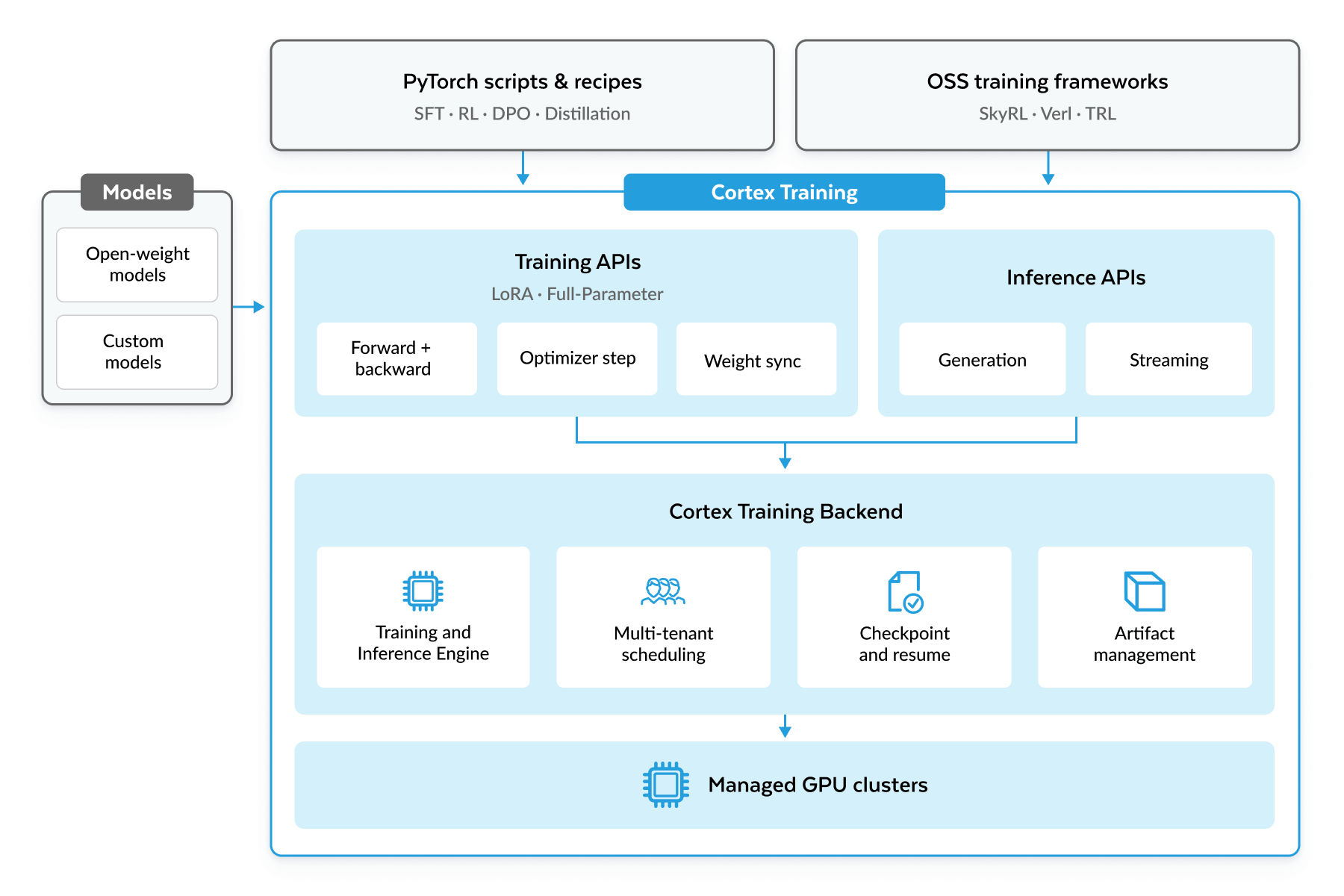
The platform supports the full model lifecycle: Benchmark leading open-weight models, customize them with popular training frameworks or low-level serverless training APIs, evaluate and compare checkpoints, and deploy them through OpenAI-compatible inference endpoints. This creates a continuous flywheel in which production data and feedback drive increasingly capable, specialized models.
Cortex Training extends Snowflake governance controls across the model lifecycle. Role-based access controls govern training data, model training, deployment and inference, while data, model weights and optimizer state remain within Snowflake’s managed environment.

At ResolveAI, we’re improving software reliability by putting AI SRE agents on the critical path and owning the outcome. Building superhuman SREs that autonomously investigate and resolve production issues requires training on long-horizon tasks, with jobs running on hundreds to over a thousand GPUs. Cortex Training’s serverless APIs let us operate at this scale without managing the underlying infrastructure or optimizing clusters. The Snowflake team’s systems expertise also complements our AI research, allowing us to innovate rapidly and iterate toward our model performance goals.
Sean Bell
Research Lead, ResolveAI
Focus on models, not GPU infrastructure
Cortex Training provides serverless APIs so teams can focus on training logic instead of on provisioning and operating GPU infrastructure.
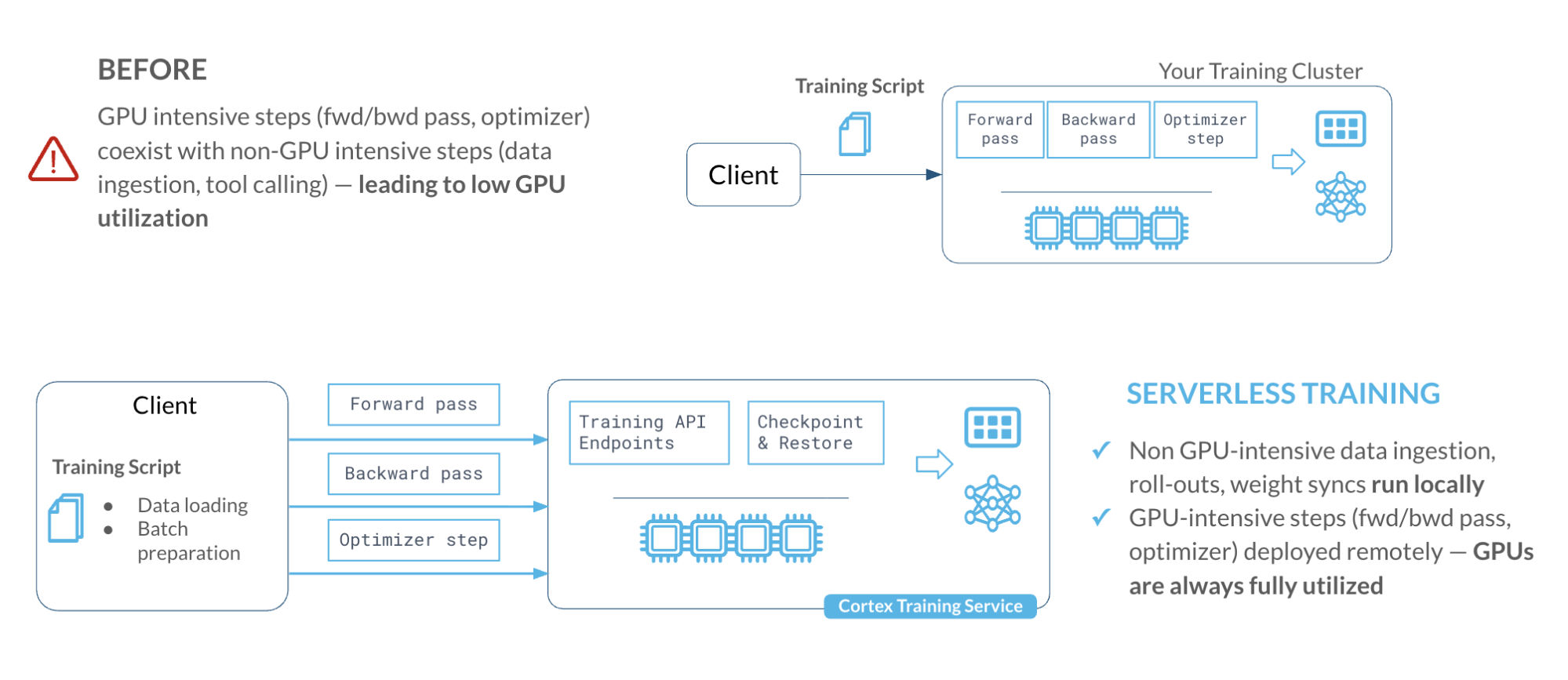
Your training script controls the training loop, while Cortex Training APIs handle GPU-intensive operations such as forward/backward passes, optimizer steps, weight synchronization and generation. You define how the model learns; Snowflake manages the GPUs, distributed execution, model state and checkpointing.
Unlock the flywheel of model improvements
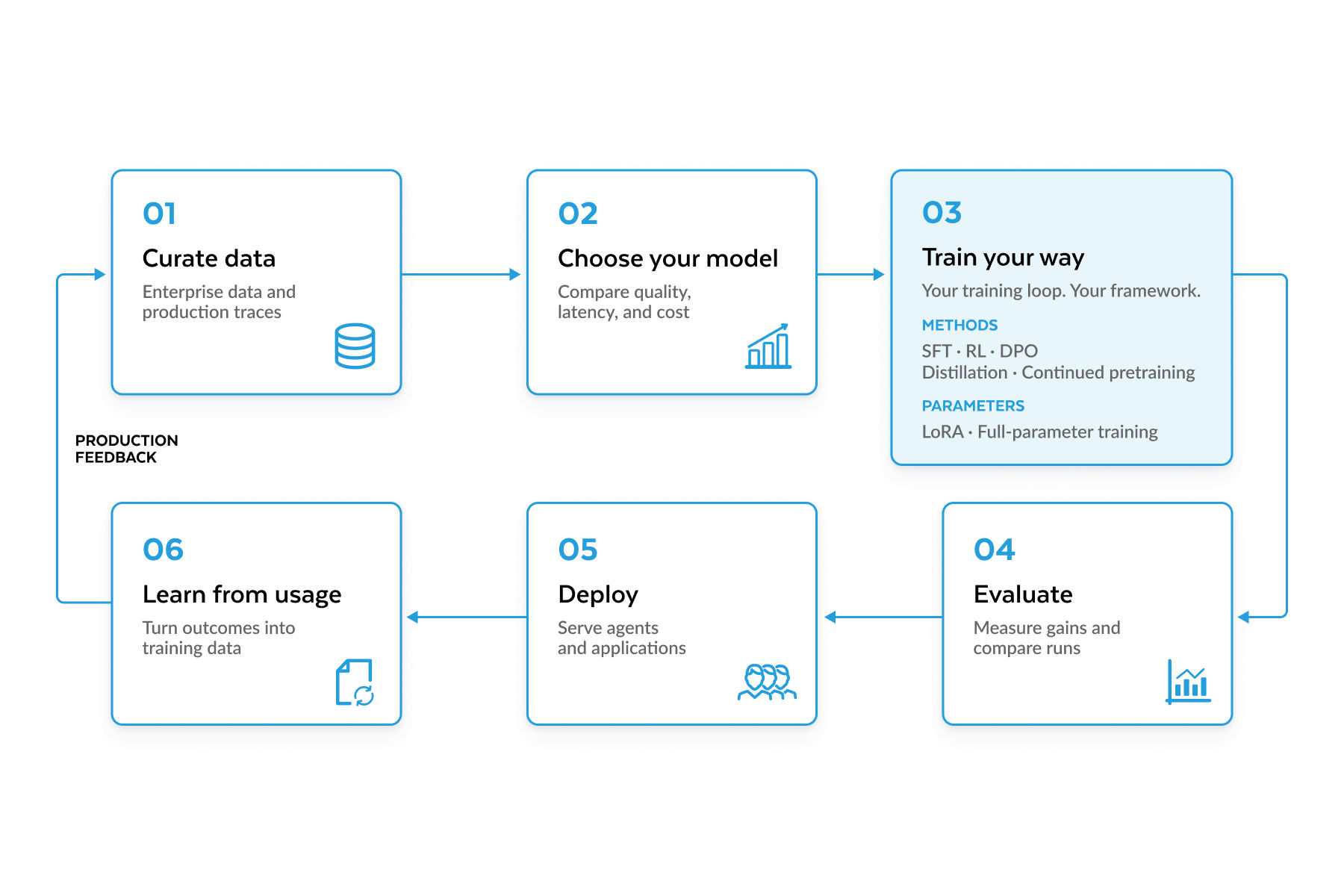
Snowflake enables a flywheel of model improvement — from capturing production agent traces and logs to curating training data, customizing open-weight models for business-specific needs and deploying them toward inference needs.
Curate your data
Successful model customization starts with high-quality training data. Snowflake’s data platform enables teams to clean, filter, enrich and label enterprise data — both structured and unstructured — into training-ready data sets with Cortex AI Functions, SQL and Snowpark. Cortex AI Gateway helps close the feedback loop between production agents and model training. Teams can capture agent traces, logs and model interactions to understand agent behavior and identify opportunities for improvement. By combining these signals with application outcomes and human feedback, teams can curate high-value training data sets for SFT, preference optimization and RL — turning real-world agent experience into continuously improving models.
Benchmark and evaluate the right open-weight model
Start by testing open-weight models against your workload before investing in customization. Compare candidates on the dimensions that matter for your application: quality, latency and cost. Cortex Training provides a rich catalog of open-weight models, including families such as Qwen, GLM, Nemotron, Gemma and DeepSeek, with batch and streaming inference to facilitate model benchmarking.
At OpenHands, we use RL frequently to train models for our agent to handle coding tasks when a user points to files or functions. In the past, we’ve had to manage our own training cluster and were spending days to weeks on cluster management and debugging. With Snowflake Cortex Training, we’ve been able to focus 100% of our time on experiments and training. What’s more, we haven’t had to change our preferred frameworks or compromise on flexibility.
Jeff Ma and Parinthapat Pengpun
Researchers, OpenHands
Flexibly train and customize the model your way
Once you have a strong base model, adapt it using the training strategy that best fits your task. Cortex Training supports state-of-the-art open-weight models — including Qwen, Nemotron, Gemma, DeepSeek and others — across a range of parameter sizes. Teams can use LoRA or full-parameter training for SFT, RL, direct preference optimization, distillation, continued pretraining and mid-training.
Cortex Training integrates with popular post-training frameworks such as Hugging Face TRL, PrimeRL, veRL and SkyRL, so teams that are already using these frameworks can onboard quickly. It also integrates with agent platforms such as OpenHands to train models and entire agent harnesses. Beyond these integrations, the serverless APIs enable agent-driven model customization for enterprise workloads, reducing training complexity and making customization accessible without specialized AI expertise.
For greater control, advanced ML teams can use lower-level APIs to define custom loss functions, model architectures and training loops. For example, Cortex Training provides APIs for generating rollouts — model responses or agent interactions — updating model weights and synchronizing those weights across the system. These building blocks enable RL workflows that repeatedly generate behavior, evaluate outcomes and use the results to improve the model over time.
This flexibility extends to the underlying infrastructure. Cortex Training is powered by Arctic Platform, an open source backend that gives users full visibility into the code running on the GPUs. Advanced teams can contribute PRs and incorporate emerging techniques and innovations from the broader AI/ML community into their training workloads.
Check out our Cortex Training examples for the complete set of recipes, integrations and skills.
At Snowflake AI Research modeling team, we build our software-engineering agents, including Arctic-SWE, on prime-rl with Cortex Training as the backend. It lets us freely develop our own algorithm frameworks and recipes on top of serverless GPUs — the training dynamics we need for state-of-the-art SWE performance, without managing the cluster.
Boyi Liu
Senior Research Scientist, Snowflake AI Research
Evaluate and iterate
Training is only valuable if the new model is measurably better. Cortex Training lets teams load trained checkpoints for batch inference or deploy them behind endpoints for evaluation and application testing. You can use Snowflake ML Experiments to track training runs, log custom metrics, observe performance and compare runs across experiments, giving you full control over what data is captured rather than relying on automatic logging. Checkpoints are persisted server-side so teams can resume training or start new experiments from previous checkpoints.
Deploy to agents and applications
Once a model meets the required quality and cost targets, teams can deploy it for inference.
Cortex Training supports OpenAI-compatible inference endpoints backed by dedicated GPUs, including streaming inference for interactive applications and agents and batch inference for noninteractive needs.
The lifecycle then starts again as production applications generate new trajectories, evaluations and outcomes: benchmark → train → generate rollouts → evaluate → deploy and serve → learn from production → train again. That loop is how enterprise data and application experience become increasingly capable, specialized models.
Cost efficiency through an open foundation
Cortex Training provides optimized configurations out of the box, while advanced teams can tune them for specific workloads or contribute improvements upstream. Because usage is billed by GPU time, faster training translates directly into lower costs.
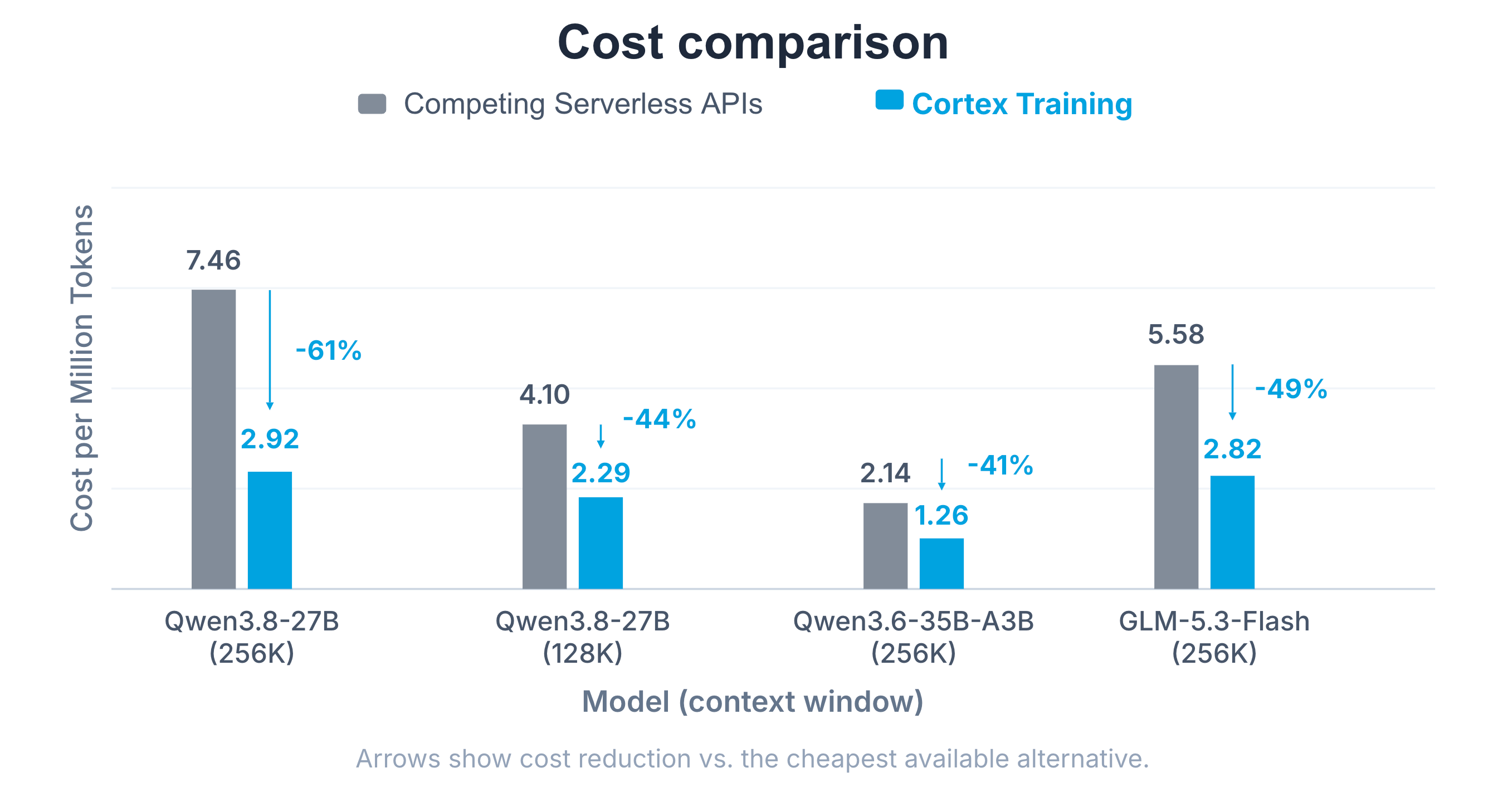
Compared to other serverless training APIs, Cortex Training delivers strong cost efficiency for LoRA training. In our benchmarks, Cortex Training is up to 61% lower cost than competing serverless training API products (Tinker and others).[1]
Poetiq is building the most powerful optimizer in the world using our own approach to recursive self-improvement. We have started to post-train the first LLM in the world that specializes in optimization with Snowflake. Cortex Training gives us the ease of use and flexibility to handle everything we need to do from LoRA, to SFT, to full-parameter post-training with our custom GRPO implementation.
Ian Fischer
Co-CEO, Poetiq
Get started with LLM post-training
- To help you get started, we’ve put together this easy-to-use quickstart notebook that operates entirely inside your existing Snowflake account.
- Read through the getting started repository, or pick from one of these ready-to-go recipes.
- To learn more about Cortex Training, check out docs or visit the web page.
- Reach out to your account teams for help or to consult with an AI specialist on Snowflake.
- Cost comparison methodology: Pricing for competing serverless API offerings is based on pricing published on Oct. 22, 2026, on their webpages. We ran LoRA SFT training workloads on Cortex Training with the context length specified in Figure 5, and measured the throughput per H200 GPU. We used the throughput (toks/sec) to calculate price per million tokens for Cortex Training using the formula (price_per_second / throughput) x 1M. ↩