Jun 2, 2026/8 min readProduct and Technology
Snowflake Horizon Context: The Governed Context Layer for AI, BI and Apps

Your head of sales sees $14.2 million in Q3 revenue. Your CFO sees $12.8 million. Both asked an AI agent this morning to provide numbers. Same data. Why the discrepancy?
This is what can happen when business logic is scattered across separate tools: a metric defined inside a BI model only one team owns, a calculation buried in a dashboard, a set of instructions manually hardcoded into an LLM prompt. The result isn’t just metric drift, where sales and finance show different numbers in response to the same question. It’s a trust gap that makes it hard to move AI projects forward quickly with confidence.
Today, that changes. Snowflake introduces Horizon Context, a new capability within Horizon Catalog that offers a connected, governed semantic foundation with active context for AI and BI.
“As AI becomes increasingly embedded across our enterprise, it’s essential that applications, analytics and agents operate from the same trusted understanding of the business. Snowflake Horizon Context helps extend consistent business definitions across our broader data ecosystem, supporting more trusted and governed AI and analytics experiences at scale.”
Jeff Miller
Managing Director, Global Head of Data Factory & Enterprise Data Platform, BlackRock Aladdin
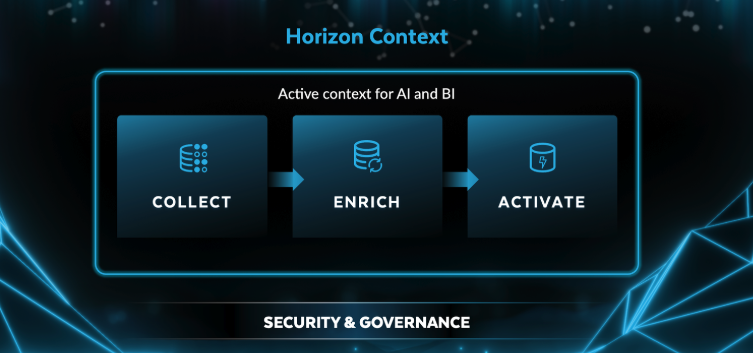
Snowflake Horizon Context builds on Horizon Catalog’s metadata foundation by turning that metadata into governed business meaning. It collects context from across your data estate, enriching it with business definitions and relationships, and activating it so AI agents, BI tools and applications can automatically discover and apply trusted logic.
From a system of record to a system of intelligence
AI agents can write SQL, debug code and analyze data. But if agents have to guess when you ask what "revenue" means in your business, that is a context problem.
The disconnect between enterprise AI and the context it needs comes down to three problems:
Context is scattered: When important context is scattered across disparate databases, BI and data pipeline systems, no single system has the complete picture it needs to deliver trusted responses.
Context is raw: Making raw resources useful for AI requires enriching them with higher levels of meaning: How are these data assets related? Which ones are authoritative? What does this column mean? What is the correct way to calculate this metric?
Context is inactive: Context only works if it gets used. If that depends on users knowing where to find a specific agent or how to prompt it in a specific way, the much larger remainder of AI sessions do not benefit.
To address each of these problems, Snowflake Horizon Context collects metadata from disparate systems, enriches it and activates it so that it’s useful for your business. It turns Snowflake from a system of record into a system of understanding.
Collect: Build the complete picture
Your AI needs context from your entire data estate, inside and outside Snowflake. Horizon Context extracts context from external systems and collects it in Horizon Catalog.
Metadata Connectors (private preview): We are expanding Horizon Catalog from a data catalog for Snowflake toward a data catalog for all your data. Connect to external database, BI and data pipeline systems including PostgreSQL, Microsoft SQL Server, Tableau, Power BI and dbt and collect database schemas, query logs, dashboard definitions and more.
OpenLineage API (public preview): Configure OpenLineage producers like Apache Airflow to send lineage information directly to Horizon Catalog.
Open Semantic Interchange (OSI): Snowflake is leading an open standard for how disparate systems exchange semantic metadata. The working group now includes 54 participating vendors and has published a specification.
Enrich: Turn raw metadata into business meaning
Raw context is a start, but it needs enrichment to create higher levels of meaning. Snowflake Horizon Context automates much of this, dramatically reducing the manual effort to build and maintain a context layer while still supporting human collaboration.
End-to-end column-level lineage: Horizon Context mines lineage from Snowflake and external query logs, BI systems and OpenLineage feeds, then stitches it together into a complete lineage graph.
Popularity: When dozens of similar-looking data assets exist, determining which to trust is key. Horizon Context uses query and access logs to calculate popularity as a signal for authoritativeness.
AI-generated data documentation: Horizon Context uses AI to generate table and column descriptions using both metadata and, optionally, sample data.
Semantic Views: Snowflake is launching several enhancements at Summit 2026. Advanced Semantics (private preview) bring level-of-detail (LOD) calculations, composable definitions and user-defined materializations with automatic query rewrite. Semantic Studio (private preview) is a full-fledged, AI-assisted IDE in Workspaces with CoCo integration and Git integration. Semantic View Autopilot takes your existing SQL, Tableau and Power BI files and creates semantic views for you.
Activate: Make context work automatically
The last mile of context is making sure it gets used. With Horizon Context, your context is discoverable, accessible and automatically activated as you interact with agents.
Context search: CoCo automatically retrieves relevant context using Universal Search, a hybrid keyword plus semantic search that uses signals like popularity for ranking and access control policies for filtering. New enhancements include search across your entire data estate (private preview), upgraded AI models for more relevant results, and search for workspace files, semantic views and agents.
Automatic semantic view discovery: When asked a data question, CoCo now automatically searches for and queries relevant semantic views, falling back to tables if none exist.
Semantic View interoperability: Expose semantic views via MCP, governed by Horizon Catalog, and connect from Claude, Cursor, Antigravity CLI or your agent of choice. We are expanding our ecosystem of supported BI platforms beyond Omni, Sigma, Hex and Tableau to include Power BI (private preview soon), Excel (private preview soon), ThoughtSpot (early access) and Looker from Google Cloud (preview).
"With Snowflake Semantic Views, we define critical business metrics once in a unified semantic layer... That single source of truth has eliminated metric discrepancies across teams and given us the confidence to scale AI-driven analytics knowing the answers are grounded in governed logic. Looking ahead, Snowflake's Horizon Catalog and Horizon Context will give us the foundation to deploy AI agents that automatically inherit our evolving business logic, keeping every system aligned without manual intervention.”
Brendan Cyrus
Director of Product, AI Analytics & Data Platforms, Indeed
Trusted context starts with governed data
This is where Horizon Context separates from other third-party semantic layers. Because it is native to the Snowflake engine, governance framework is enforced at the meaning level, not just the table level. Your role-based access control policies and row-level masking follow the context: every tool, every query and every AI response. A definition restricted for the finance team stays restricted in Power BI, in Salesforce and in any agent that queries it.
“At Simon AI, our focus is helping businesses turn data into real, actionable outcomes. But inconsistencies between business logic have historically slowed how far AI can be applied. Semantic View Autopilot provides our AI systems with a consistent, governed understanding of business metrics that we can collaborate upon with our customers. This allows us to deliver reliable personalization and AI-driven engagement that our customers can trust to drive measurable results."
Matt Walker
CTO, Simon AI
"At Wix, we serve millions of creators who depend on data-driven experiences across our platform. Snowflake Semantic Views let us define our business logic once and apply it consistently, whether it is powering internal dashboards, customer-facing analytics or AI features. The result is fewer inconsistencies, faster development cycles and a semantic layer our teams actually trust. As Snowflake expands Horizon Context, we see a path to embedding governed intelligence directly into our products, ensuring that as our data estate grows, the meaning behind it stays unified and accessible to every application we build."
Kyrylo Andriiashevskyi
Analytics Data Team Lead, Wix
Your context layer should work everywhere your teams do
Horizon Context is designed for an open ecosystem, so governed business definitions travel seamlessly to the BI tools, AI agents and applications your organization already relies on. Our business partners are a vital part of this equation, providing Snowflake customers direct connections to the systems and applications they use every day. Here's a look at how they're integrating with — and using — Horizon Context, in their own words.
Alation
“Alation's integration with Snowflake Horizon Context connects governed semantic definitions to enterprise data catalogs, giving teams the context they need to discover, trust, and use business metrics across every tool and AI agent in their organization."
—Satya Mishra, Head of Alliances and Corporate Development, Alation
AtScale
"AtScale and Snowflake share a simple belief: business definitions should be governed once and used everywhere analysts and AI applications work. With Horizon Context, trusted semantic context becomes part of Snowflake's broader governance framework, making it easier to discover, secure and activate across the enterprise. Whether teams define semantics in AtScale or Snowflake, they can invest with confidence knowing those definitions are governed alongside the rest of their data estate and available to the AI and analytics experiences that depend on them."
—David Mariani, Co-Founder & CTO, AtScale
Collibra
"Governed, consistent semantics and business ontology across the enterprise are required for AI agents and data users to understand, trust, and act on data at the speed of AI. Our integration with Snowflake Horizon Context ensures trusted metadata flows bi-directionally, giving joint customers a single, trusted view of the full enterprise context — to accelerate AI at production scale."
—Chandra Papudesu, VP, Product Management, Integrations & Lineage, Collibra
Domo
"Integrating Snowflake's governed semantic definitions with Domo helps joint customers reduce duplication, strengthen governance, and accelerate time-to-insight on trusted KPIs across their entire organization."
—Matthew Payne, VP of Engineering, Domo
Hex
"With Snowflake Semantic Views in Hex, teams work from trusted, governed metrics in notebooks, SQL and data apps, reducing inconsistencies and moving faster with reliable insights."
—Carlos Aguilar, Head of Product, Hex
Looker
"We’re excited to expand Looker’s universal semantic layer to support analytical models hosted in-database with Snowflake Semantic Views. Customers will now have the option to query and write back semantic definitions to scale conversational analytics across the enterprise with the Snowflake AI Data Cloud."
—Sean Zinsmeister, Director, Outbound Product Management, Google Cloud
Omni
"Our integration with Snowflake Horizon Context brings governed definitions into every interface, from AI-driven chat to spreadsheets and dashboards. This consistency helps customers scale self-service analytics and power trustworthy data products."
—Jamie Davidson, Co-Founder, Omni
Sigma Computing
"Sigma integrates directly with Snowflake Horizon Context, querying Semantic Views in real time so governed business definitions are instantly reflected in every spreadsheet, dashboard and exploration. This gives our mutual customers a single source of truth without sacrificing the flexibility they need to move fast."
—Hassen Karaa, SVP of Product, Sigma Computing
Tableau
"Tableau is adding support for Snowflake Horizon Context semantic definitions within its data model, ensuring analysts can trust that metrics are consistently defined and accurately aggregated by the underlying semantic layer. This gives joint customers a single definition of truth across Tableau and Snowflake."
—Nick Brisoux, Senior Director of Product Management, Tableau
ThoughtSpot
"With ThoughtSpot's native support for Snowflake Semantic Views, our users can query from a semantics layer enriched with AI-native context, so every agent, dashboard and embedded experience your business runs on reasons from one governed, continuously improving context layer.”
—Francois Lopitaux, SVP Product Management, ThoughtSpot
The path to agentic AI
Autonomous agents cannot reason about your business if your data carries no embedded meaning. Without context, an agent guesses. With context built natively into the platform, an agent acts. With context that is also governed natively, an agent can be trusted.
But context does not come from one place. It lives in your BI tools, your query history, your metadata catalogs and the institutional knowledge your teams have built over years. Horizon Context connects to these sources, enriches your semantic layer automatically, and governs the result in one system, preventing sync and drift issues.
That is what most platforms cannot offer. A context layer bolted on top of a governance engine must reconcile two systems every time a query runs. When definitions drift, the agent follows the wrong one. Horizon Context is different because semantics live inside the governance engine and are enforced at query time, not copied or cached.
Learn more about Horizon Context at snowflake.com/en/product/features/horizon-context
This content contains forward-looking statements, including about our future product offerings, and are not commitments to deliver any product offerings. Actual results and offerings may differ and are subject to known and unknown risk and uncertainties. See our latest 10-Q for more information.