

Model Registry: How ML Teams Track, Promote and Govern Model Versions
A model registry keeps trained ML model versions and their lifecycle records organized as they move from experimentation toward production. Learn how registries support evaluation, promotion, rollback, lineage and governance — and how they differ from experiment trackers, artifact stores and model catalogs.
MODEL REGISTRY DEFINED
A model registry is a system for managing identifiable versions of machine learning models and the metadata and relationships needed to operate them through their lifecycle. Depending on the platform, the registry may store the model artifact directly or reference artifacts managed elsewhere.
“The production model” sounds like a fixed thing. In practice, it’s a moving reference. As new machine learning (ML) model candidates are evaluated and released, the production designation moves from one version to another. The model registry preserves the versions underneath that changing reference, together with the metrics, lineage and other context needed to compare, investigate or restore them.
This level of detail can look excessive when a model is viewed as a single deployment. Across multiple releases, however, it determines how confidently teams can change and recover the system. For example, it lets them distinguish a model regression from an upstream data change, compare candidates against the right baseline and restore a previous version with an understanding of the data, features and configuration behind it.
As these release cycles accumulate, keeping track of their history becomes increasingly important. Researchers interviewing 18 ML engineers responsible for production systems found that versioning and visibility become significant operational concerns as systems evolve, particularly when teams need to reconstruct earlier models, data and pipelines.
Over time, the role of the model registry is to preserve enough context across releases to understand how the production system got to its current state — and to move it forward or backward without guesswork.
What is a model registry?
A model registry manages trained model versions and the metadata needed to operate them through later stages of the machine learning lifecycle. A registered model generally provides the stable identity — a fraud detection model, for example — while individual versions represent specific trained instances produced over time.
In an MLOps workflow, the registry provides the model-version record that connects experimentation with evaluation, release, deployment and ongoing model governance. Each version typically includes the model artifact, evaluation metrics, input and output signature, training lineage, ownership, aliases and information about its lifecycle or deployment state. The exact schema varies across platforms, as do the mechanisms used for promotion and deployment.
Several neighboring ML lifecycle capabilities manage some of the same information, which can make the terminology confusing. Additionally, modern ML platforms like Snowflake’s include more than one, or even all, of these capabilities.
- An experiment tracker records training runs during development. If a team tests various combinations of features, hyperparameters and preprocessing choices, the tracker documents those experiments so practitioners can compare results and reproduce promising runs. Most of those runs will never need to be managed as production models.
- An artifact repository stores model binaries, packages, container images and other build outputs. Generic artifact systems can version those files reliably, and teams can attach additional metadata through manifests, CI/CD systems or other tooling. Their underlying data model, however, typically doesn’t center on ML concepts such as candidate models, evaluation history, production aliases or model lineage.
- A model catalog emphasizes inventory and discovery. Depending on the platform, it may help users find available models, examine ownership or governance metadata and understand how models relate to other data and AI assets.
- A model registry concentrates on the operational lifecycle of the model versions a team has chosen to carry forward.
| Capability | Primary job | Typical scope |
|---|---|---|
| Experiment tracker | Compare and reproduce development runs | Training parameters, metrics, logs and artifacts across many experiments |
| Artifact repository | Store and version build outputs | Model files, packages, containers and other artifacts |
| Model catalog | Help users discover and understand available models | Inventory, ownership, descriptions and governance metadata |
| Model registry | Manage model versions through operational lifecycle stages | Artifacts, metrics, lineage, aliases, signatures and lifecycle state |
Another consideration is that model versioning has to account for more than the artifact itself. A trained model depends on the data, feature logic, configuration and evaluation conditions around it, so understanding a version later requires preserving those relationships as well. Generic source-control and artifact systems typically rely on conventions or adjacent metadata to reconstruct that context, while a registry gives it an explicit model-lifecycle structure.
Who needs a model registry?
Not every ML environment needs a dedicated model registry. A small team managing only a few models with infrequent releases may be able to keep track of what it needs through source control, artifact storage and consistent conventions.
The case for a registry gets stronger as the lifecycle becomes harder to coordinate. Frequent retraining produces more versions to compare and retain, while multiple deployment environments or owning teams create more places where model identity and release state need to stay synchronized. Formal approval, lineage, audit or rollback requirements add another reason to maintain those records consistently rather than reconstructing them across separate tools.
The determining factor is how much lifecycle history the team needs to retain and coordinate. A practical signal is when model identity has to be reconstructed rather than simply looked up. If a release requires practitioners to reconcile a training run ID, an artifact URI, a deployment configuration and an approval record just to establish that they all refer to the same model version, the team is already manually doing much of the coordination a registry is designed to provide.
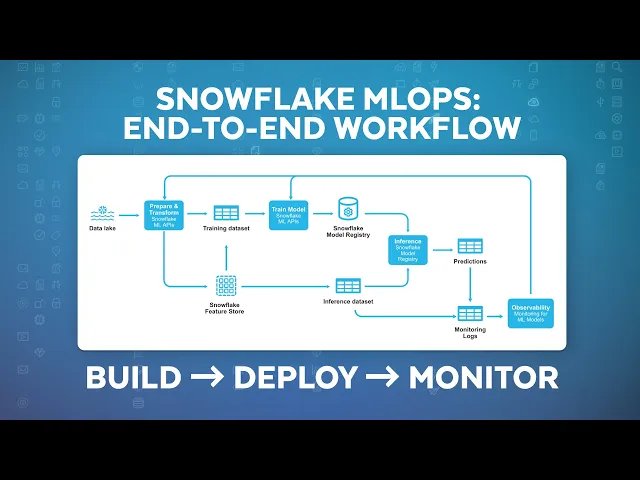
In this video, Sukanya Joshi, AI/ML Solutions Consultant at Snowflake, guides you through an end-to-end MLOps workflow — from model development to deployment:
What a model registry records
Suppose versions 14 and 15 of a forecasting model use the same architecture and live in the same artifact store. Version 15 was trained on a newer feature set and performed better on the agreed validation data, while version 14 remains the model currently serving production traffic.
Those differences are reflected in the records surrounding the artifacts.
- Model identity and version: An immutable version identifier provides an exact reference to a trained model. Version 15, for example, continues to identify the same artifact even after versions 16 and 17 are registered, which gives deployment and investigation workflows a stable object to work with.
- Evaluation evidence: Metrics capture how the version performed under a defined evaluation. The metric alone is only part of the record. Teams also need to know what data, threshold or evaluation procedure produced it.
- Training lineage: Useful lineage connects the model version to the training run and, from there, to the data, features, code and configuration that produced it. A registry may record some of these relationships directly and obtain others through integrations with experiment tracking, data lineage, feature management and source-control systems. When a feature definition changes or a source data issue is discovered, those relationships help identify which models may need review.
- Model signature: The signature describes the input and output interface expected by the model. Depending on the framework and registry, this can include feature names, data types, tensor shapes or output schemas. Deployment and inference systems can use the signature to detect incompatible inputs before they reach the model.
- Aliases, tags and lifecycle state: A version number or name identifies one artifact. An alias can identify the version currently assigned a particular role. A production or champion alias, for example, can move from one version to another as teams promote and replace models. Tags may carry additional context such as ownership, task, environment or review status.
Preserving evaluation results is especially useful when the conditions behind them remain visible. A higher score on version 15 doesn’t necessarily mean it improved on version 14 if the evaluation data, metric definition, decision threshold or preprocessing changed between runs. Keeping that context with each version helps teams determine whether a performance difference reflects the model itself or a change in how it was evaluated.
Together, these records provide both directions of traceability. A team investigating a production prediction can work backward toward the version and its training history, while a deployment process can work forward from an approved model designation toward the exact artifact it needs.
QUICK TIP
Treat evaluation context as part of the model record, not just the score. A metric is difficult to compare later if the evaluation data set, preprocessing, threshold or metric definition has changed.
How models move through a registry
Registration usually starts once a training run has produced a model worth preserving beyond the experiment itself. That model may still require extensive evaluation; entry in the registry simply gives the candidate a stable identity and lifecycle record.
From there, the sequence commonly looks like this:
- Register the candidate: The training workflow records the artifact, version and relevant metadata, usually with a reference back to the experiment or run that produced it.
- Evaluate the version: Teams compare the candidate with an existing baseline or production model using the evaluation protocol defined for the workload. For a classifier, that might include per-class precision and recall alongside overall performance. Other models may require calibration, latency, resource use or domain-specific measures.
- Review and promote the candidate: Next, teams represent the candidate’s lifecycle status using whatever mechanism the platform and release process support — for example, aliases, tags, approval records, environment-specific registries or lifecycle states. A registry may record some of these relationships directly and obtain others through integrations with experiment tracking, data lineage, feature management and source-control systems. Higher-consequence applications may add independent validation or human approval at this point. In integrated workflows, that state change may also provide an input to downstream CI/CD or orchestration.
- Deploy or serve the selected version: Depending on the serving architecture, the selected version may be deployed to a separate inference environment or served directly from the platform.
- Retain a recovery path: Earlier production versions, along with their configurations and dependencies, remain identifiable, allowing the team to restore a known-good release when the serving architecture supports it.
Champion-challenger workflows make this progression explicit. The current production model remains the champion while a challenger is evaluated against the same criteria. If the challenger shows sufficient improvement and satisfies the release requirements, the production designation can move to the newer version.
The comparison needs enough evidence to justify the change. Offline evaluation typically holds the evaluation conditions constant so differences between champion and challenger are interpretable. When comparison happens on live traffic, the amount and distribution of traffic matter as well because an underpowered test can make a small difference look more conclusive than it is.
Aliases provide a practical way to manage the resulting change in production. For example, an application that resolves a `production` alias doesn’t need every downstream reference rewritten when version 18 replaces version 17, for example — the alias moves while the underlying version history remains intact.
That version history also captures the recovery path. If version 18 later shows unexpected behavior, the previous production version and its associated metadata remain identifiable for rollback.

How model registries support governance
A model registry gives governance processes a consistent record of each model version, including its owner, lineage, evaluation results, approvals and current lifecycle status. That record lets reviewers trace a deployed model back to the evidence and dependencies associated with the exact version in use.
Organizations can then build governance requirements around that record. For example, promotion policies might require specific evaluation results or approvals before a version is released, while access controls restrict who’s allowed to change model metadata, aliases or deployment-related settings. Earlier versions and their associated records remain available for audit, investigation and review.
Lineage extends governance upstream as well. By connecting a model version to the data, features and training process that produced it, teams can identify which versions are affected when a source data issue, feature change or other dependency needs review.
For organizations with formal model-risk or AI governance requirements, registry metadata can also contribute to model inventories and documentation by preserving version history, ownership, validation evidence and lineage over time. For example, the EU AI Act requires technical documentation for high-risk AI systems to be kept up to date, and revised 2026 U.S. banking guidance describes maintaining comprehensive information on models under development or in use as common industry practice for model risk management.
The registry provides the model-level record, while the organization’s policies and review processes determine what evidence is required and what actions follow from it.
How to keep a model registry reliable
Model registration itself is relatively straightforward. The harder problems appear as the registry accumulates versions and other systems begin depending on them.
Keep the registry authoritative
Suppose the registry identifies version 12 as the production model, but an application has loaded version 13 directly from object storage. Both systems are operational but the model inventory no longer describes the production environment accurately.
This often occurs when registration is encouraged but optional. Teams follow the registry workflow for normal releases, then use an alternate path during an urgent deployment or one-off experiment. Over time, those exceptions leave the lifecycle record incomplete.
Making the registry authoritative requires integration around it. Production deployment needs to resolve a registered version, and changes to that version need to leave a corresponding record.
Authority also depends on how registry state relates to deployment permissions. When the registry and serving environment sit behind separate permission surfaces, two sets of controls have to remain aligned: who’s allowed to change the production designation and who’s allowed to load or release a model artifact.
COMMON PITFALL
A common mistake is allowing production deployments to bypass the registry. If applications can load an unregistered model or a different version than the registry identifies as production, the registry stops being a reliable record of what is actually running.
Preserve lineage across system boundaries
Training data, feature pipelines, transformation logic and model artifacts often live in different parts of the ML environment. The lineage recorded for a model version has to remain connected across those boundaries as pipelines change, tables are replaced and feature definitions evolve.
This continuity is especially important during impact analysis. If a source table contains incorrect values or a feature definition changes, teams need to trace the affected dependency forward to the model versions trained from it. A lineage record that stops at the training job — or points to data and code references that no longer resolve — limits how far that investigation can go.
A useful test is whether an upstream incident can be answered from the lineage graph itself. If a bad-data window is discovered in a source table and practitioners still have to search pipeline code or ask the model owner which versions consumed it, the lineage doesn’t yet extend far enough.
Reevaluate as conditions change
A model is approved based on the data, evaluation results and operating conditions available at the time. Those conditions will almost certainly change after release: input distributions shift, new products are introduced, customer populations change and upstream features are revised.
If those conditions change enough to affect how the model is expected to perform, the team may need to evaluate it again. Teams should define those triggers in advance. Depending on the workload, they might include a major feature change, a significant drift signal or expansion into a new customer population.
Monitoring helps surface those changes in production, while the registry identifies the version and approval record they relate to. Together, the two give teams a direct path from a drift or performance signal to the model version that needs review.
Keep version history interpretable
Automated training can populate a registry quickly. If every candidate is preserved indefinitely with inconsistent names, tags and ownership, the registry might contain dozens of versions whose operational significance is unclear.
Retention and aliasing conventions help keep that history interpretable. Teams may document all versions required for audit or reproducibility while distinguishing active candidates, prior production versions and experiments that no longer need to remain readily deployable.
Ownership must be addressed as well. Teams need to know whether an older model can be retired, for example, or which evaluation requirements apply before another version takes its place.
LLM applications add another versioning boundary because the model artifact often represents only one part of the deployed configuration. Changes to system instructions, retrieval configuration, tool schemas or evaluation suites may alter application behavior while the underlying model version stays fixed. Reproducing a release depends on version records for those surrounding artifacts as well.
Model registry on Snowflake
Teams can use Snowflake Model Registry to manage ML models and their versions within Snowflake, including models trained through Snowflake ML workflows as well as supported models produced elsewhere.
Teams can log a selected model after training, preserve version-level metadata and use the registered model for downstream inference and lifecycle management. In a broader Snowflake ML workflow, ML Experiments can retain the parameters, metrics and artifacts associated with training runs before a selected candidate is added to Model Registry.
Keeping these records in the same governed environment as the underlying data can simplify the connections discussed earlier. Model objects can participate in Snowflake access controls, while lineage can relate models to the data and other ML assets used to produce them. Teams still define who may promote or deploy a version and what evidence a release requires, but those decisions can operate within the same governance framework used for other Snowflake objects.
Snowflake Feature Store can extend the record upstream by managing reusable feature definitions used during training and inference. Where a model depends on a particular feature view, maintaining that relationship helps practitioners reproduce the training inputs and keep online or batch inference aligned with the definitions used during development.
The registry also provides the model-management stage in a longer workflow. Practitioners can experiment and compare runs, select a candidate, register a version and use that registered model for inference while retaining earlier versions for comparison or recovery.
For teams already training against governed data in Snowflake, this reduces the number of separate systems that need to maintain overlapping records of model identity, data access and lifecycle history.
Keeping the model lifecycle traceable
The model running in production will change over time as new versions are trained, evaluated and released. The history behind those changes needs to remain traceable: which version was used, how it was evaluated, what data and features produced it and why it replaced the version before it.
As model release cycles accumulate, that history supports comparison, investigation, governance and recovery. A model registry gives teams a consistent record for each version, but its usefulness depends on whether lineage stays connected, lifecycle information remains current and the surrounding workflows continue to reference the same versions.
KEY TAKEAWAY
A model registry gives trained model versions a persistent operational record. Its value depends on how well that record connects evaluation, lineage, promotion, deployment and monitoring across the model lifecycle.
Frequently Asked Questions
Your common questions about model registries, answered by Snowflake experts.
What is the difference between a model registry and a model catalog?
A model registry manages versions of models through operational lifecycle stages such as evaluation, promotion and deployment. A model catalog focuses on discovery and inventory, helping users find available models and understand information such as ownership, purpose or governance metadata. Some platforms combine both sets of capabilities.
Is a model registry the same as an experiment tracker?
No. An experiment tracker records the large number of runs produced during development, including parameters, metrics and artifacts used to compare experiments. A registry generally manages the smaller set of model versions selected for continued evaluation or operational use. The two systems are often connected so a registered version retains a link to the experiment that produced it.
Does a model registry enforce which models can go to production?
That depends on the surrounding architecture. A registry can record lifecycle or approval state, but deployment systems, access controls or release pipelines must use that state if the organization wants it enforced. Integration between those systems determines whether an unapproved model can bypass the expected release path.
Does every ML team need a model registry?
A small team managing a few models may be able to maintain sufficient history through source control, an artifact repository and consistent release practices. A registry becomes more useful as model versions, contributors and deployment environments multiply or when teams need stronger lineage, approval, reproducibility and auditability across the lifecycle.
Explore AI Resources
Explore AI Topics
Deep dives into every aspect of artificial intelligence
