

Foundational Guide
AI in Business Today: How Companies Turn AI Projects into Production Results
AI has no shortage of business use cases, but many initiatives fall short once they move beyond the pilot stage. The difference between experimentation and real business value comes down to the system around the model: trusted data, governed workflows, human oversight and feedback loops that improve over time.
AI IN BUSINESS DEFINED
Artificial intelligence in business is the use of AI systems to analyze data, interpret information, generate content and take actions across business workflows. It's most useful in processes where the work depends on recognizing patterns, understanding context, predicting outcomes or synthesizing information at a scale or speed that would be difficult to manage manually.
Businesses have no shortage of AI ambition. But turning that ambition into production value has proven harder than many expected. MIT’s 2025 State of AI in Business report found that despite $30–40 billion in enterprise generative AI investment, 95% of organizations were seeing no measurable return. The report’s diagnosis was not that the models were incapable: “Most fail due to brittle workflows, lack of contextual learning, and misalignment with day-to-day operations.”
That gap is the starting point for understanding AI in business today. AI can support a wide range of work, from analytics and automation to document intelligence, forecasting, decision support and agentic workflows. What determines whether those efforts produce value is not the use case alone, but how well each one is matched to the business problem, connected to trusted data, governed appropriately and measured against outcomes the organization actually cares about.
What is AI in business?
The use of AI in business spans several approaches. Machine learning trains models on historical data to classify, score, rank or forecast — it underlies most predictive use cases, from churn risk to anomaly detection. In business workflows, generative AI often uses large language models (LLMs) to retrieve, understand, summarize and draft information, making it well suited to problems where the input or output is unstructured. Predictive analytics surfaces forward-looking signals from historical and operational data when an organization needs to act before an outcome is fully visible.
The capabilities AI brings to business problems have expanded faster than most organizations have been able to absorb them. So has the technology itself. The most significant recent development is the emergence of agentic AI: systems that can plan and take sequences of actions through approved tools and within defined permissions — querying data, retrieving documents, calling external systems, drafting responses.
What stays constant across all of these approaches is the dependency on the system around the model. The data pipelines, access controls, semantic layer, evaluation process, deployment path and workflow integrations around the model — these are what determine whether an AI initiative delivers in production. They are also what most implementations underinvest in.
Benefits of using AI in business
AI enables greater efficiency, reduced costs and faster insights, but the real benefit is that humans are freed from repetitive, tedious tasks so they can apply judgement to decisions that shape the business.
When AI is implemented well — with the right data, a process built to act on what the model produces and a feedback loop that improves it over time — it also changes the economics of work that previously didn’t scale. A few examples:
- Fraud review that required a team of analysts to manually investigate alerts can run continuously across every transaction.
- Demand forecasting that took a planning team weeks to produce can update automatically as new signals arrive.
- Customer interactions that depended on manually researching account history, searching for relevant policies and drafting a response can be prepared in seconds for human review.

How businesses use artificial intelligence
AI shows up in business in several distinct ways. The sections below cover six of the most common, though most real-world systems combine more than one.
Business intelligence
Traditional business intelligence was built around reports and dashboards — useful for tracking known metrics, but slow to answer questions that weren’t anticipated when the dashboard was built. Every follow-up question that falls outside the existing views requires an analyst, a query and a wait.
Governed natural-language analytics changes that dynamic: business users ask questions in ordinary language and get answers derived from approved metrics and business definitions, without filing a request or waiting for a custom report. The people closest to a decision can investigate it directly, which changes both the speed and the quality of the analysis that informs it.
AI automation
Most business workflows contain a step where the next action depends on interpreting the content of a request rather than following a fixed rule. For example, a procurement request requires reading contract language to determine whether a vendor qualifies. A customer inquiry requires understanding account history to determine what response is appropriate.
These steps slow processes down not because they’re difficult but because assembling the right context takes time. AI automation addresses this by doing the assembly work that precedes judgment: identifying what information is needed, retrieving it from structured and unstructured sources, applying business logic and preparing a recommendation for review. The human step remains, but it arrives with the context already assembled.
Natural language processing and document intelligence
A significant portion of business knowledge lives in unstructured form, such as contracts, policies, support transcripts, research reports and regulatory filings. LLMs, often paired with semantic search or retrieval systems, make that content accessible in ways that keyword search can’t: summarizing long documents, extracting specific clauses, comparing versions, answering questions against a corpus of internal knowledge.
For organizations managing large volumes of documents — in legal, compliance, finance or customer support — work that previously required skilled humans to read and synthesize at length can be prepared for review in a fraction of the time. The quality of the output depends on the quality and currency of the underlying sources, and on whether the system is connected to content that’s maintained and governed rather than left to accumulate and drift.
Predictive analytics and decision support
Predictive analytics is most valuable when an organization needs to act before an outcome is fully visible. ML models trained on historical data can estimate churn risk before a customer leaves, flag transactions that resemble fraud before a loss is confirmed, forecast demand before inventory decisions have to be made. The model’s output — a score, a ranking, a probability — changes what a decision-maker knows at the moment they need to act.
What determines whether that signal is useful is the quality of the data behind it, the accuracy of the model trained on it and whether the workflow around it is built to act on what it produces.
Agentic AI
Agentic AI systems take sequences of actions — such as querying databases, retrieving documents, calling external systems, executing tasks — in pursuit of a defined goal. A procurement agent doesn’t flag a request for a buyer to investigate. It pulls the relevant contract language, checks spend history against policy, confirms vendor approval status and surfaces a recommendation with the evidence already assembled.
That autonomy changes the governance requirements significantly. The boundaries of what an agent can access and act on without human approval are not optional design considerations — they determine whether the system is safe to deploy in a consequential business process.
QUICK TIP
Start with the workflow, not the model. Define the decision, process or outcome the AI system is meant to improve, then work backward to the data, governance, integrations and review steps required to support it.
AI in the enterprise
Most organizations began their AI programs the same way: a handful of projects, each owned by a different team, each making its own decisions about data access, model selection and what good output looks like. That approach produces results — individual workflows improve, teams become more productive — but it doesn’t scale.
Teams discover they can’t access data that another team already uses. Features get built twice because nobody knew the first versions existed. Models reach production without clear answers to basic questions: which version is running, what trained it, who approved it and who is accountable if the output is wrong.
The organizations moving past that wall have stopped treating enterprise AI as a collection of projects and started treating it as an operating model. That means shared data infrastructure with consistent access controls, semantic definitions that give AI systems accurate business context, agent frameworks with defined boundaries for what can be retrieved and acted on without human approval, and evaluation practices that measure output quality after deployment, not just before it. Governance, in a mature enterprise AI program, is not a gate before launch. It is part of how the system runs.
The next stage of enterprise AI is defined by how effectively organizations can embed AI into the workflows where business decisions happen — connected to trusted data, operating within clear boundaries and producing outputs that teams can act on and account for.
AI for small business
Small businesses are not a scaled-down version of enterprises. They face a different set of constraints: fewer technical resources, less formal data infrastructure, less runway for extended implementation cycles. They also have a set of advantages that enterprise organizations often lack.
The most significant advantage is proximity. The person overseeing a small business AI project is usually close enough to the underlying process to evaluate the output directly. For example, a small retailer testing inventory forecasting knows within a season whether the model is reducing overstock or creating new problems. That direct feedback loop cuts through the ambiguity that makes enterprise AI evaluation slow and political.
Proximity also shortens the decision cycle. When an AI project is not performing, a small business can adjust or stop without a large governance committee, a vendor negotiation or a multi-team alignment process. That speed is an asset — if the project was scoped narrowly enough and with sufficient guardrails.
Scope discipline is where small business AI projects tend to succeed or fail. The organizations that get value start with one workflow, confirm the data is available and define what improvement looks like before implementation. The ones that struggle try to solve too much at once, discover the data is not ready and have no clear way to measure whether anything changed.
Guardrails are crucial but often overlooked. Small businesses tend to underinvest in defining what the AI system is permitted to do, which data it can access and who reviews its outputs before they reach a customer or inform a decision. Those boundaries are necessary at any scale.
A model producing inaccurate inventory recommendations, a customer-facing assistant drawing on outdated pricing or an automation acting on data it shouldn’t have accessed can create problems that are harder to unwind than they would have been to prevent. Establishing clear ownership, governed data sources and a review process for consequential outputs prevent unnecessary risk.
AI business strategy
Early AI demand almost always exceeds an organization’s capacity to implement, govern and measure it well. The projects that move forward without rigorous evaluation or planning tend to consume resources without producing the outcomes desired — and often create problems instead. A strong strategy starts with a filter for what deserves investment now, what needs better data or governance first, and what shouldn’t move forward at all.
A useful evaluation framework considers four dimensions:
- Business value: Which specific decision, process or cost structure would change if this project worked — and is that change material enough to justify the investment?
- Feasibility: Are the required data, skills and integrations available today, or does the project depend on a future state that hasn’t been built?
- Risk: How does the AI touch regulated data, customer communications or financial outcomes, and what review is required before it goes into production?
- Reuse potential: Does the project produce shared infrastructure — semantic definitions, retrieval services, governance patterns — that reduces the cost and complexity of the next project?
Measurement should be defined before implementation. A support assistant, for example, might be measured by resolution time, escalation rate and agent adoption, while a forecasting workflow might be measured by forecast accuracy, planning cycle time and whether the forecast actually changed the decisions it was designed to inform. Defining the metric in advance forces the scoping conversation that separates useful AI projects from expensive ones.
COMMON PITFALL
Teams shouldn’t treat AI as a standalone tool but rather as part of an operating process. Even a strong model can fail to create value if its inputs are incomplete, its outputs don’t reach the right workflow or no one is responsible for reviewing and improving performance over time.
How and when to establish an AI council
Most organizations reach a point where AI adoption is happening faster than the guidance around it. Employees are experimenting with tools, teams are building workflows and integrating AI into business systems. But questions about what’s permitted, what’s safe and what constitutes a good use case are getting answered inconsistently — or not at all. An AI council exists to close that gap.
The AI council’s primary function is enablement: helping employees understand which tools are available, what responsible use looks like in their specific context and where to go when they have questions. In practice that means live demos, office hours, hackathons, role-based training, prompt libraries and use case showcases.
Multiple formats are necessary because employees come to AI adoption from different starting points. Some need inspiration. Others need hands-on support. Peer examples are especially effective: when employees see colleagues using AI successfully in work that resembles their own, they can more clearly envision how it can help them.
The council’s operating artifacts should be concrete enough to be useful at the point of decision: approved tool lists, data handling guidelines, use case intake criteria, required review steps for high-risk outputs and documented examples of what good AI use looks like in practice.
AI business use cases and software applications
AI creates business value through specific use cases — demand forecasting, fraud detection, customer churn prevention, contract review, inventory planning, sales and marketing — each tied to a process that would change and an outcome that can be measured. Understanding which use cases are realistic, which require data that doesn’t yet exist, and which would produce the most material change is where AI planning tends to do its most important work.
Applications are the software layer that makes use cases operational: recommendation engines, anomaly detectors, document assistants, natural-language analytics interfaces, conversational AI. The right application depends on what the use case requires — the data available, the decision being supported and the workflow it needs to fit into.
Why build AI on Snowflake?
The model is one component. Whether it produces value in production depends on everything around it: the data it was trained on, the features it relies on, the governance controlling what it can access, the monitoring that detects when context changes and the workflow that acts on its outputs.
Snowflake brings those pieces into a governed environment where data, permissions, model artifacts, retrieval services and application logic can operate with consistent access controls.
Key capabilities:
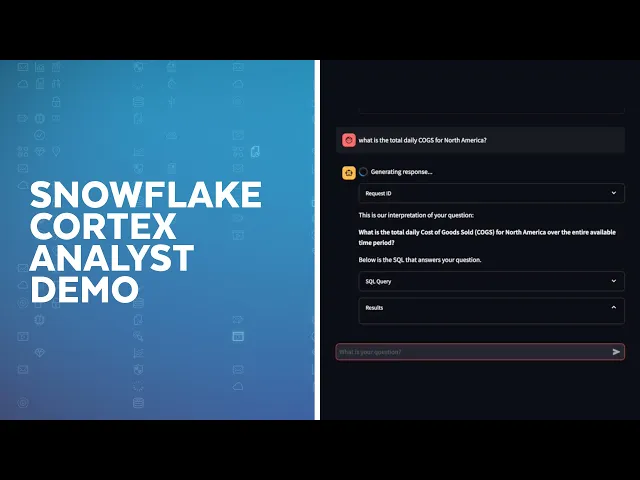
- Cortex Analyst: Governed text-to-SQL over semantic views, so natural-language questions return answers based on approved business definitions rather than raw column logic.
- Cortex Search: Retrieves relevant context from unstructured data for RAG pipelines and agentic workflows, keeping retrieval connected to governed content sources.
- Cortex Agents: Combine structured and unstructured inputs in agentic workflows, generating SQL and retrieving document context in a single governed process rather than across separate tools.
- Cortex AISQL: Brings AI functions directly into SQL workflows, so teams can apply machine learning to data without moving it out of the governed environment.
- Snowflake Intelligence: Conversational interface for working with enterprise data and business logic, without exporting data into tools where access controls and lineage do not follow.
- Snowflake Model Registry: Manages models with versioning, metadata and deployment status, so teams can answer the questions that matter in production: which model is running, what trained it and what has changed since the last version.
A self-serve analytics experience, an automation workflow, a predictive model and a customer-facing assistant may appear to be separate initiatives, but they’re built on many of the same underlying assets: trusted data, semantic definitions, retrieval paths, access controls, lineage and monitoring. When those assets are shared, each new project starts with more of the operating model already in place — and the distance between a working prototype and a production system gets shorter.
The path to reliable AI in business
Getting AI right in a business context requires solving two problems simultaneously. The technology has to be matched to the problem — the right approach, trained on accurate data, producing outputs that are precise enough to act on. And the system around it has to be built to support it.
Most AI initiatives that fall short have underinvested in one side or the other. The ones that compound, where each new project builds on what the last one established, treat both as equal requirements from the start.
KEY TAKEAWAY
The organizations that see durable results from AI initiatives connect their AI systems to trusted data, governed processes, clear ownership and measurable outcomes from the start.
Frequently Asked Questions
Your common questions about AI in business, answered by Snowflake experts.
What types of AI are most commonly used in business?
The most common types include machine learning, generative AI, predictive analytics, conversational AI, business intelligence and automation. Many workflows combine several of these approaches, such as a support assistant that retrieves documents, summarizes a customer issue and recommends the next action.
How long does it take to implement AI in a business?
Implementation time depends on the workflow, data readiness, governance requirements and integration work. A narrow analytics or automation project usually moves faster than an enterprise AI application that touches sensitive data, multiple systems, formal review and ongoing monitoring.
Can small businesses afford AI?
Small businesses can often start with focused AI workflows, such as customer-service automation, inventory forecasting, marketing personalization or document summarization. The key is to choose a narrow business outcome, confirm that the required data is available and measure whether the workflow improves before expanding.
What's the difference between AI automation and traditional business automation?
Traditional business automation follows predefined rules, such as routing a form, updating a record or moving data between systems. AI automation uses models, search and business logic to interpret information, generate outputs or support decisions when the next step depends on the content of the request.
Explore AI Resources
Explore AI Topics
Deep dives into every aspect of artificial intelligence
