
3 novembre 2026/Lettura: 9 minAnalytics
Real-Time Analytics on Snowflake: Stream It In, Keep It Fresh, Serve It Fast
Every customer interaction is a chance to either earn trust or lose attention. To stay competitive, businesses need to act before that interaction ends. A financial services team needs the latest market data to discuss portfolio adjustments with their clients. A network operations team needs to know the moment when a network starts to degrade to help affected customers during a live support conversation. A retailer needs to personalize an experience while a customer is still shopping and optimize inventory levels based on real-time demand. And an AI agent needs trusted, current and accurate context to recommend the next best action, resolve an issue or support a decision.
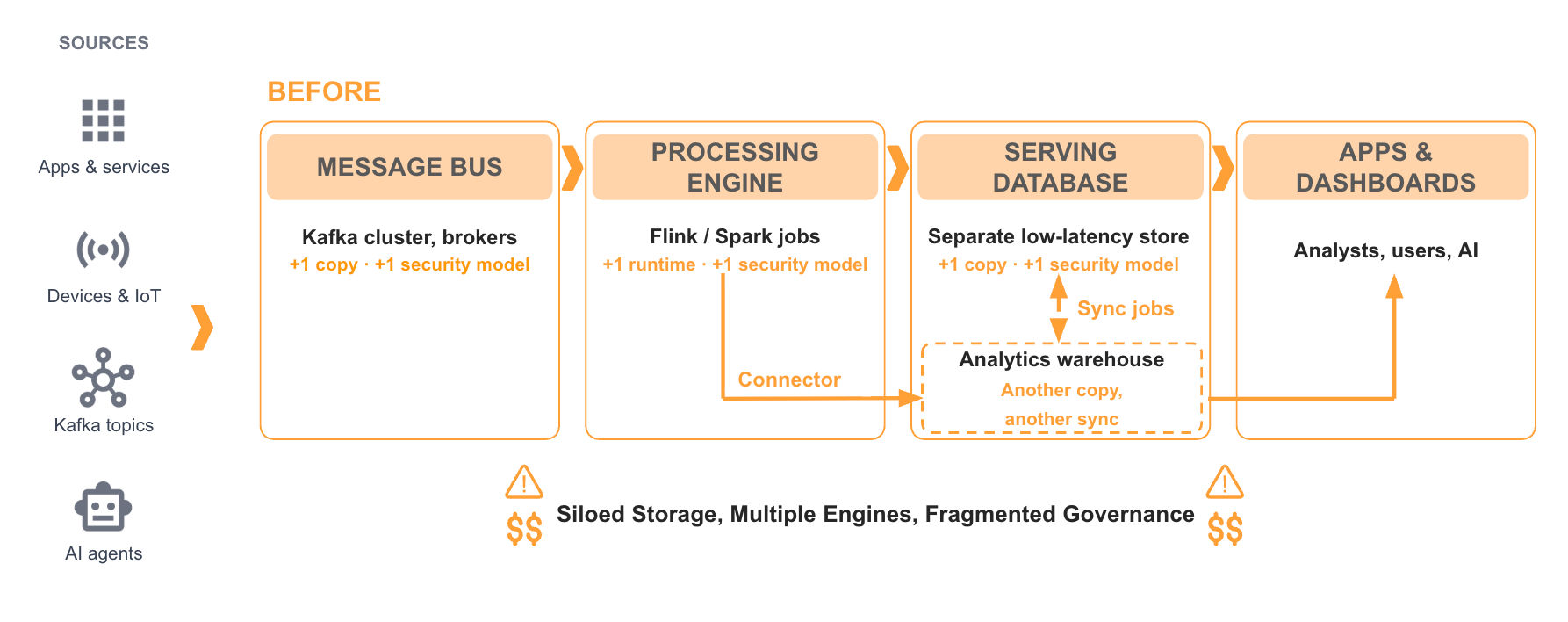
In each case, the value of data depends on how fast teams can move from seeing what is happening to acting on it. When a team can identify an issue early, understand its impact and act in the moment, it increases revenue, improves customer experience and makes better decisions. This urgency and speed to insight is what can separate your business from your competitors. Yet building a real-time stack has often meant stitching together separate systems for ingestion, transformation and serving by hand: connecting producers to a message broker, standing up separate transformation jobs and landing results in yet another database. Each layer brings more infrastructure to run, more specialized experts to hire, more pipelines that can break, more costs to manage and another set of security rules to maintain.
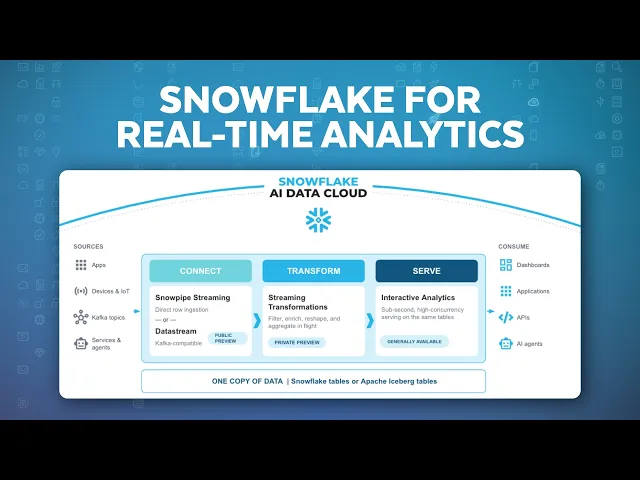
As such, Snowflake is introducing a connected experience that makes real-time analytics simpler to build, cost effective to scale and governed at every step. It brings connectivity, transformation and serving together across Snowflake native tables and Apache Iceberg™ tables so teams can turn fresh data into decisions without managing a fragmented stack or giving up the freedom to choose their engines and tools.
Introducing Snowflake for real-time analytics
Real-time analytics is the ability to turn live data into trusted insight and action within seconds. Real-time analytics processes and analyzes data as events happen, giving people and systems the current view of what’s happening, and the right latency depends on the workload.
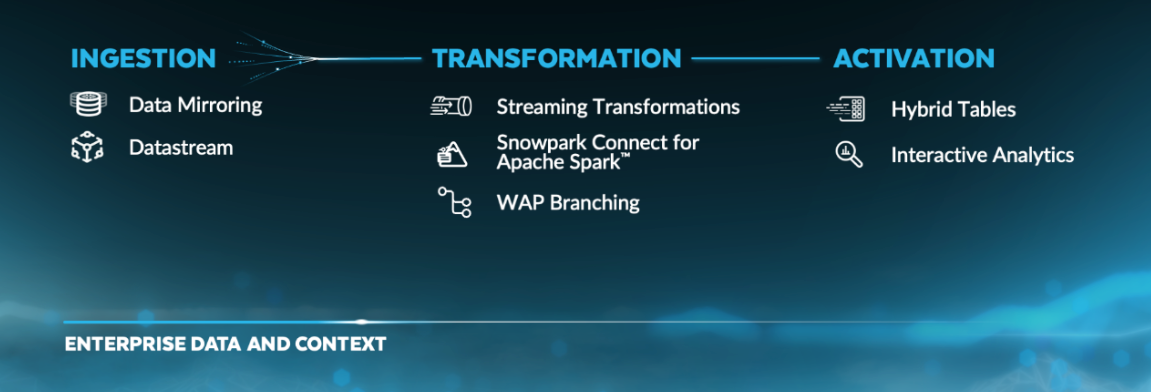
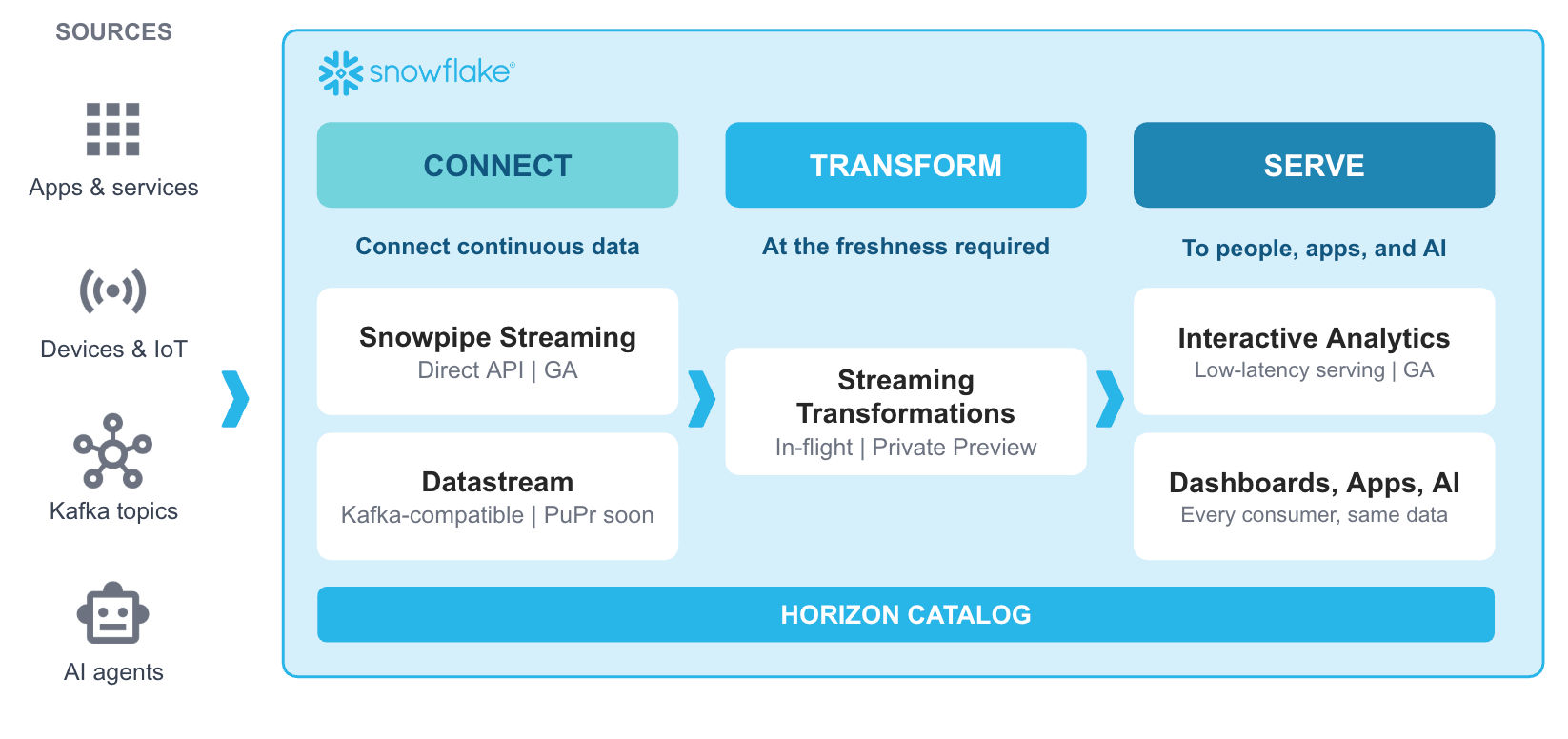
Snowflake now brings connectivity, transformation and serving together for end-to-end analytics in real time. This blog post focuses on those capabilities: how to connect data, transform it in-flight and serve it fast. Snowflake is designed to meet the following needs without forcing teams to rebuild their architecture for each one.
- Simplicity at scale: Build real-time pipelines without becoming an expert in every system behind them. Snowflake manages the infrastructure, scaling and pipeline across connectivity, transformation and serving. Snowflake CoCo skills turn pipeline setup into a guided conversation. Describe what you need, and CoCo configures, builds and implements logic.
- Fast performance at lower total cost: Deliver fresh insights without paying for an entirely separate real-time stack. Your team can remove the need for separate serving databases or duplicated storage, along with the engineering effort needed to operate, monitor and troubleshoot them. In our internal testing, we’ve seen a P50 of three seconds of end-to-end latency[1] with Snowpipe Streaming, streaming transformations, alongside Snowflake Interactive Analytics.
- Governance at every step: Discover, secure and build with data and AI assets in an integrated environment. Horizon Catalog brings access controls, lineage, data quality and business context together across Snowflake. Build trust throughout your organization with data quality monitoring and data classification for data and AI assets.
Connect real-time data without adding infrastructure
Real-time analytics starts with getting data in quickly and simply. Snowpipe Streaming brings data from applications, devices and services directly into Snowflake native or Iceberg tables. Teams have the flexibility to choose the table format that fits their architecture. Native tables provide a simple and fully managed path for operational analytics and applications. Iceberg tables keep data in an open format that other tools can access. Data is queryable in seconds, with throughput of up to 20 GB/s per table at a flat ingestion-based pricing model.
Ingestion is often the line item that determines whether a real-time project ships. When costs climb with every new source, teams keep less data live than they want to. Snowpipe Streaming is 5x cheaper[2] than Zerobus and 80% cheaper than ClickPipes[3] for comparable workloads. You pay a flat rate based on the data you ingest so your costs stay predictable as you add sources.
For financial services teams, every second counts. Making trading activity, transaction records and operational events available for analysis within seconds helps teams act on current information. Cboe Global Markets demonstrates the scale of this approach, using Snowpipe Streaming to land 190 billion rows a day in under 30 seconds, then serves that data directly to analysts through interactive warehouses.
As event volume grows, teams should not have to spend more time managing the mechanics of ingestion. With Snowpipe Streaming’s Elastic Channels (generally available), hundreds of producers, including apps and Internet of Things devices, can write through a single elastic channel into one destination. You can connect more sources without creating or managing additional channels. Snowflake automatically scales the ingest path as volume rises. Delivery is ordered exactly once, so teams spend their time on analysis instead of on writing deduplication logic downstream. In our internal testing, we pushed throughput further, reaching 41 GB/s into a single table.
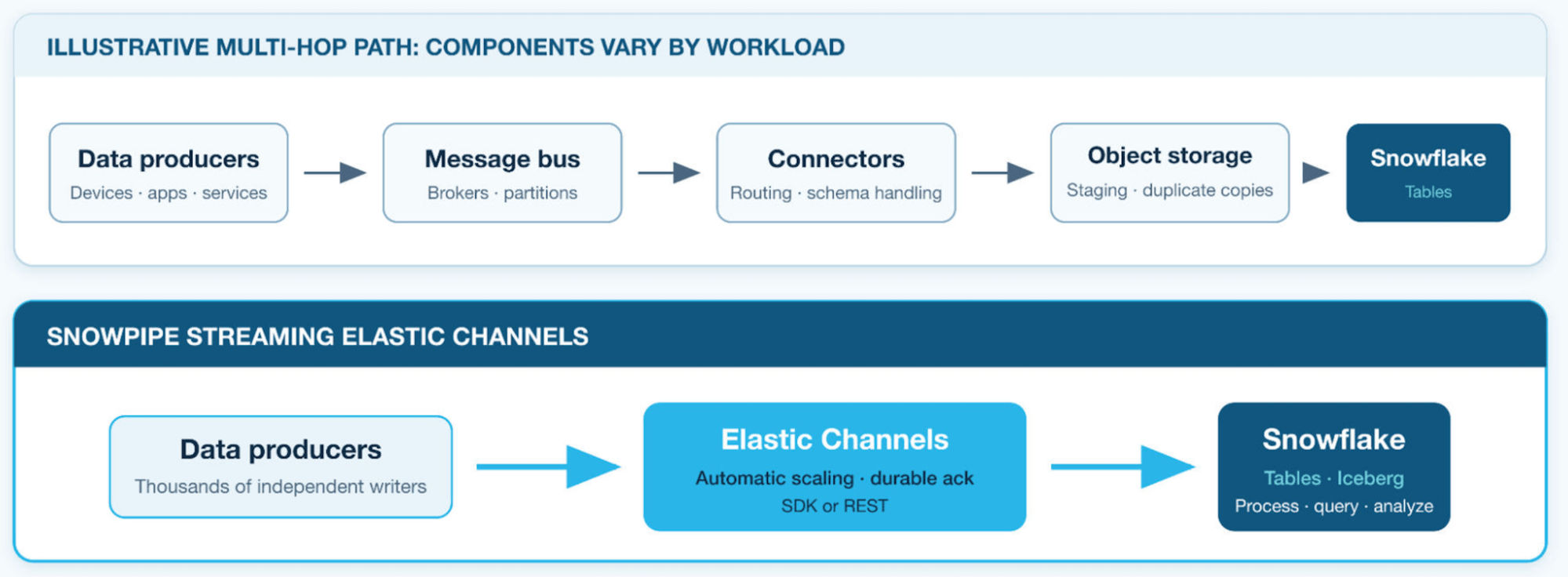
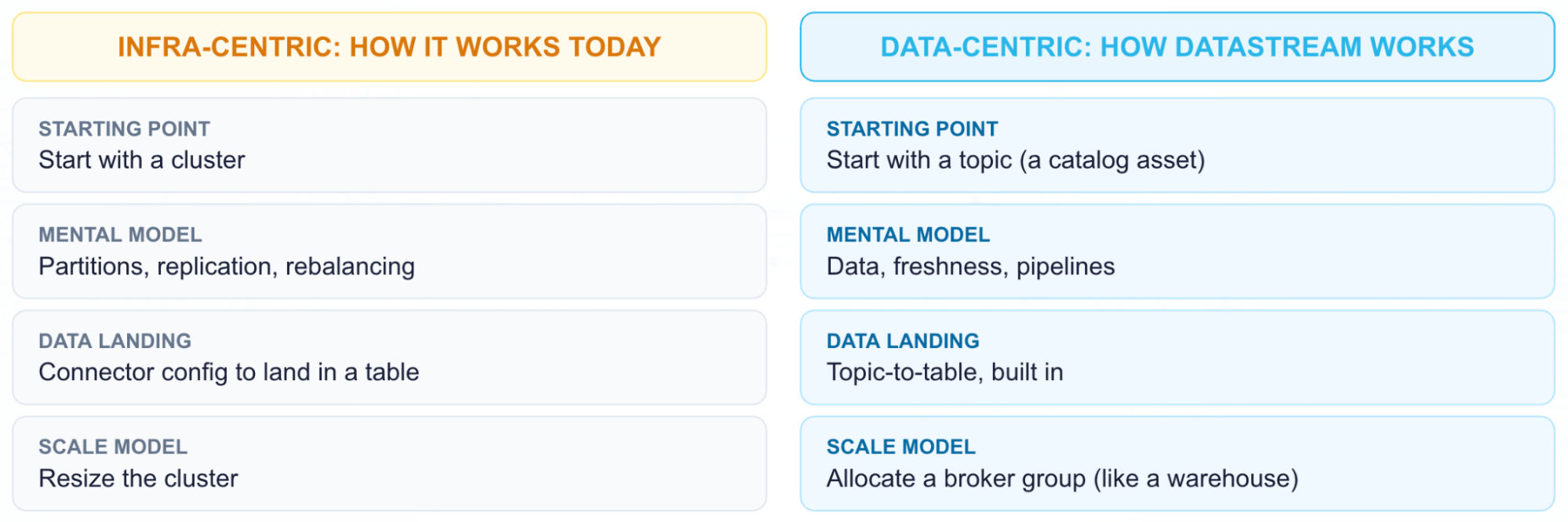
Many teams have Apache Kafka® producers and consumers in place, but the streaming infrastructure is often designed for infrastructure engineers. Datastream (public preview soon; currently in private preview) takes a data-centric approach. It is a Snowflake native, Kafka-compatible service that lets data teams use their existing Kafka producers and consumers with a managed endpoint without operating brokers or maintaining a separate connector layer to move data into tables. Data-centric streaming reorients teams around governed data assets, so they manage topics, freshness and pipelines rather than partitions, replication and cluster capacity. Customers such as Minted and Zywave are using this approach to reduce separate Kafka and Snowflake authentication, roles and monitoring.
Transform data with the freshness your business needs
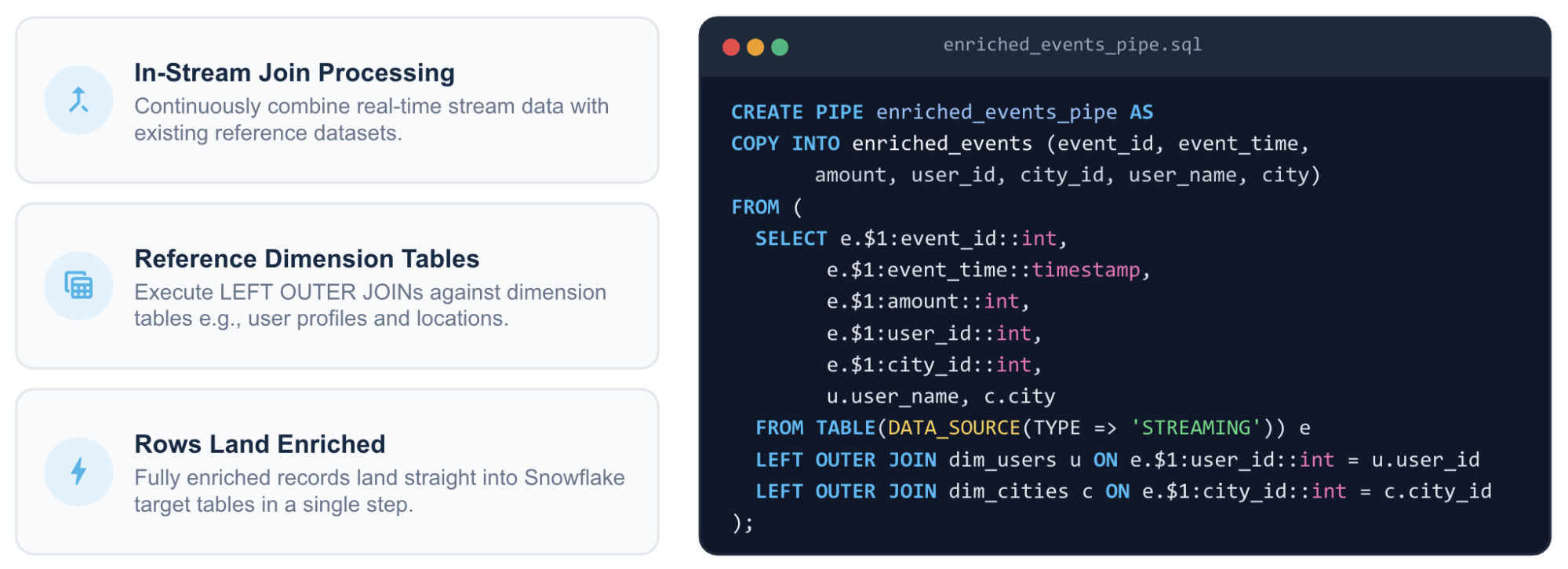
Fresh data only matters once it takes the shape the business needs. Streaming transformations (private preview) makes incoming data usable for analytics in real time by filtering, enriching, reshaping and aggregating it during ingestion with Snowpipe Streaming. Teams define the logic once, in a SQL pipe definition, and records are transformed before they land in a table.
Teams can filter out irrelevant events, enrich incoming records with reference data, apply custom logic and expand nested arrays into individual rows. Bringing transformation into the ingestion path simplifies the streaming stack and ultimately makes data useful sooner, as several Snowflake customers are already seeing. One industrial equipment manufacturer is standardizing customer and asset identifiers so its analytics workflows receive consistently named records, while a cybersecurity firm is using streaming transformations to process security events in real time to reduce processing costs and latency for monitoring and reporting.
For other supported workloads, streaming transformations can help remove the need for an external stream processing layer or for building, scheduling and maintaining downstream transformations after data lands. This means less infrastructure to operate and a shorter path from raw events to actionable insights. Streaming transformations support standard Snowflake tables, interactive and Snowflake-managed Iceberg tables. Current ingest-to-serve freshness targets are less than three seconds for interactive and less than 10 seconds for standard and Iceberg sinks.
Serve subsecond answers at high concurrency with Interactive Analytics
The last mile is where many real-time projects fall apart. Dashboards, customer-facing apps and AI agents all hit the same data at once, and teams often reach for a separate serving database to keep up. Interactive Analytics serves those workloads directly in Snowflake.
Interactive warehouses delivered subsecond queries with 9x higher concurrency and 3x lower latency than standard warehouses in internal tests. With Zero-Copy Interactive (generally available), they run directly on existing standard, dynamic and Iceberg tables. You don’t need specialized copy for low-latency serving. For streaming ingestion, we support up to 41 GB/s per table and data is queryable within seconds.
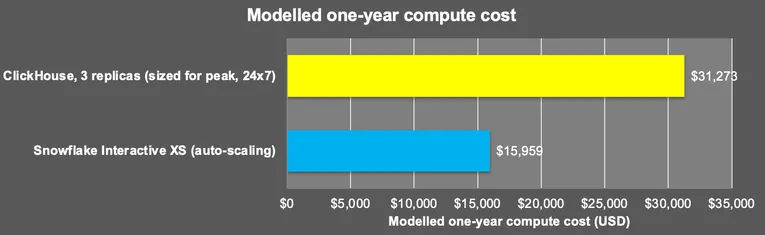
In two benchmark tests conducted by McKnight Consulting Group, at comparable hourly compute cost, Snowflake completed 100% of queries at every concurrency level tested, up to 32 concurrent users. It also delivered more than 5x the throughput of a leading real-time analytics database on dashboard queries, while the competitor failed 73% of high-cardinality aggregations. In a third test simulating a sudden 5x traffic spike, Snowflake scaled out automatically and kept 99.997% of queries within SLA, with p99 latency 40% lower than the competitor sized for peak. To match Snowflake's results, the competitor would have to run peak-sized capacity around the clock, at nearly 2x the annual cost ($31,273 vs. $15,959).
Since serving happens on the same governed data your business uses, there is no sync job to maintain and no second copy to secure. Teams store data once and serve it from that copy, so cost stays predictable as volume and concurrency grow.
In one example, rather than standing up a separate threat-detection platform, Canva brought detection to its data. Interactive Analytics runs thousands of detection queries a minute against live audit logs and the trusted reference data Canva already keeps in Snowflake, with no second copy to maintain. In a production-grade evaluation, the interactive warehouse carried over 10x the concurrent load of an equivalent standard warehouse at a significantly lower modeled cost.

We didn’t want to build and staff another platform. Our best data about our product and our community already lived in Snowflake, so we brought detection to the data, and alert fidelity followed.
Calvin Wang
Staff Analytics Engineer, Security Group, Canva
Start today
Businesses need a simpler way to turn fresh data into decisions. Snowflake provides a connected environment for real-time analytics that is simple to operate, fast to serve, cost effective to scale, open across native and Iceberg tables, and governed from the first event to the final decision. And Snowflake CoCo makes every step easier to build. Just describe what you need in natural language, and CoCo can help you set up connectivity, build transformations, and configure Interactive Analytics.
See how the pieces fit together in our on-demand webinar “Real-Time Data: The Foundation of Agentic AI,” where we share best practices and a reference architecture for building real-time analytics that supports dashboards, applications and AI agents.
- The median (P50) data-readiness latency of 3 seconds was measured in Snowflake internal testing conducted on October 20, 2026, covering the full path through Snowpipe Streaming, streaming transformations and Interactive Analytics. ↩
- Cost comparison based on Snowpipe Streaming at 0.0037 credits/GB × $2.35/credit (Snowflake average credit price), equaling approximately $0.0087/GB. Compared to Databricks Zerobus list price of $0.05/GB, this yields ~5.75x, rounded to ~5x on average. ↩
- Compared with ClickPipes’ published streaming ingestion price of $0.04/GB, this yields approximately 78% lower cost, rounded to 80%. ClickPipes also charges separately for compute; those charges are excluded from this comparison. ↩