


Foundational Guide
Databases Explained: How They Work, Where They Differ and What’s Changing
Different database architectures support different workloads, but modern platforms are changing which operations need separate systems. Explore how databases work, where specialized engines fit and what AI applications add to the equation.
DATABASES DEFINED
A database is an electronically stored collection of information organized for retrieval and modification. Database management software controls operations on that information, allowing applications to query records, enforce data rules and coordinate updates.
Databases have traditionally been designed around particular workloads. An application that processes thousands of small transactions needs different storage and query characteristics than a system analyzing billions of historical records. As those requirements diverged, organizations adopted separate database technologies, each optimized for a particular kind of work.
That separation made architectural sense, but it also created dependencies between systems. Transactional records had to be copied into analytical databases, search indexes had to be updated as source data changed, and applications increasingly needed information distributed across several environments. Each additional system introduced integration work, data synchronization requirements and another place to manage access.
Modern database architectures are changing those trade-offs. Relational databases now support semi-structured data and vector operations, open table formats allow multiple processing engines to work with shared data, and platforms increasingly support transactional, analytical and AI workloads together. Understanding how databases work helps explain both why specialized engines developed and when a workload still benefits from one.
What is a database?
A database is an organized collection of electronically stored data that applications and users can retrieve, update and manage. Databases can contain structured information, such as records organized into tables, as well as semi-structured data, including JSON documents.
A database management system (DBMS) is the software that manages the stored data. It processes queries, coordinates concurrent operations, enforces data integrity rules and controls access. Together, the database and DBMS form a database system, although the term database is often used to refer to the entire system.
For example, an inventory database stores information about products, stock levels and transactions. When a customer purchases an item, the DBMS retrieves the relevant records, updates the inventory quantity and coordinates simultaneous purchases to prevent conflicting changes. It also helps ensure that committed changes survive a system failure.
Understanding where data storage ends and management software begins is essential when comparing databases with other forms of cloud data storage. Files in cloud object storage, for example, can contain the same inventory information, but storing those files doesn’t inherently provide query processing, transaction management or concurrency control. Those capabilities require additional software, which may include a DBMS or other data management components.
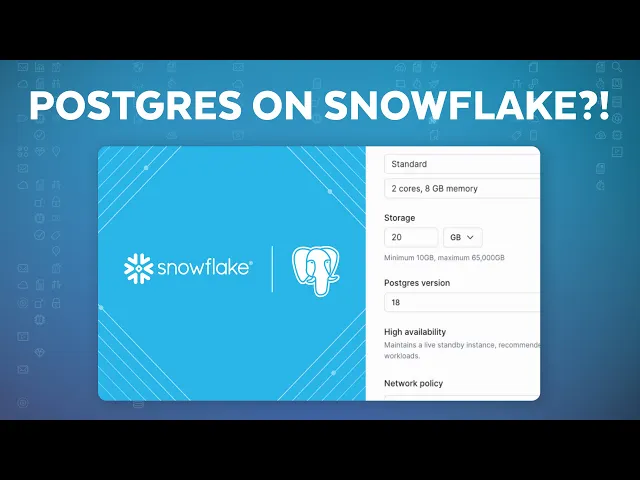
See how Snowflake Postgres supports familiar PostgreSQL development workflows while connecting operational database workloads with the Snowflake platform:
How does a database work?
When an application requests information from a database, the DBMS must determine what data is needed, locate it in storage and return the result. The way it performs these operations depends on the database model and query engine, but relational databases provide a useful example of the underlying process.
Suppose an application requests the details of a customer order using SQL. The DBMS parses the statement, checks that the requested objects and operations are valid, and develops an execution plan. The query optimizer evaluates possible ways to retrieve the data, considering factors such as available indexes, table statistics and the cost of different operations. The execution engine then carries out the selected plan and returns the requested records.
Several database mechanisms work together to support these operations. Although their implementations differ across database types, they address common requirements for organizing, retrieving and updating information reliably.
- Schemas define how data is organized and what rules it must follow. In relational databases, a schema specifies tables, columns, data types and relationships, along with constraints that help maintain data integrity. For example, a column’s data type restricts the values it can contain, a primary key uniquely identifies each record, and a foreign key can prevent an order from referencing a customer that doesn’t exist.
- Indexes and storage organization determine how efficiently the engine locates data. An index provides a targeted way to retrieve matching records without scanning an entire table, although maintaining indexes introduces additional storage and write overhead. Analytical systems may also use columnar storage, partition pruning and metadata-based filtering to reduce the amount of data processed.
- Transactions group related operations into a unit of work, helping preserve data integrity when an operation fails. For example, transferring funds between accounts requires the withdrawal and deposit to succeed together. Many database systems support ACID transactions — atomicity, consistency, isolation and durability — although the scope of those guarantees and the operations they cover vary by engine.
- Concurrency control coordinates operations when multiple applications access or modify the same data. Depending on the engine and isolation level, mechanisms such as locks and multiversion concurrency control prevent conflicting changes while allowing operations to proceed in parallel.
- Partitioning and replication help databases handle growing data volumes and availability requirements. Partitioning divides data into manageable portions, potentially reducing the amount a query must examine, while replication maintains additional copies to support availability or distribute read activity. Both introduce design considerations involving data distribution, coordination and consistency.
Traditionally, database administrators managed much of this infrastructure directly, including storage provisioning, tuning, backups and recovery. Managed cloud database services automate many of those responsibilities, allowing database teams to spend more time on schema design, application requirements and performance analysis.
For more detail, see Data Modeling, Transactional Databases and SQL Query Optimization.

Types of databases: relational, NoSQL, graph and vector
Different database models developed in response to different requirements for organizing and accessing information. A system designed to retrieve records through well-defined relationships has different optimization opportunities than one built to traverse large networks of connected entities or find records with similar vector representations.
Those differences continue to influence database selection, although many modern engines support capabilities associated with more than one model.
Relational databases
Relational databases organize data into tables whose rows represent records and whose columns represent attributes. Relationships between records can be expressed through keys, allowing applications to connect information stored in separate tables.
For example, an ecommerce application might maintain customers, orders and products in different tables. Rather than repeating every customer attribute in every order, the orders table can reference a customer identifier. SQL joins allow the database to combine the relevant records when an application needs a complete view.
This separation supports data integrity and reduces certain forms of redundancy. Database normalization provides a systematic way to organize related information so updates can be made consistently without unnecessary duplication.
Relational systems are particularly well suited to applications that depend on structured records, complex queries and transactional consistency. Financial systems, order processing and inventory management commonly use relational databases because their operations depend on maintaining valid relationships between records.
SQL provides a standardized language for defining, querying and modifying relational data. Although implementations vary, its widespread adoption has helped make relational databases practical across a broad range of applications.
Relational databases are no longer limited to strictly tabular information. Many support JSON, geospatial data, specialized indexes and other features that extend their usefulness beyond conventional structured records.
They also remain widely used even as newer database models gain capabilities. In Stack Overflow’s 2026 Developer Survey, PostgreSQL was the most widely used database technology, with 57.9% of respondents reporting extensive development work with it during the preceding year.
NoSQL databases
NoSQL describes a broad group of database approaches that don’t rely exclusively on the traditional relational model. These systems organize information in different ways, depending on how applications need to retrieve and update it.
Three common approaches are:
- Document databases store related attributes together in JSON-like records. This is useful for applications such as product catalogs, where individual records may contain different attributes or change frequently. Keeping related information in one document can also simplify operations that routinely retrieve or update those attributes together.
- Key-value databases retrieve values through unique identifiers, making them useful for session management, caching and other workloads that primarily access individual items by key without requiring complex joins.
- Wide-column databases organize and distribute records around defined access patterns, often supporting high-volume operations across large data sets. Their data layouts can make particular queries efficient, although applications generally need to design tables with those queries in mind.
These approaches have different indexing, consistency and transactional capabilities. Some NoSQL engines prioritize distributed scalability and availability, while others provide strong consistency and transactional features.
Graph databases
Some applications need to examine relationships across many connected records. In a fraud investigation, for example, identifying accounts that share a device may be straightforward, but following connections through multiple accounts, transactions and devices can require repeatedly traversing an expanding network.
Graph databases organize information as nodes and relationships, often called edges. Properties describe the entities and their connections, while graph query languages allow applications to traverse those relationships.
Because the relationships are central to the data model, graph engines can optimize operations that follow connections through several levels. In addition to fraud detection, their architecture is useful for knowledge graphs, network analysis and certain recommendation systems.
Relational databases can also represent connected information through tables and joins, but a graph database is most attractive when relationship traversal is frequent, complex enough to benefit from specialized processing, and central to the workload’s performance requirements.
Vector databases
Vector databases support a different kind of retrieval. Rather than finding records that match a particular identifier or relationship, they search for vectors that are close to a query vector in a mathematical space.
An embedding model converts content such as text or images into numerical representations called embeddings. These vectors capture patterns learned by the model, allowing systems to compare content through measures such as cosine similarity or distance.
For example, a semantic search application can convert a user’s question into an embedding and retrieve documents with nearby vector representations. The results don’t have to contain the exact words in the question, although similarity alone doesn’t guarantee relevance or factual correctness.
Searching large collections of embeddings efficiently often requires specialized indexing techniques. Approximate nearest neighbor algorithms reduce the amount of comparison work, trading some retrieval accuracy for lower latency and greater scalability.
These operations are important to retrieval-augmented generation (RAG), recommendation systems and semantic search. However, vector retrieval isn’t necessarily handled by a standalone database. Relational and analytical systems increasingly support vector data types, indexing or integrated search services. As a result, organizations can sometimes add similarity search to an existing data architecture rather than maintaining a separate database dedicated to embeddings.
Note: The distinctions between database types are becoming less rigid as engines support multiple data models and retrieval methods. Relational databases can manage semi-structured documents, for example, while analytical databases increasingly support vector operations and similarity search. These capabilities give organizations more flexibility to support different workloads without maintaining a separate database for every access pattern.
Database vs. data warehouse, data lake and lakehouse
Databases, data warehouses, data lakes and lakehouses all store information, but they differ in how they organize data and support applications that use it. A data warehouse is a specialized type of database designed for analytical workloads, while data lakes and lakehouses use different approaches to storing and managing data at scale.
The distinction between databases and data warehouses developed largely because operational and analytical applications have different performance requirements. An order management application, for example, needs to retrieve individual records and process frequent updates with predictable latency. These operations are characteristic of online transaction processing (OLTP). A business intelligence application, on the other hand, might examine millions of orders to calculate revenue trends over several years. This is characteristic of online analytical processing (OLAP), which benefits from storage and query engines optimized for large scans, joins and aggregations.
Learn more about OLTP vs. OLAP >
Historically, organizations separated these workloads so resource-intensive analytical queries wouldn’t interfere with production transactions. Data pipelines transferred records from operational databases into data warehouses, where information from multiple sources could be integrated, transformed and analyzed. Data marts provided smaller, subject-specific collections for particular departments or business requirements.
Data lakes emerged to address another requirement: storing large volumes of data in different formats without first converting everything into warehouse tables. Typically built on scalable object storage, data lakes can retain structured, semi-structured and unstructured information in open file formats. Multiple processing engines can then work with the stored data, although the storage layer alone doesn’t provide the transactions, schema management and concurrency controls associated with database systems.
Data lakehouses extend database-like capabilities to data stored in lakes. Open table formats such as Apache Iceberg maintain metadata describing table structure, file locations and snapshots, allowing compatible processing engines to read consistent table versions and coordinate changes. This gives organizations more flexibility to work with lake data through SQL and other processing tools while retaining open storage formats.
The structural choices can be summarized this way:
| System | Primary purpose | Typical characteristics |
|---|---|---|
| Operational database | Support application transactions | Targeted reads and writes, concurrency control, transactional guarantees |
| Data warehouse | Analyze integrated data | Large scans, joins, aggregations, historical analysis |
| Data lake | Store varied data at scale | Object storage, open file formats, multiple processing engines |
| Data lakehouse | Manage analytical tables on lake storage | Open table formats, metadata management, transactions, interoperability |
These architectural distinctions are useful, but modern platforms increasingly support capabilities that once required separate systems. Transactional and analytical operations can share a platform, while open table formats allow compatible engines to access common data without maintaining a separate copy for every processing environment.
Because of these modern capabilities, organizations can sometimes query shared data directly or use managed replication where separate storage remains appropriate — rather than always transferring data between isolated operational, analytical and serving databases. The key question that determines architecture is which workloads require specialized processing or storage and which can share data, infrastructure and governance without compromising performance or reliability.
Common database use cases
Database requirements are easier to understand when considered in the context of the applications they serve. The same organization may need strong transactional consistency for payments, high-throughput retrieval for application sessions and large-scale analytical processing for reporting. Those requirements influence the database models, storage structures and query engines the organization chooses.
Common database use cases include:
- Transaction processing: Orders, account balances and inventory records must remain consistent as multiple applications read and modify them. Transactional databases use concurrency control and commit mechanisms to coordinate these changes, preserving valid results even when operations overlap or failures occur.
- Analytics and business intelligence: Analytical queries often scan large volumes of historical information to calculate trends and aggregate results. Columnar storage and parallel query execution help reduce processing costs, making analytical database engines particularly useful for these workloads.
- Fraud detection and relationship analysis: Investigations may require tracing connections between accounts, devices and transactions across several levels. Graph databases organize these relationships for efficient traversal, helping applications identify patterns that aren’t apparent from individual records.
- Content and session management: Document databases support records with varying attributes, while key-value databases provide efficient retrieval by identifier. These capabilities suit content management systems, application sessions and certain gaming workloads.
- Recommendations and semantic search: Vector search compares embeddings to retrieve related content, supporting applications that need to find semantically similar documents, images or products.
- AI applications and agents: AI workflows may combine current transaction records, historical analysis and semantic retrieval within a single interaction, creating requirements for fresh information and coordinated access across different data systems.
These workloads increasingly intersect, especially with AI systems. If the information lives in separate systems, the application must coordinate access, permissions and data freshness across them. Database architecture influences how easily applications combine operational data, historical context and search capabilities. Choosing the best engine for each individual operation is important, but the connections between those engines also need attention.
How to create a database
Creating a database starts with understanding the operations it must support. The data model, storage design and choice of engine all depend on what applications need to read and write, how frequently those operations occur and what consistency guarantees they require.
For example, an order management application needs to maintain relationships between customers, orders and products. Before creating tables, a database designer identifies those entities, determines which attributes belong to each and defines how records reference one another. These decisions establish the logical structure that the database will implement.
The process generally involves six steps:
- Define workload requirements: Identify the operations applications must perform, expected data volumes, read and write frequency, and concurrency requirements. Consistency, latency and availability expectations also influence the database’s architecture, so they should be established before choosing an engine.
- Design the data model: Identify entities, attributes and relationships, then determine appropriate keys and data types. Data modeling moves from the business concepts an application represents toward the logical and physical structures needed to store them. In relational systems, this includes defining tables and relationships while considering normalization and data integrity.
- Select the database engine: Choose a data model and engine whose capabilities match the workload. A relational system may suit applications dependent on joins and transactional guarantees, while other requirements may justify document storage, graph traversal or specialized analytical processing. Making this decision before implementing the schema helps avoid structures that perform poorly with the selected engine.
- Create the database and its objects: Use the engine’s supported commands to establish databases, schemas, tables and other required structures. In Snowflake, for example,
CREATE DATABASEcreates a database object, while additional commands define schemas and tables within it. The command also supports creating a database from a share or cloning an existing database, including from a historical point supported by Time Travel. - Load data and validate performance: Populate the database with representative records and test the queries and updates the application will perform. Evaluate query plans, indexing or other access optimizations, and concurrency behavior under realistic conditions. A schema that works with a small test data set may perform very differently as data volume and simultaneous activity increase.
- Configure access and recovery: Apply least-privilege permissions and establish appropriate backup, recovery and availability mechanisms before production use. These controls determine who can modify information and how the system restores operations following failures.
The SQL commands used to create database objects are only one part of the implementation. Most of the consequential decisions concern the relationships between the data, the operations applications need to perform and the guarantees the database must preserve as usage grows.
How to choose database software
Choosing database software requires translating application requirements into architectural trade-offs. Database models provide a starting point, but engines within the same category can differ substantially in performance, consistency, scalability and operational complexity.
Evaluate database software against the following requirements:
- Access patterns and performance: Determine whether applications perform frequent row-level reads and writes, complex relational queries, large analytical scans or specialized retrieval operations. These differences influence the storage layouts, indexing methods and query engines most likely to perform efficiently. Performance testing should use representative data and query patterns, since results from unrelated benchmarks may reveal little about the intended workload.
- Data model and consistency: Consider how records relate to one another, how frequently their structures change and what guarantees updates require. Transactional applications often need strong consistency to preserve valid results across related operations, while some distributed workloads can tolerate temporarily stale information. Evaluate the actual transaction and isolation capabilities of the engine rather than assuming guarantees based on its database category.
- Scale and concurrency: Assess how the engine handles increasing data volumes, simultaneous users and variable demand. Partitioning, replication, distributed processing and automatic resource management can influence both performance and operating costs. The key question is how well the system supports the expected mix of reads, writes and analytical operations as usage changes.
- Security and operational responsibility: Evaluate encryption, role-based access control, auditing, backup and recovery capabilities alongside the work required to configure, maintain and monitor the database. Managed services can reduce administrative overhead, but organizations still need to understand which responsibilities remain with application and database teams.
- Integration and total cost of ownership: Consider how the database connects to existing applications, analytical systems and AI services. A specialized engine may perform one workload efficiently while introducing additional data pipelines, storage copies and governance responsibilities. These dependencies contribute to overall cost and can affect data freshness, reliability and maintenance requirements.
These criteria often involve trade-offs for data engineering. An engine optimized for individual key lookups may offer limited support for complex joins, while an analytical system designed for large scans may be less suitable for frequent row-level updates. Similarly, distributing data across many nodes can improve scalability while introducing coordination or consistency considerations.
The selection process should account for both the performance of the application and the complexity of keeping its data useful throughout the organization. This is especially important as operational, analytical and AI workloads increasingly depend on the same information.
QUICK TIP
Test database candidates using representative application queries, data volumes and concurrent activity. A system that performs well on individual lookups may behave differently when transactional updates, analytical queries and search operations run together.
How databases support AI applications
AI applications depend on databases for many of the same reasons traditional applications do — they need reliable access to stored information, consistent records and mechanisms for managing changes. What distinguishes many AI workloads is how they retrieve and use that information. Rather than following a predefined sequence of database queries, an AI agent may select different retrieval methods and operations based on the user’s request and the results of previous steps.
AI applications combine several database requirements that have traditionally been handled by different systems:
- Multiple retrieval methods: AI applications frequently need structured queries alongside semantic search. RAG, for example, supplies a language model with relevant information retrieved from external sources. Although vector similarity helps identify related content, applications may also need exact matches and structured filters to retrieve the appropriate records.
- Context for interpreting data: Retrieving the correct records doesn’t guarantee that an AI application will interpret them correctly. Agents may also need semantic definitions, relationships, metadata and business rules to understand what the data represents and how it can be used. For example, an agent analyzing customer revenue needs to know which transactions count toward revenue and how refunds are treated. Making that context available helps prevent the agent from producing results that are technically valid but inconsistent with the organization’s business definitions.
- Data freshness and consistency: AI applications need data that’s sufficiently current and consistent for the operations they perform. Freshness requirements depend on how quickly changes in the source data must be reflected in application results, while consistency requirements determine which updates an application can observe and how concurrent operations are handled. When data is replicated between operational and analytical systems, synchronization delays can affect both.
- Controlled database operations: AI agents often go beyond retrieving information to perform actions, such as updating records or advancing workflows. Their authority to act should be distinct from their permission to access information. Applications must enforce appropriate authorization boundaries, while database transaction mechanisms preserve data integrity when approved operations are performed.
The importance of access controls is reflected in IBM’s 2025 Cost of a Data Breach Report, which found that 97% of organizations reporting breaches involving AI models or applications also lacked proper AI access controls. As AI agents gain the ability to retrieve sensitive information and initiate database operations, organizations need to enforce permissions at the appropriate points in the workflow, including when applications invoke tools or submit database changes.
These requirements don’t necessarily call for a new kind of database. Many existing systems already support the individual operations AI applications perform. Organizations need to determine whether those operations can share a database environment or require specialized engines.
To make that determination, teams should evaluate the application’s retrieval, transaction and data freshness requirements together. If an existing database supports the necessary query methods and performance characteristics, keeping the workload there can eliminate the need to replicate data into a separate system. When specialized processing is necessary, the architecture should account for how data will be synchronized, how permissions and policies will be enforced across systems, and whether the resulting latency and consistency guarantees are sufficient for the application’s operations.
As AI workflows combine more kinds of data access, these cross-system dependencies deserve as much scrutiny as the performance of the individual database engines.
COMMON PITFALL
A common mistake is assuming that retrieving the correct records guarantees a correct AI response. An agent also needs the semantic definitions and business rules required to interpret those records. A technically successful query can produce a misleading result if the application uses the wrong definition of a business metric.
How Snowflake supports modern database workloads
Snowflake brings transactional, analytical and AI capabilities together within its AI Data Cloud, helping organizations use operational information alongside historical data and AI-ready content.
Snowflake Unistore uses hybrid tables to support low-latency row-level reads and writes alongside analytical workloads. Hybrid tables use row-oriented storage, indexes and row locking to support transactional operations, while Snowflake’s standard tables are optimized for analytical processing. Applications can query both table types together, reducing the need to maintain a separate serving database for certain operational workloads.
For applications built around PostgreSQL, Snowflake Postgres provides a managed PostgreSQL environment integrated with Snowflake. Its data mirroring capability continuously replicates operational records into Snowflake for analysis, including inserts, updates, deletes and schema changes. Replication still involves maintaining another copy of the data, but built-in synchronization reduces the need for separate change data capture infrastructure.
To keep transformed data current for downstream workloads, Snowflake provides dynamic tables. Developers define the desired results in SQL and specify a target freshness lag, while Snowflake manages the refresh process using incremental or full updates as appropriate. This reduces the need to build separate scheduling and orchestration logic for those transformations.
For AI applications that need to retrieve relevant information, Cortex Search combines vector search, keyword search and semantic reranking. For organizations using open data architectures, Snowflake’s Apache Iceberg capabilities also support access to managed tables through compatible processing engines.
By supporting more workloads within an integrated environment, Snowflake helps organizations reduce the engineering and maintenance associated with moving data between separate systems while retaining specialized database capabilities where application requirements justify them.
Choosing a database architecture for modern workloads
Database design has always involved balancing how data is organized, accessed and updated against the performance and consistency requirements of applications. Specialized database engines developed to address these different needs, and they continue to serve workloads that benefit from particular storage structures, query methods or transactional guarantees.
As databases support more data types and processing methods, organizations have greater flexibility to combine workloads that once required separate systems. AI applications extend that consideration by bringing structured queries, semantic retrieval and operational actions into the same workflows, with additional requirements for data context, freshness and governance.
Choosing a database architecture involves evaluating how individual engines perform and how their capabilities work together. The goal is to give applications reliable access to the information and operations they need, while minimizing unnecessary data movement and the complexity of maintaining separate systems.
KEY TAKEAWAY
Database selection increasingly depends on how workloads interact, not just how individual engines perform. Modern systems can support multiple data models and retrieval methods, reducing the need for separate databases while preserving specialized capabilities where they’re warranted.
Frequently Asked Questions
Your common questions about databases, answered by Snowflake experts.
What is database indexing?
Database indexing is a technique that speeds up data retrieval by creating a separate lookup structure that points to where records are stored. Instead of scanning every row or document, the database uses the index to locate matching records more efficiently. The trade-off is additional storage and write overhead, because indexes typically need updating when indexed data changes.
What is the difference between data and a database?
Data consists of facts, measurements, documents or other recorded information. A database organizes and stores data so applications can retrieve, update and manage it through defined operations. A database management system adds capabilities such as querying, access control, concurrency management and recovery, allowing multiple users and applications to work with stored information reliably.
What are the main data types in a database?
Database data types define the kinds of values that fields or columns can store. Common examples include integers, decimal numbers, text, dates, timestamps and Boolean values. Depending on the database engine, additional types may support JSON documents, geospatial information, binary content or numerical vectors. Data types also influence validation, storage and available operations.
Explore Data Engineering Resources
Explore Data Engineering Topics
Deep dives into every aspect of data engineering
