Jun 2, 2026/11 min readAI & ML
Snowflake for AI: Putting Intelligence Where Work Happens


AI is becoming the new operating model for the enterprise. Organizations are looking to transform how work gets done, from sales planning and finance reviews to customer operations, forecasting and decision-making at scale.
But production AI is fundamentally harder than a demo. Enterprise AI systems must understand business context, choose the right tools, reason across structured and unstructured data, follow enterprise policies and continuously improve while operating efficiently at scale. At enterprise scale, the hardest problem is no longer model intelligence alone; it's context. The next generation of enterprise AI will be defined by systems that can combine governed enterprise data, operational knowledge, and intelligent orchestration directly within business workflows.
With Snowflake's fully integrated platform for data and AI, more than 13,900 customers are bringing context-aware AI applications and operational workflows on governed enterprise data.
Today, Snowflake is introducing new innovations that help organizations bring intelligent agents where work happens: across workflows, business operations and enterprise applications, all governed by the same security, compliance, and operational controls organizations already trust.
From systems of insight to systems of action
For years, enterprise platforms helped organizations understand what happened. The next generation of AI platforms must help organizations decide what to do next, and increasingly, execute those decisions across enterprise workflows and applications.
This shifts AI from reactive question answering to proactive operational execution.
Instead of manually assembling dashboards, coordinating analyses and stitching together workflows across disconnected systems, teams can now describe business outcomes in natural language and have AI systems coordinate analysis, generate outputs and initiate workflows across the enterprise.
Rather than functioning as a chatbot layered on top of dashboards, enterprise AI becomes a governed execution layer for enterprise work.
Knowledge workers reap the benefits of AI with Snowflake CoWork
Snowflake CoWork (formerly Snowflake Intelligence) is a personal work agent that helps knowledge workers reason across enterprise data, automate workflows and take governed actions across the tools their teams already use.
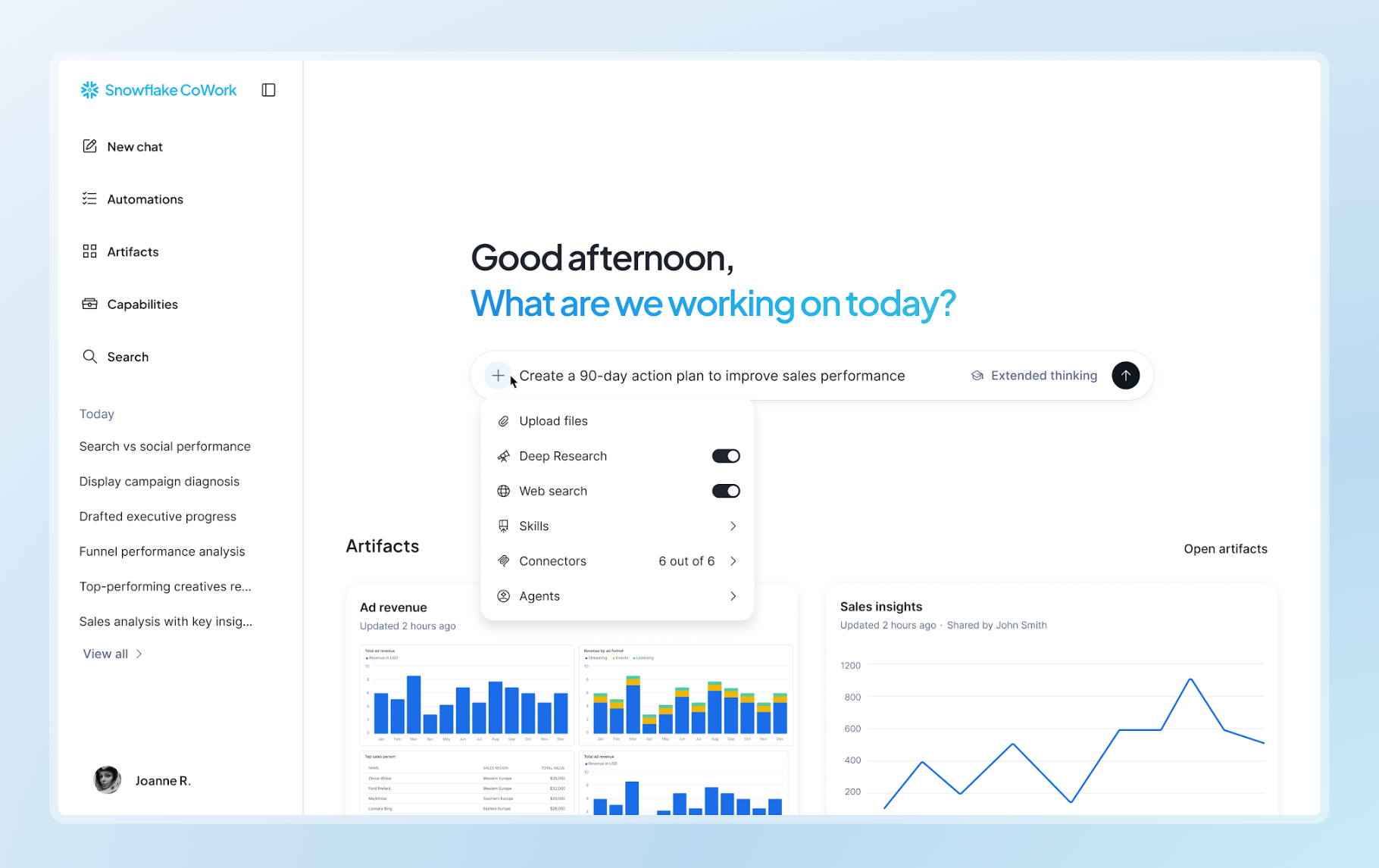
Figure 1: Snowflake CoWork: A personal work agent for every knowledge worker.
- Snowflake CoWork iOS app (generally available soon) allows employees to stay connected to enterprise intelligence wherever they work. Face ID authentication and conversation history let users take action on the go, whether from an airport, a customer meeting or on a conference show floor.
- Snowflake CoWork Slack app (private preview soon) brings governed enterprise intelligence into Slack conversations where employees can ask CoWork questions in any Slack channel or thread, receive responses with rendered charts inline and follow up without leaving the platform.
Underpinning these experiences is Cortex Agents, Snowflake's managed agent framework for building enterprise AI agents that can plan tasks and invoke tools, so teams can deliver insights and take action across enterprise systems without managing orchestration, infrastructure or runtime complexity themselves.
“With Snowflake CoWork and Cortex Agents, leaders no longer have to rely on siloed portals or navigate disconnected tools to get answers. They can ask questions in natural language, directly from their browser or Microsoft Teams, and get trusted insights grounded in real enterprise data. What started as a digital transformation initiative has evolved into a fundamentally new way of working for Synopsys, and we’re continuing to discover new use cases across the organization.”
Ramji Jagannathan
VP of Enterprise Digital Platforms at Synopsys
CoWork adapts to how employees work using enterprise context
Cortex Sense (private preview soon) learns how an organization defines its business, including workflows and relationships between data assets. Using query history, dashboards and agent trajectories Cortex Sense helps Snowflake CoCo and Snowflake CoWork to enable grounded business reasoning from day one. Furthermore, Semantic View Autopilot's ability to automatically ingest metrics and business logic from Power BI dashboards (public preview), immediately converts an organization's BI assets into a governed semantic layer for agents. These foundations allow employees to move from searching for information to understanding and acting on it.
Deep Research (generally available soon) helps users investigate complex business questions and delivers state-of-the-art performance across enterprise data, outperforming single-agent systems by over a third on Snowflake's Hybrid Deep Research Benchmark. Analytical Search (public preview soon) enables computed analysis across document collections such as contracts and support. Together, these capabilities allow enterprise AI to reason across the full operational context of the business.
Multi-agent orchestration (public preview soon) automatically routes requests to the right tools and workflows, while persistent memory (public preview soon) allows CoWork to learn user preferences and recurring tasks over time.
User Skills (public preview soon) allows teams to capture workflows in natural language and turn them into reusable organizational capabilities. Skills can also invoke the Code Execution Tool (public preview soon) to generate governed business outputs such as reports (PDFs), presentations including PowerPoint decks, analyses and visualizations directly within CoWork. Skills and plugins can now also be shared (private preview) via a link, automatically discovered when you ask a question and governed with built-in RBAC and security scanning. Over time, organizations build shared operational knowledge instead of isolated workflows trapped in individual chats or notes.
Snowflake CoWork also makes enterprise intelligence reusable across teams. Artifacts (generally available soon) allow users to save and share live analyses, dashboards and conversations with full context preserved and governed by role-based access controls. Interactive dashboards (public preview soon) extend this by allowing teams to explore metrics conversationally and collaborate using a shared source of truth.
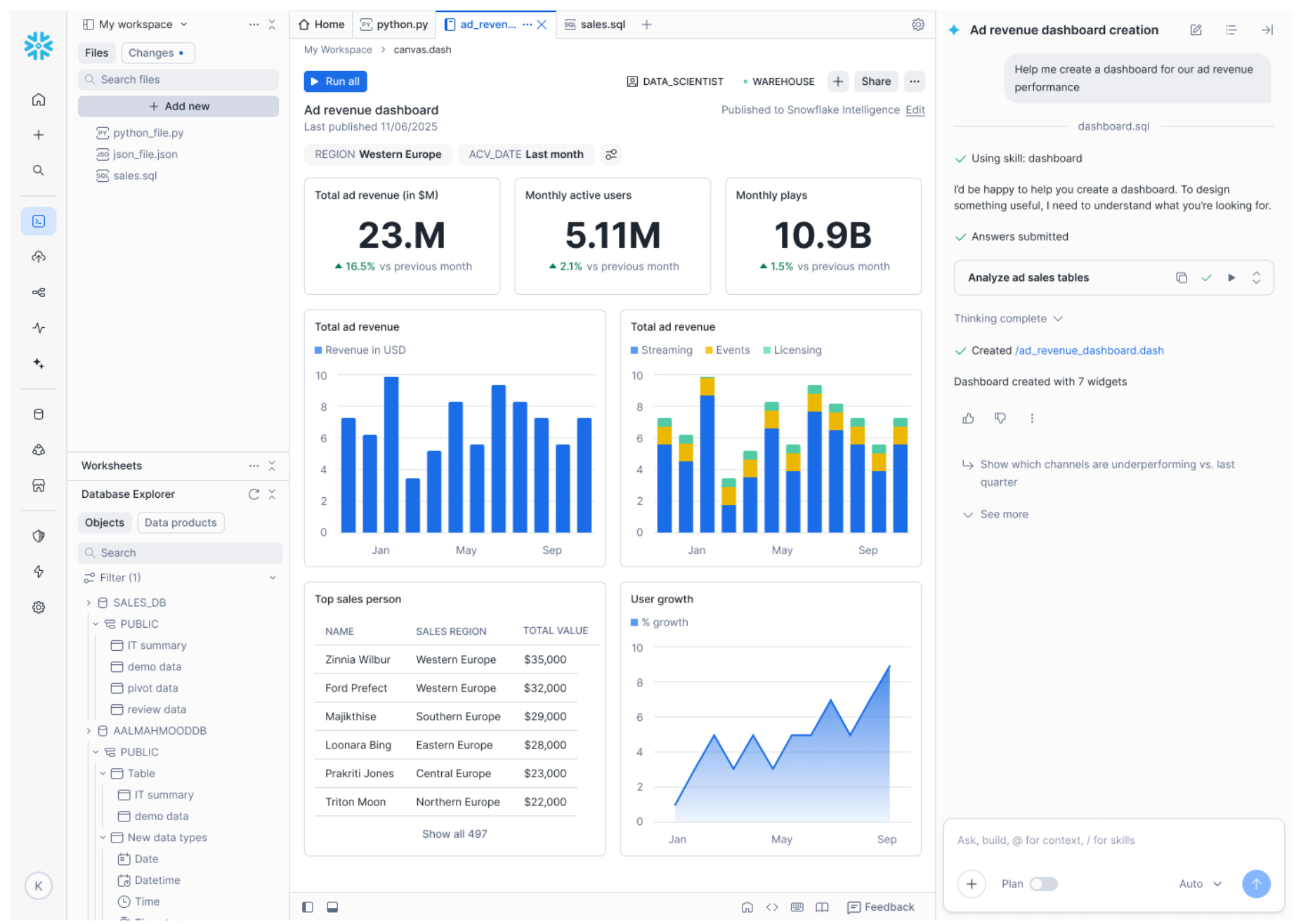
Figure 2: Interactive dashboards for collaborative analysis, within Snowflake CoWork.
CoWork helps organizations operationalize enterprise AI securely at scale.
Automations and time-based subscriptions (public preview soon) analyze enterprise activity and deliver proactive briefings through Slack, email or mobile notifications. Async Agent API (generally available soon) allows agents to work on longer-running workflows and investigations asynchronously.
Agent Studio (generally available soon) provides a centralized environment for deploying and governing enterprise agents. Role-based access controls and audit trails help organizations ensure every interaction remains secure and fully auditable. Agent identity provides a recognizable signal that distinguishes actions performed by AI agents on behalf of users, enabling operational accountability across enterprise workflows.
MCP connectors allow CoWork to operate across the enterprise tools teams already use, including Slack, Jira, Gmail, Salesforce and more, all within Snowflake's governance boundaries.
Post-train open weight foundation models efficiently
Models are the foundation of every agentic workflow, and Snowflake is investing in making it easier for you to train any model to your domain requirements.
When trying to customize agentic workflows, AI-native startups and enterprises often struggle with the limitations of frontier model options and the daunting challenge of procuring and managing GPUs. Cortex Training (in private preview) enables startups and enterprises to customize open weight foundation models such as the Qwen or Mistral family of models to their own domain, data and cost requirements without scrambling for scarce GPU capacity or worrying about the high cost of GPU ownership due to low usage. With Cortex Training, customers do not have to manage a complex distributed training infrastructure. Snowflake provides immediate access to a fully managed group of GPUs that are available at near 100% utilization based on experiments and demos from Snowflake Research, without reservation processes or custom orchestration setup. This creates a significant opportunity for startup users and enterprise users to cost-effectively improve the accuracy and latency of their AI solutions at scale, while maintaining unified governance across experimentation, evaluation and deployment.
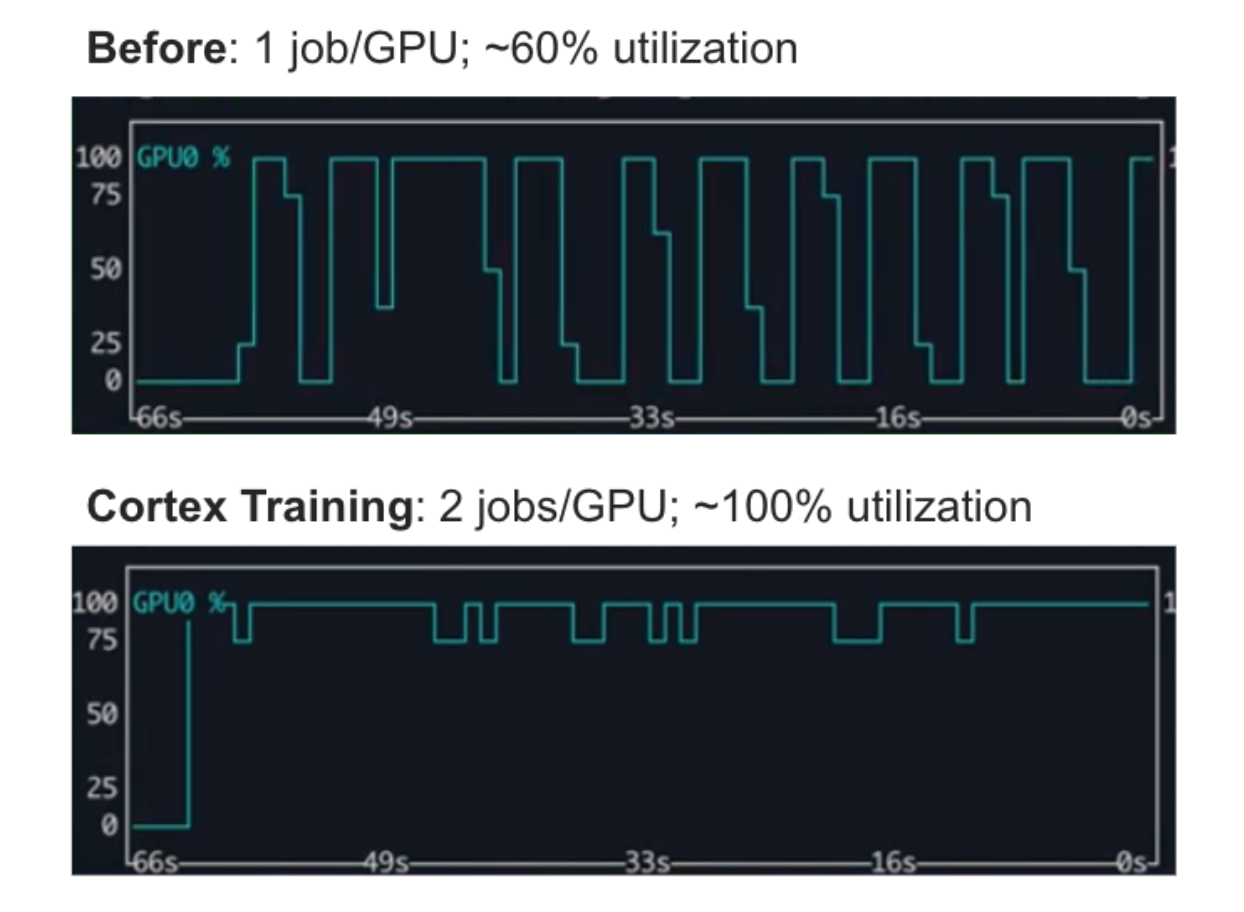
Figure 3. With Cortex Training, drive increased utilization, up to a ~2x lift, to optimize your GPU spend. Results above are based on experiments and demos from Snowflake Research.
Resolve AI, the AI for running and operating software in production, made a multi-million-dollar commitment over two years to use Cortex Training to build domain-specific models through reinforcement learning (RL) on proprietary training data. Resolve AI uses Cortex Training to consolidate model training inside a secure, governed environment, accelerating work that previously required stitching together infrastructure across multiple platforms.
Resolve AI offers domain-specific AI agents for production, built on multi-agent harnesses, simulated environments, and evaluation workflows. As AI models are further refined using RL, teams need infrastructure that can handle the heavy GPU-intensive parts of training and inference, without forcing them to give up control of their data or environments. Resolve AI provides this balance with scalable compute abstraction for performance, while keeping customers in control of their systems, data, and deployment environments. Cortex Training provides Resolve AI with governed infrastructure to run RL training workloads continuously, building and improving models that outperform general-purpose alternatives on the reasoning tasks that matter most to enterprise engineering teams in production. Snowflake is also a Resolve AI customer, with Snowflake engineering teams incorporating Resolve AI into their existing agentic workflows to run and manage production systems at scale. This, in turn, provides enterprises with faster, more reliable AI experiences.
"General-purpose API models will continue to improve, but there is a limit to how far you can get when building on top of them. Production operations for running and managing complex software systems have specific failure modes, reasoning patterns, and the highest bar for accuracy. We are overcoming these limitations with purpose-built training infrastructure, simulated large-scale environments, and evaluations based on real operational workflows. Cortex Training is a core part of how we scale these research priorities at Resolve AI."
Spiros Xanthos
Founder and CEO, Resolve AI
Build and serve production workflows faster using agentic ML
Machine learning is undergoing a fundamental shift as coding agents cross the threshold from simple autocomplete to sophisticated reasoning and autonomous execution. At Snowflake, we are pioneering the new era of agentic ML by investing heavily in Snowflake CoCo, Snowflake AI's coding agent that sits at the heart of Snowflake ML. Using ML-optimized skills and natively integrated context awareness across all your data and models, your ML and data science teams can use Snowflake CoCo to accelerate the path from idea to business-critical results faster by 10x.
With over 6,000 monthly active accounts running millions of models and trillions of inference requests, Snowflake ML is continuously investing in more productivity improvements accessible from Cortex Code, so your teams can get to production faster, expand development tooling and achieve faster real-time inference.
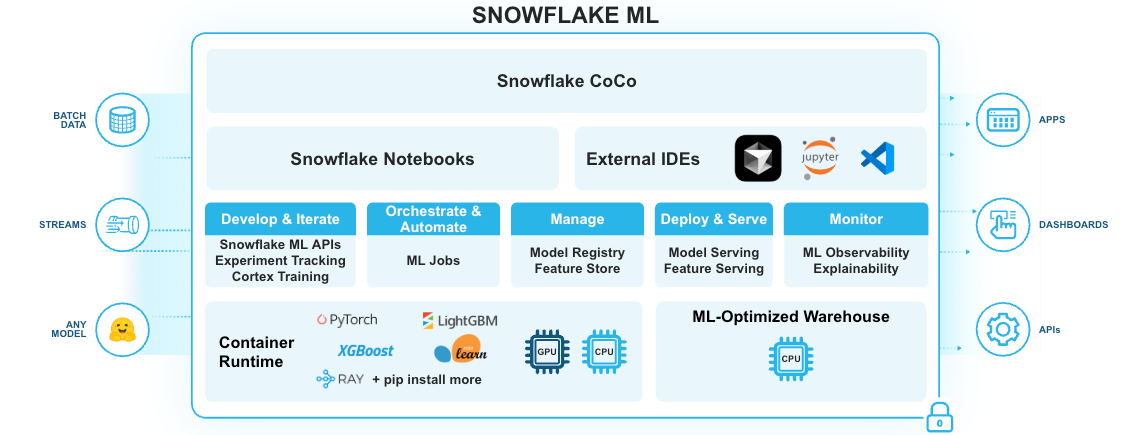
Figure 4. Customers can accelerate ML workflows with native context awareness across data, models, notebooks and features with agentic workflows in Snowflake.
For scalable development, you can already train models on terabytes of data in Snowflake Notebooks. Now, you can securely and seamlessly build models remotely from VS Code and Cursor without moving data. Snowflake's VS Code and Cursor extension (public preview soon) now lets you connect to remote compute environments, so you can develop ML pipelines over CPU or GPU compute pools without leaving your IDE. Furthermore, we are expanding flexibility to use your own packages and configurations in your Snowflake environment. Custom Container Runtime (in public preview) allows teams to use organization-approved, security-scanned container images in Snowflake Notebooks or ML Jobs.
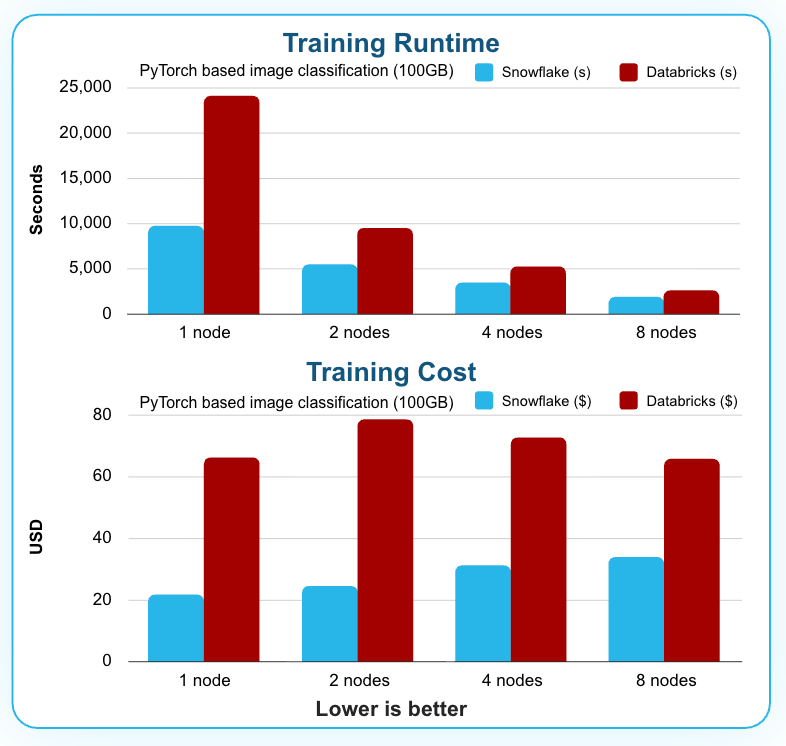
Figure 5. Natively integrated distributed xgboost, lightgbm, pytorch, HPO deliver superior price-performance, with TPCx-AI use case showing a median of 3x lower cost vs Databricks for XGBoost at scale factor 1000. Lower is better.
For inference that supports your production needs, we are announcing faster feature serving, online model observability and multimodal support for batch inference. ML teams can now serve online features in 10ms from Snowflake Feature Store with streaming feature support (generally available soon). These improvements deliver <2s data freshness from ingestion to serving, better developer experience with CI/CD integration and efficient computation of time-window aggregated features.
Attentive is modernizing marketing personalization at billion-row scale, delivering 68% speedup over Tecton’s legacy feature store with over 30% in cost savings.
During model serving, you can now easily conduct A/B testing for real-time models (public preview) to quickly experiment on live traffic in a controlled environment, compare model performance and promote the best-performing model to production. Additionally, inference support for unstructured data (generally available) unlocks AI use cases such as object detection, visual Q&A and automatic speech recognition on Snowflake without complex pipelines or data movement.
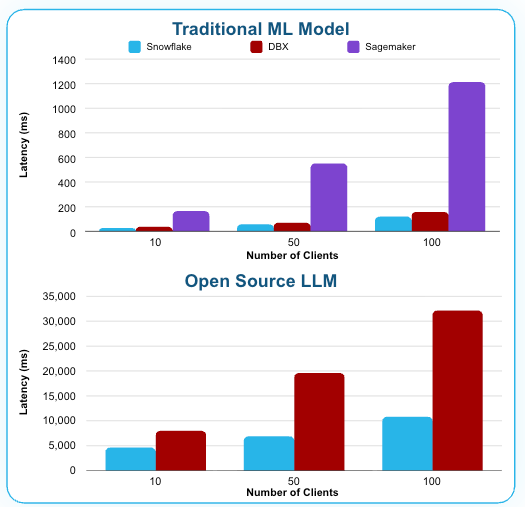
Figure 6. Run 2-5x faster and up to 3x cheaper inference by eliminating data movement and maximizing compute throughput. Lower is better.
Intelligence that operates within the boundaries organizations trust
As enterprise AI becomes operational across workflows, applications and decision-making systems, governance becomes even more critical. Snowflake's AI innovations are built on the same trusted data foundation organizations rely on for security, compliance and enterprise governance capabilities.
Role-based access controls, data masking, auditability, observability and policy enforcement apply consistently whether a business user is interacting with CoWork, an agent is executing workflows or a team is deploying AI-powered applications.
Snowflake is putting intelligence where work happens, grounded in enterprise context, operational across workflows and governed by the same controls organizations already trust.
To get started with AI at Snowflake, check out the following resources:
- Explore the full Snowflake CoWork announcement and see how governed work agents are transforming how enterprises operate.
- Explore Snowflake CoWork documentation, product page and implementation guides.
- Follow along this guided solution to build your first agentic ML pipeline.
All references to CoWork above refer to Snowflake CoWork.
Forward-looking statements
This article contains forward-looking statements, including about our future product offerings, and are not commitments to deliver any product offerings. Actual results and offerings may differ and are subject to known and unknown risk and uncertainties. See our latest 10-Q for more information.


