

The build vs. buy discussion has plagued IT teams for decades. The core dilemma isn't new: offloading operational complexity to a vendor traditionally meant giving up control over your underlying data. Frameworks like SOC 2, ISO/IEC 27001, HITRUST and FedRAMP/GovRAMP emerged to manage that risk. For most organizations, outsourcing to proprietary storage was a necessary risk-transfer strategy. However, self-hosting and scaling a complex logging infrastructure (like an ELK stack) may no longer be cost-effective.
At the same time, storing operational telemetry inside proprietary, vendor-controlled data stores may also no longer be viable (or necessary). Logs, metrics and spans are fundamentally structured data.
Modern open ingestion standards have made data collection portable. OpenTelemetry (OTel) support is now standard across most observability vendors. Instrumentation is flexible, the OpenTelemetry Collector can now serve as your entire telemetry pipeline, and no single provider owns the transport mechanism. Yet, when telemetry hits a proprietary backend, vendor neutrality (and your governance) vanishes. Open collection coupled with closed storage offers only partial freedom: The ingestion mechanism is open, but the storage remains locked.
For SREs, that lock-in may show up at the worst possible time: in the middle of an incident. The deploy history, feature flags and customer impact data you need sit in other systems, so you end up switching between tabs and pasting IDs from one tool to the next. And when renewal costs climb, the usual fix is to sample traces and cut log retention, which means the data you need for the next incident may already be gone.
This architectural pattern tends to result in data that is costly to move, difficult to correlate with the broader business data ecosystem and bound to vendor renewal rate hikes. Snowflake eliminates this barrier by enabling full data access (and seamless migration) at any point through Snowflake Secure Data Sharing.
Iceberg turns observability into an open data platform
Confining telemetry data to a proprietary silo can present an operational roadblock. Business analytics may not be able to join trace data with corporate warehouse metrics without extraction scripts and pipelines.
Apache Iceberg™ removes those limitations by changing where telemetry data lives. With Observe on Apache Iceberg (currently in Private Preview), your telemetry is written as open Iceberg tables to an S3 bucket in your own AWS account, and your observability platform becomes a processing and enrichment pipeline instead of a data terminus. Data remains directly accessible to industry-standard tools like Snowflake, dbt, Apache Spark™ or DuckDB. Observe enriches, deduplicates and surfaces this data across dashboards and alerts without locking it into a proprietary format.
Learn more about Observe by Snowflake and how it turns telemetry into insights — fast.
Observe builds further on this foundation by constructing an Observability Context Graph and storing it directly inside the Iceberg table metadata. This graph models service dependencies, resource attributions and correlation points during ingestion. As a result, Observe's AI SRE can follow explicit relationships to find root causes faster, instead of running expensive, unorganized searches across your telemetry. Because this context graph uses open Iceberg formats, external tools and custom AI agents can consume the same structured knowledge Observe uses internally.
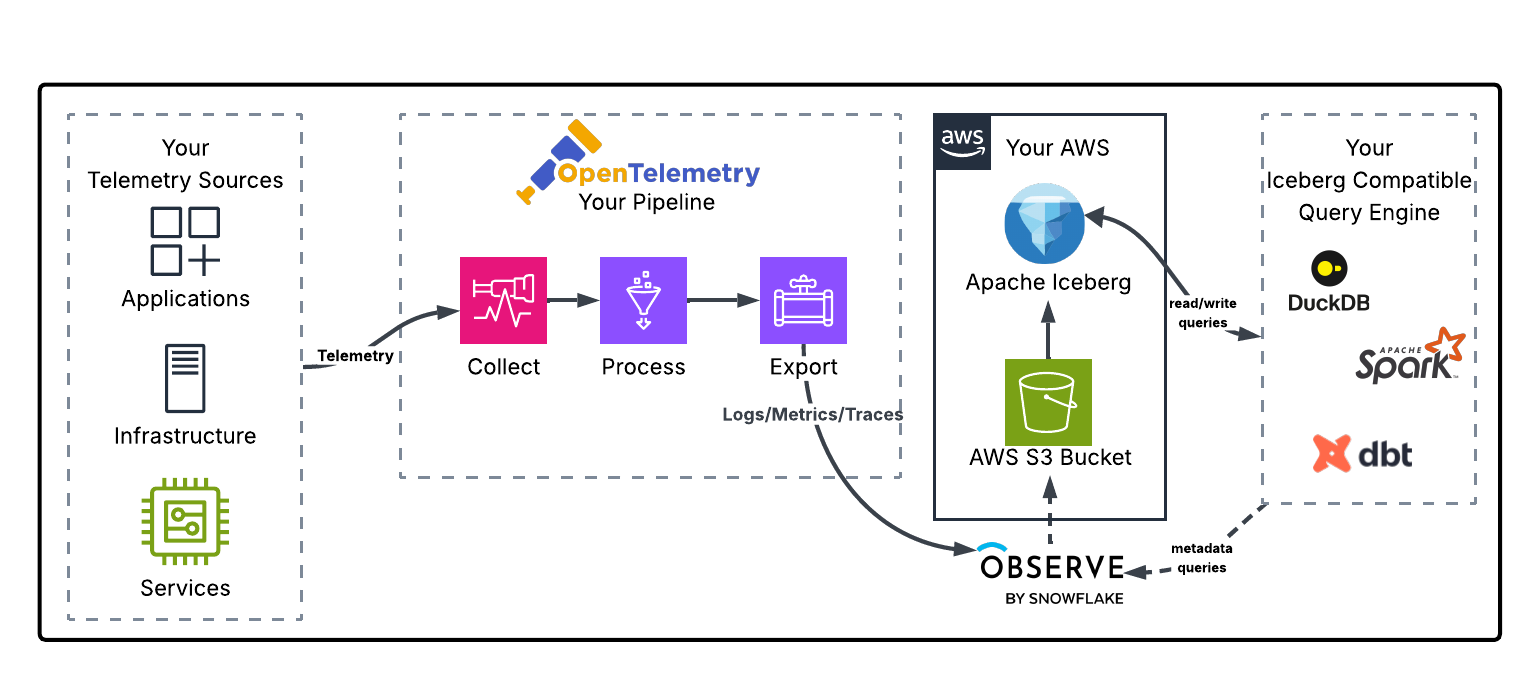
Preview customers are capitalizing on this paradigm shift across critical operational workflows:
- Executing unified SQL queries that merge operational telemetry directly with product and financial metrics.
- Conducting scheduled batch data engineering jobs across deep historical trace repositories.
- Training machine learning models on live telemetry without needing manual export pipelines.
- Auditing system logs for compliance and security within native data lake boundaries.
Opening telemetry to more tools and teams raises an obvious question: Who controls access? When your telemetry lives in your own storage, you control access and can use the same rules you already apply to the rest of your data.
Governance extends to your observability data
Storing telemetry in Iceberg enables you to align operational data with enterprise governance through the Snowflake Horizon Catalog. You can apply the same access boundaries, retention schedules and regional data residency rules across your main data lake and extend them to your observability data sets.
Your infrastructure governs storage access: You manage the S3 bucket, define the IAM roles and enforce security policies. If access is ever revoked, your data remains intact in open, standard formats ready for any Iceberg-compatible query engine to crawl through.
The question to ask every vendor
Observability evaluations have traditionally focused on dashboard UI design and alerting flexibility. While still important, the more strategic question is whether a platform integrates with your broader enterprise data model or isolates operational telemetry inside a discrete, invisible silo.
Isolating observability data is an architectural choice, not a technical necessity. Operational data does not need to bypass internal governance controls, remain invisible to analytics teams or be trapped in proprietary storage.
Observe is engineered on OpenTelemetry and Apache Iceberg because open standards multiply in value over time. Every integrated tool can operate against unified data sets under consistent governance policies without requiring complex data pipelines. Rather than remaining isolated, your telemetry strengthens your enterprise data ecosystem, thus delivering an observability architecture built to outlast any individual software decision.
