Sep 4, 2026/8 min readAI & ML
Build Reproducible Data Pipelines with CoCo, Snowflake's AI Coding Agent

AI slop is everywhere. And for some reason people are still impressed that someone was able to write a simple natural language prompt and wait for the AI coding agent to pump out a large amount of code or text. Generative AI coding tools are the future and are completely reshaping the software and data engineering landscape. But the fact that AI coding agents can generate essentially infinite code isn't that interesting.
What matters instead is how professional data engineers should think about and use these tools. Anyone can get an AI agent to produce a result — that's not an accomplishment. What separates a professional data engineer from everyone else is the ability to use AI tools to create repeatable, high-quality outcomes. That's the goal of this post: to share emerging best practices for data engineering with AI coding agents, and particularly with Snowflake CoCo.
In this post you'll find four best practices for professional AI-assisted data engineering, the reasons why CoCo outperforms generic coding agents for Snowflake and ways to build skills and plugins that make your team's workflows reproducible.
Best practices for data engineering with AI coding agents
There are a few overall best practices to mention before we get into setup:
- Start minimal, and iterate from failures: Resist the urge to overengineer things up front. Run prompts, notice what the agent gets wrong, then add a rule.
- Understand the model is already intelligent: Recent frontier models are trained on current data and capable of most data engineering tasks. You generally only need to tell the model what it can't infer.
- Treat conciseness as a hard constraint: The context window is fixed and shared during the session. Challenge every sentence: Does the agent actually need this?
- Make reproducibility the goal: Instructions, skills and tools turn individual expertise into repeatable, high-quality outcomes.
There are two more that deserve special attention because we're already seeing people use coding agents in ways that create real problems.
First, agents don't replace enterprise data engineering tools. AI coding agents can help data engineers design, build and monitor data pipelines — but in production, they should use the tools built for them: dbt for transformation and DCM tools, such as schemachange, Flyway or Terraform, for deployment. Using agents to execute activities directly in production without established tooling introduces fragility.
Second and closely related: Agents should not make changes directly in production. Even with clear instructions, agents are dynamically generating content as they run, which means the output is nondeterministic. Allowing nondeterministic processes to act directly in a production environment has always been a bad practice. Adding AI doesn't change that.
Why CoCo for Snowflake data engineers
Frontier LLMs are already very effective for most data engineering tasks. Most AI coding tools that use them are genuinely useful. But for data engineers working with Snowflake, CoCo is the best choice. Here's why:
- Inference runs within the Snowflake security perimeter: The LLM is deployed and executed inside Snowflake's infrastructure rather than routed to a third-party AI provider, and your data is processed under Snowflake's governance controls and data classification policies.
- Native Snowflake integration: CoCo can read your schemas, tables, warehouse configuration and query history from the first prompt.
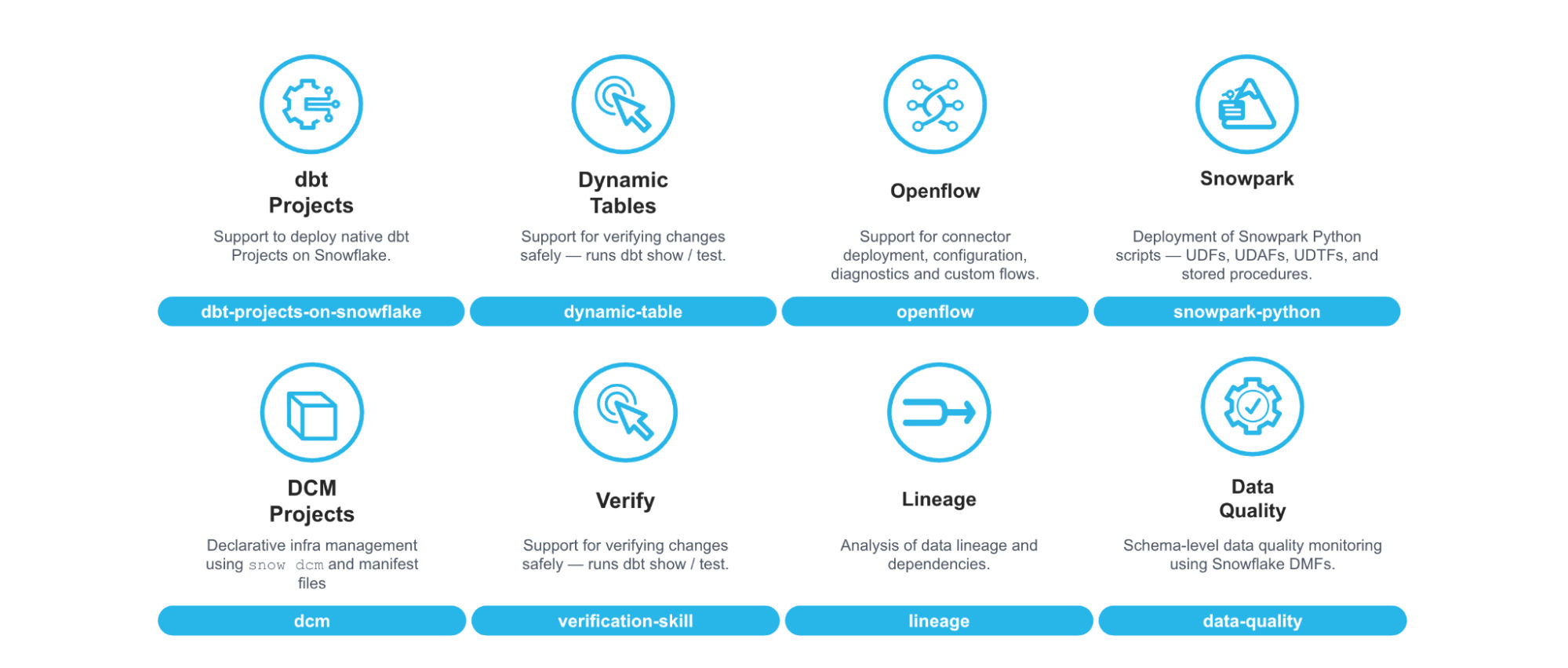
- A large set of built-in skills for Snowflake native workflows: Dynamic Tables, Snowpipe Streaming, Snowflake Openflow, Spark migration, dbt, Snowpark, machine learning, DCM and more each load automatically when your prompt matches the domain.
- Model flexibility: Choose among top frontier models, including leading open source models and more, that are matched to the task.
How to access CoCo: CLI, Desktop and Snowsight
CoCo runs in three environments. The CLI is a command-line tool for terminal-native engineers. The Desktop is a full VS Code-based IDE — best for those who want their local repo and OS tooling alongside Snowflake-native intelligence. CoCo in Snowsight requires no installation; it's the right choice for engineers who want to kick off long-running tasks in Snowflake's cloud and return to completed work. All three share most of the same functionality.
To install CoCo CLI, use the following:
- macOS or Linux (including WSL):
curl -LsS https://ai.snowflake.com/static/cc-scripts/install.sh | sh
- Windows (native, PowerShell):
irm https://ai.snowflake.com/static/cc-scripts/install.ps1 | iex
Download CoCo Desktop at ai.snowflake.com. Access CoCo in Snowsight directly from the left nav — no installation required.
Once connected, CoCo uses your existing Snowflake connection. Run /status to confirm it's working, then ask your first question:
What databases do I have access to?How to build reproducible workflows with CoCo skills and plugins
With a series of one-off prompts, anyone can get an AI agent to produce a result. But those results vary widely from one activity or person to the next. Professional data engineers don't just solve problems one at a time — they encode solutions.
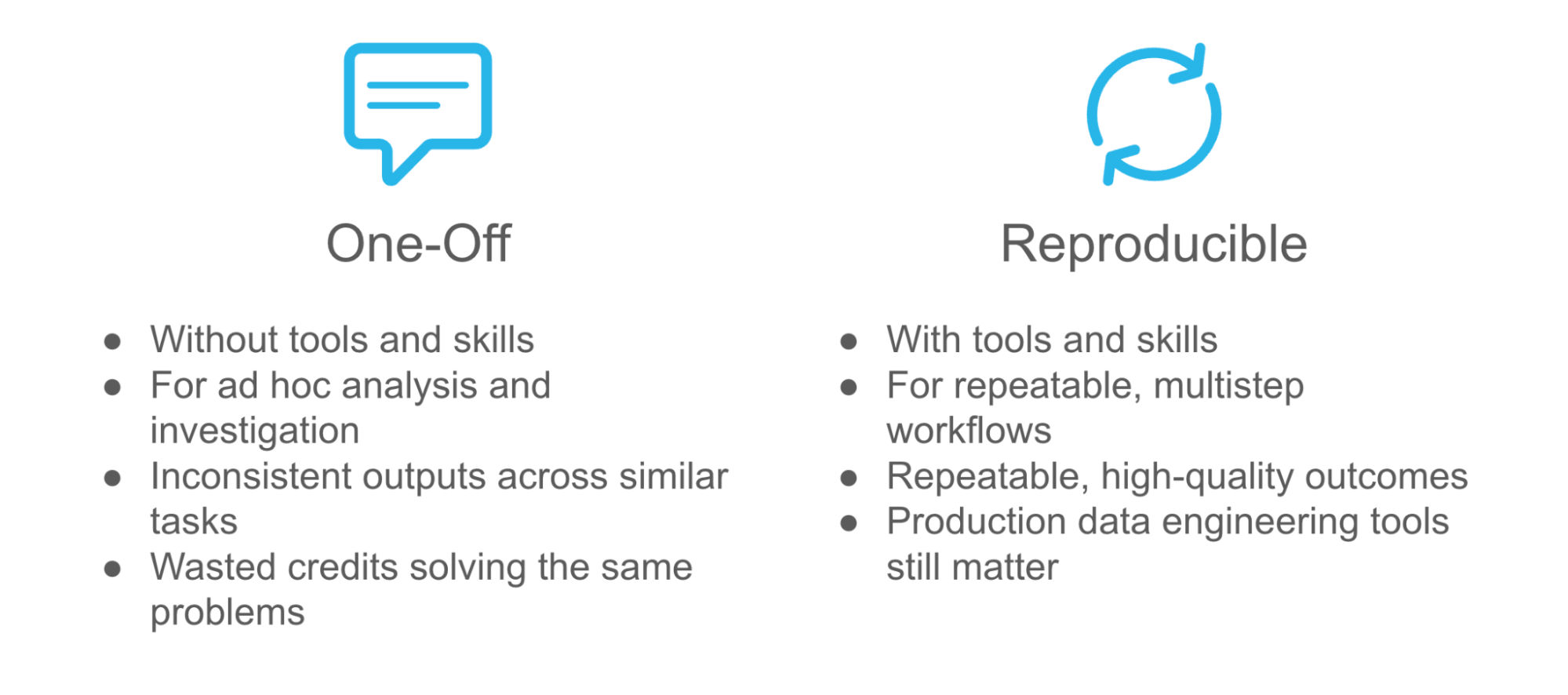
Several standards have emerged to help data engineers encode reproducible solutions:
- AGENTS.md: Repo-level conventions, commands and project structure that don't change session to session
- Skills: Markdown files that inject domain-specific instructions and knowledge into a session
- Subagents: Custom agent definitions for specialized, autonomous tasks
- Slash commands: Project-style commands invoked from the CoCo CLI prompt
- Hooks: Lifecycle hooks that run on events such as PreToolUse or UserPromptSubmit
- MCP servers: Model Context Protocol servers, which expose external tools to the agent
The sections below cover skills and plugins, which matter most for getting started.
Agent skills
Skills implement repeatable, multistep workflows. They're composed of instructions plus scripts and tools, and are supported by most AI coding agents. The open standard is documented at agentskills.io:
"Agent skills are a lightweight, open format for extending AI agent capabilities with specialized knowledge and workflows. At its core, a skill is a folder containing a SKILL.md file. This file includes metadata (name and description, at minimum) and instructions that tell an agent how to perform a specific task. Skills can also bundle scripts, reference materials, templates and other resources."
One key thing to remember when building skills: The model is already intelligent. You generally only need to tell it what it can't infer. For dbt, you don't need to teach the model what dbt is or how to build a project — the model already knows. What you capture in a skill is any repeatable process specific to your team: the exact steps to follow when building and testing a dbt project, your naming conventions or your partitioning strategy.
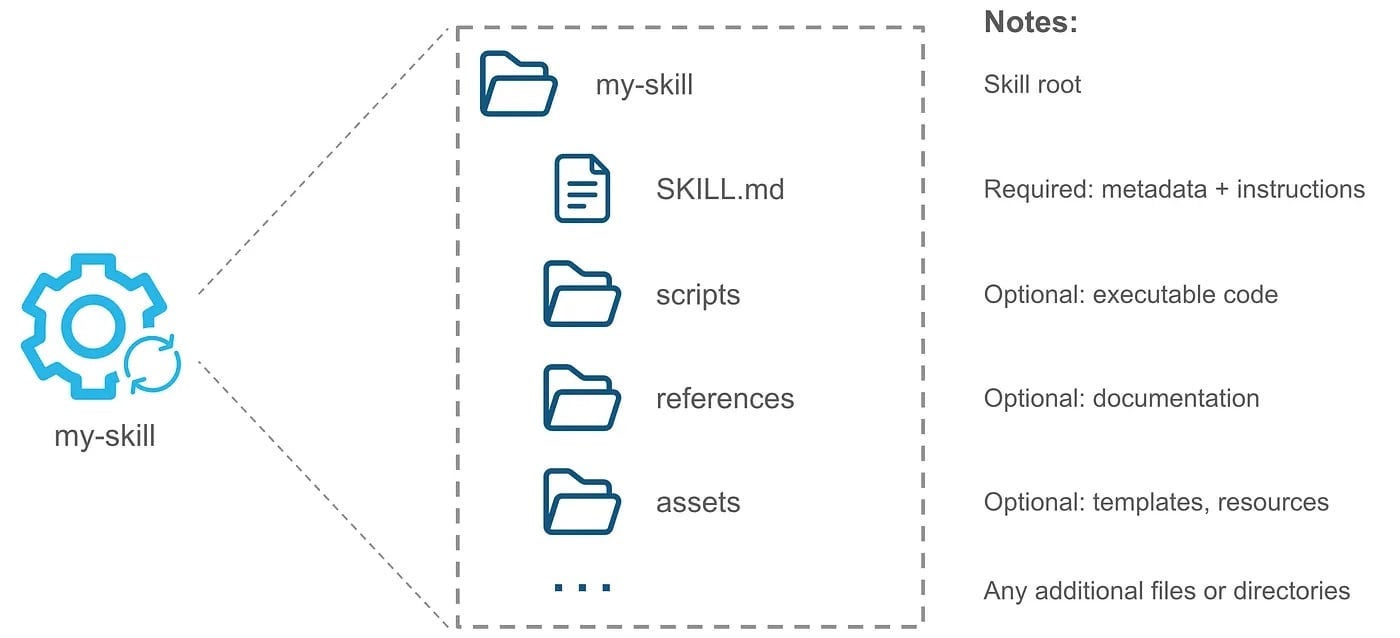
Skills are defined in natural language via Markdown files. The core instructions live in a SKILL.md file. At minimum, a skill is a folder with that single file — but the real power comes from bundling reusable scripts in a /scripts folder, which makes a skill consistent and reproducible.
The SKILL.md file starts with YAML front matter followed by Markdown instructions. Only name and description are required; the model uses the description to decide when to invoke the skill. Here's a minimal example:
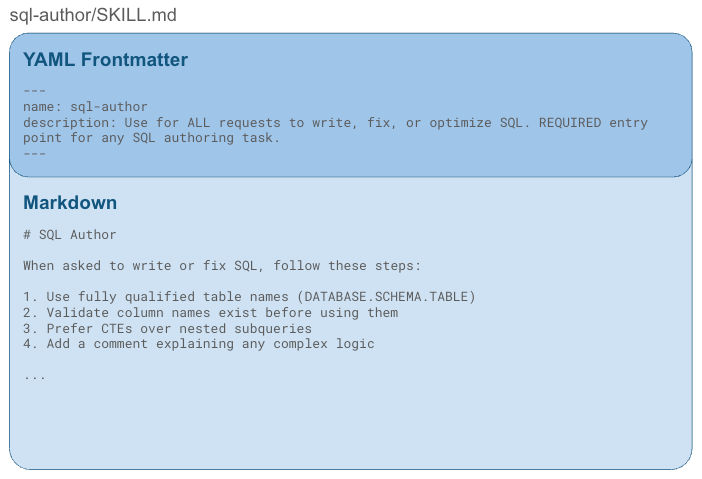
If your team has institutional knowledge that takes new engineers weeks to absorb, a skill can encode it and make it available to CoCo for every session. Skills are an open standard implemented by most AI coding agents. Managing their lifecycle — versioning, deployment and updates — is where plugins come in.
CoCo plugins
Professional data engineering requires professional SDLC practices, and managing skills individually is harder than it looks. Plugins address that with a richer packaging and deployment unit that bundles skills, subagents, slash commands, hooks and MCP servers into a single managed unit.
Plugins are a better unit of packaging and deployment than skills alone because plugins are:
- Versioned: The manifest has a version field; skills alone don't.
- Validatable in CI: “cortex plugin validate” gives you a formal check before shipping.
- In a single installable unit: “cortex plugin install” is one command; skills require “cortex skill add” for each skill.
- Updatable: “cortex plugin update” pulls the latest version from the registered source.
- Bundlable: One plugin carries skills, hooks, MCP servers and subagents as a coherent capability.
- Able to use registry tracking: Installed plugins are recorded in registry.json with source, install time and active state.
A plugin is a self-contained directory with a manifest file at a well-known path:
my-plugin/
├── .cortex-plugin/
│   ├── plugin.json          # manifest (required)
│   └── activation.md
├── skills/
│   └── my-skill/SKILL.md
├── commands/
│   └── my-command.md
├── agents/
│   └── my-agent.md
├── hooks/hooks.json
└── .mcp.json
The key file is plugin.json:
{
  "name": "data-engineering",
  "description": "Skills, hooks, and MCP servers for Snowflake data engineering",
  "version": "1.0.0",
  "author": { "name": "Data Platform Team" },
  "skills": ["./skills"],
  "agents": ["./agents"],
  "hooks": {
    "PreToolUse": [
      {
        "matcher": "Bash",
        "hooks": [
          { "type": "command", "command": "bash hooks/validate-bash.sh" }
        ]
      }
    ]
  },
  "mcpServers": {
    "internal-api": {
      "type": "http",
      "url": "https://internal.example.com/mcp"
    }
  }
}
Snowflake's Plugins Catalog lets you deploy plugins to Snowflake's built-in registry, enabling sharing and discovery across your organization with native governance and access control.
Reproducibility is the standard that separates professionals from prompt-typers. The data engineers who will matter most in an AI-native world are the ones encoding institutional knowledge into skills, plugins and standards that make their entire team more capable, not just themselves.
Get started
If you're a data engineer and not yet regularly using AI coding agents, don't wait. Start with the CoCo documentation and the getting started quickstarts for CoCo CLI and Desktop — they walk through installation, first queries, session management and more using real Snowflake examples.
If you're already using AI coding agents but still mostly working through one-off prompts, start building skills and plugins with the help of this quickstart guide. That's where the compounding returns are.
Jun 2, 2026AI & ML
Snowflake CoCo: The Coding Agent Built for Data Now Available Where You Work

Jun 10, 2026Product and Technology
Data Engineering in the AI Era: New Snowflake Tools Built for Smart Pipelines

Aug 6, 2026Data Engineering
Introducing Data-eng-bench: Why You Need "Data-Native" Harnesses for Data Engineering

