Nov 16, 2026/5 min readProduct and Technology
Share Live Data with Users Outside of Snowflake with Open Data Sharing

Suppose a customer wants to put your data to work in the analytics and AI tools they already use. To use your data in tools outside of Snowflake, their fallback is often a scheduled export, which means there’s another pipeline to maintain, another copy to track and a delay for your updated data to reach their workflows.
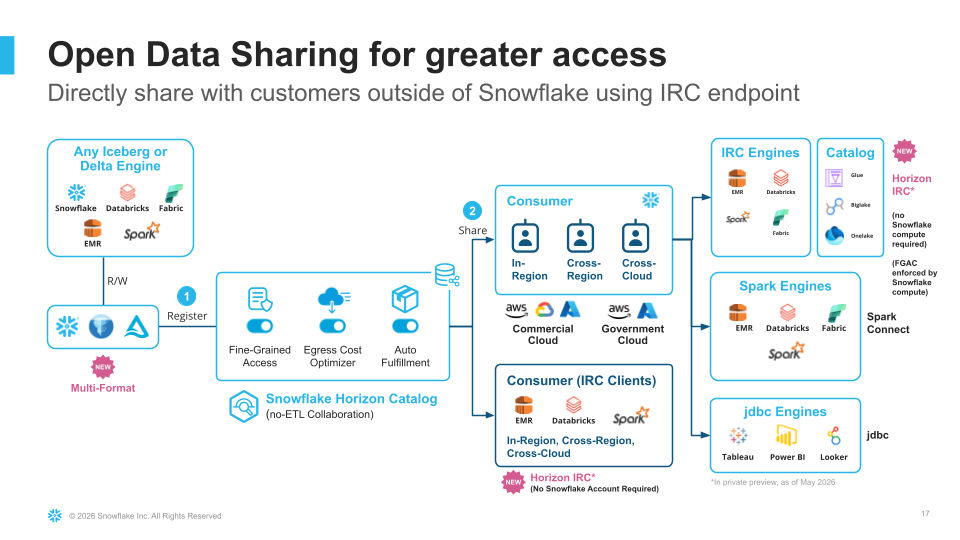
Snowflake AI & Data Sharing now enables Open Data Sharing for anyone, powered by Apache Polaris™. Providers can share supported Apache Iceberg™ tables with any consumers using Iceberg REST Catalog (IRC)-compatible clients, including Apache Spark™ and other tools that implement the API. Customers can analyze the data in the tools and compute environments they already use without waiting for scheduled exports or maintaining another copy.
Openness, built step by step
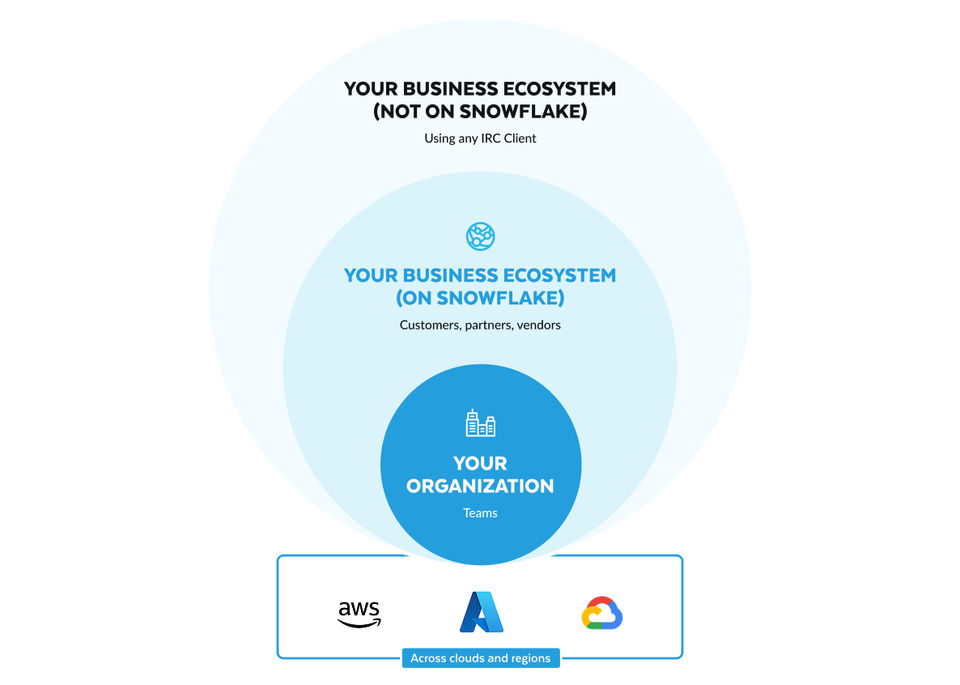
Open Data Sharing is the latest step in Snowflake’s expanding support for open data exchange. Each release has added another layer of choice:
- October 2025 — Open table formats: Snowflake enabled sharing of open table formats such as Apache Iceberg and Delta Lake across clouds and regions.
- August 2026 — Catalog-linked databases: Snowflake added support for databases linked to catalogs such as Apache Polaris, Unity Catalog and AWS Glue.
- October 2026 — Open Data Sharing: Open Data Sharing lets providers share data with external consumers through IRC-compatible clients.
The direction is consistent: give customers more choice in where data lives, which catalogs manage it and which engines can read it. Open formats make data portable; open protocols provide a common way for compatible systems to connect. The latest release extends that foundation to a provider-to-consumer sharing workflow beyond Snowflake.
The IRC API defines an open interface for compatible clients to interact with Iceberg data. It serves as the interoperability layer, not a protocol specific to Snowflake. It is the lingua franca for modern data exchange between systems. A consumer can use an IRC-compatible engine and its existing compute environment to read shared Iceberg data. Based on the official community matrix from the Apache Iceberg vendors page and tracking from independent Iceberg compatibility matrices, there are currently more than 40 platforms and tools that natively read from or integrate with an IRC ecosystem.
Using the protocol alone, however, doesn’t mean you have a sharing program. Providers need a way to establish consumer relationships, grant and manage access, distribute the data and maintain control as relationships change. Open Data Sharing adds a full sharing product experience around the IRC interface: Snowflake shares and listings, dedicated external consumer identities, and controls to manage and revoke access. All of this is done entirely — and exclusively — using IRC.
Open Data Sharing is not a proprietary replacement for Iceberg REST Catalog. It is a managed way to use the open protocol for external data sharing. It doesn’t replace other Snowflake sharing options but complements the existing pathways with a new way to distribute data. For example, Snowflake Marketplace helps providers reach consumers within the Snowflake environment, while Open Data Sharing extends their reach to external consumers using IRC-compatible tools. In the open source community, Apache Polaris recently merged its own foundational specification for a Shares API built on the same Iceberg REST Catalog protocol, and community members are actively working on the next steps.
Historically, if consumers have not had Snowflake accounts, we have recommended reader accounts or third-party accounts. Open Data Sharing adds a complementary path for external consumers who prefer to remain in their existing environments, while reader and third-party accounts remain appropriate for sharing with consumers outside of Snowflake who want a managed experience without IRC.
Providers can share supported Iceberg tables and dynamic Iceberg tables with Open Data Sharing. Data in another supported table type can be prepared for sharing by materializing it into a dynamic Iceberg table. Dynamic Iceberg tables allow you to share filtered data or other format-based tables, such as those that use the Snowflake native format.
For example, a data provider can make a customer-specific Iceberg table available to a partner’s Spark environment. The partner connects through an IRC-compatible client and reads the shared data without adopting Snowflake. The provider can manage the partner’s access through Snowflake and revoke it when needed.
This provides data providers with a standardized, reproducible alternative to FTP exports or legacy Delta Sharing (recently rebranded as “OpenSharing”), without requiring consumers to go through Delta Sharing's recipient-activation and credential-file process. It is designed for organizations that distribute data products to customers, partners or other external consumers across mixed technology environments with minimal friction.
How to get started with Open Data Sharing
Snowflake Open Data Sharing is now generally available, and you can start using it today. Begin by exploring the Open Data Sharing documentation and joining our virtual hands-on lab on Dec. 11, 2026, “Share Live Data Outside Snowflake Using Iceberg REST Catalog.” You’ll work through the provider-to-consumer flow and connect to shared Iceberg data from Spark.
Learn more here about all things related to Snowflake AI & Data Sharing.