Jun 10, 2026/4 min readProduct and Technology
Hybrid Tables Just Got Up To 8x Faster


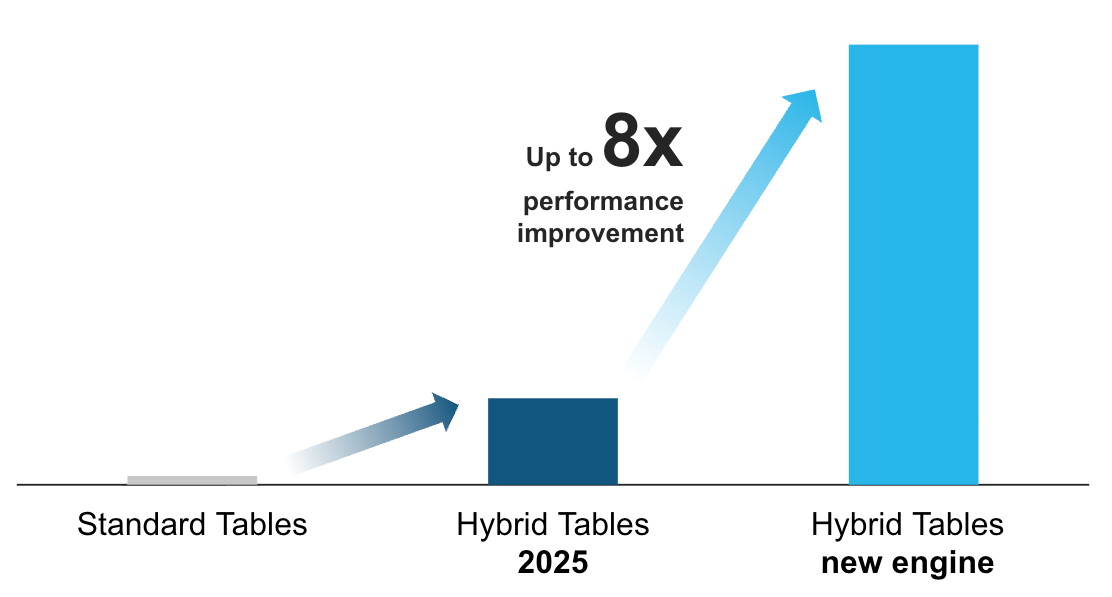
Hybrid Tables just got up to 8x faster (based on internal benchmarks),1 with standardized billing and dramatically improved batch performance. This breakthrough makes Hybrid Tables even more performant for high-concurrency, low-latency workloads like AI apps and workflow state management.
Here’s what this means in practice: Teams can now run thousands of concurrent point lookups, store AI agent state and manage transactional application logic directly on Snowflake, at speeds that previously required a separate, dedicated database.
Transactional workloads shouldn't require complex data movement
For too long, teams building transactional applications have been forced to maintain and connect separate online transaction processing (OLTP) databases alongside their analytical platform. This creates painful complexity: brittle pipelines, data inconsistency, and duplicated governance and engineering hours spent syncing systems instead of building products.
In the age of AI agents and real-time applications, this fragmentation can be a liability. When your agent needs to read fresh transactional state, query historical context and write back results — all in milliseconds — you can't afford the latency of data pipelines.
Hybrid Tables address this by deeply integrating transactional workloads into the Snowflake database, allowing you to join transactional and analytical data in a single query, while maintaining unified governance and security controls across all your data.
What's new: Performance that changes what's possible
This release encompasses three major improvements.
1. Higher throughput, applied automatically
Hybrid Tables now support single-statement query execution that can dramatically reduce overhead for repetitive operations. The results: up to 8x higher throughput for point operations, based on internal benchmarks.1
Once generally available, this performance improvement will be enabled by default for all Hybrid Tables workloads — no code changes, no configuration required.
2. Faster, more cost-effective batch operations
Bulk inserts into Hybrid Tables are now optimized at the storage engine level, with benchmarks showing up to 10x faster batch writes at 10x lower cost, even on tables with existing data.2 The system dynamically selects the optimal execution model. Optimized batch update, merge and delete operations are coming soon.
This makes a difference for teams running extract, transform, load (ETL) into Hybrid Tables, backfilling state or syncing large data sets. What once required careful orchestration now works with a simple INSERT statement.
3. Request credits eliminated for cost savings
Snowflake has removed request credit billing for Hybrid Tables. Pricing now follows a simplified compute-and-storage model, the same model Snowflake customers already understand. Customers observe reduced Hybrid Tables costs by 15% on average and up to 40% or more for demanding, high-throughput workloads,3 enabling teams to scale with Hybrid Tables more cost efficiently.
Improvement |
Benchmark Results |
Higher throughput |
Up to 8x more throughput on an XS warehouse, applied automatically |
Faster batch performance |
10x faster, 10x cheaper bulk loads with no workflow changes |
Cost reduction |
Up to 40% cost savings with request credits eliminated |
Next-level performance translates to real business outcomes
With these breakthroughs, Hybrid Tables now enable even better performance across a wide range of production workloads. Here's how customers are putting them to work:
Metadata and state management
Simplify architecture by consolidating state inside Snowflake
Teams running complex data pipelines and applications often maintain external databases just to track job state, workflow checkpoints, user session data or application configuration metadata. Hybrid Tables eliminate this overhead, letting state live alongside your analytical data with ACID transactional guarantees, no separate infrastructure required.
MarketWise, the financial services holding company powering self-directed investing for millions of subscribers, replaced MySQL and DynamoDB with Hybrid Tables to track the workflow state of numerous data engineering pipelines in real time. The result: 35% reduction in infrastructure costs and a centralized platform that got rid of unnecessary data movement.
"Hybrid Tables just made everything much simpler for us. We reduced our architectural footprint, centralized our data on one platform and accomplished jobs that were previously unachievable."
Ron Stiffler
Chief Architect, MarketWise
The same consolidation pattern extends beyond data engineering. Verantos, the life sciences company generating real-world evidence from billions of clinical records, unified research metadata and application state with their analytical workloads on Hybrid Tables — cutting out separate RDS and Redshift infrastructure. Complex queries that once took 30 minutes now complete in under 10 minutes. Their lean DevOps team accomplishes what previously required additional headcount.
"Using Hybrid Tables enabled our existing DevOps team to accomplish what were previously considered monumental tasks without needing to add headcount."
Chris May
Technical Lead, Verantos
Data serving
Serve fresh, low-latency lookups directly from Snowflake
When applications need to serve real-time results like product recommendations, geospatial lookups and pricing data, teams traditionally spin up a dedicated serving layer. Hybrid Tables turn Snowflake itself into a high-performance serving tier, eliminating data movement and keeping results fresh.
Grailed, a leading community-driven marketplace for luxury, streetwear and vintage fashion, uses Hybrid Tables to deliver sub-second, personalized style recommendations to millions of users. By storing pre-computed ML recommendations in Hybrid Tables, they serve high-throughput, low-latency point lookups directly from Snowflake without a separate serving database.
"Unistore's Hybrid Tables have streamlined our data workflows by eliminating the need for complex ETL pipelines. This provides a more lightweight and efficient way to deliver recommendations."
Conor Curry
Staff Data Engineer, Grailed
Lightweight applications and agentic workflows
Run customer-facing application logic natively on Snowflake
For applications that need fast reads and writes — customer journeys, case management, session tracking, and entitlement enforcement — Hybrid Tables provide the transactional guarantees of an OLTP database without the operational burden of running one.
Elementum, the AI-driven workflow automation platform, runs directly on Snowflake using Hybrid Tables to deliver both operational speed and analytical power. Their platform orchestrates AI agents, business rules and human interactions in multi-step processes, all requiring real-time, high-concurrency reads and writes with enforced primary key and foreign key constraints.
The results speak for themselves. Customers achieve 2x faster contract resolution, 15-minute average support resolution times (a 125% boost in customer satisfaction scores) and more than $10 million in annual savings from automated software license management.
"Our AI-driven platform runs directly on Snowflake, using Hybrid Tables to deliver both operational speed and analytical power. This enables our customers to automate critical business processes — from contract management to customer support — while keeping all their data centralized and secure.”
Joshua Waite
Vice President of Product and Engineering, Elementum
Get started today
Check out this quickstart guide to get started with Hybrid Tables today. To try our latest performance improvements, follow our documentation to opt in to the public preview.
Forward-looking statements: This article contains forward-looking statements, including about our future product offerings, and are not commitments to deliver any product offerings. Actual results and offerings may differ and are subject to known and unknown risk and uncertainties. See our latest 10-Q for more information.
1 Data based on benchmarks run using the Yahoo Cloud Serving Benchmark (YCSB) with a 100% read workload on Gen2 XS warehouse.
2 Data based on internal benchmarks for loading 50 GB into Hybrid Tables using a 2X-Large warehouse.
3 Data based on Snowflake estimates of average cost savings across customers, measured on real-world production credit consumption in February 2026.