Nov 13, 2026/8 min readData Lake
Snowflake Named a Leader in the Inaugural Gartner® Magic Quadrant™ for Data Lakehouse Platforms


In its inaugural report evaluating data lakehouse platforms as a distinct market, Gartner has named Snowflake a Leader in the first Magic Quadrant™ for Data Lakehouse Platforms. We're especially proud of the recognition for data warehouse modernization, because for our customers, modernizing no longer means another migration.
We believe this moment marks a transformation — in our platform and in the market around it.
The market has moved past "warehouse or lake"
Talk to any chief data officer (CDO) and you hear the same story: Data lives across platforms, clouds and regions, and each system comes with its own trust model. Teams copy data to get work done, and every copy chips away at governance and meaning. Cost and risk climb with each new pipeline.
There's a deeper fear underneath. For decades, every new wave of technology asked customers to migrate into another proprietary system, often with costs they couldn't predict or control. Then AI raised the stakes. Agents need trusted data and consistent context, and they need them across every cloud a business runs on.
Openness alone doesn't resolve that fear. Nearly every vendor in this market now supports Apache Iceberg™ and open standards, and that's a good thing for customers. The harder questions are whether a platform removes the reasons teams copy data in the first place, and whether it gives them one way to govern everything produced in today’s multiengine world.
Gartner defines data lakehouse platforms as analytical data management systems that provide a unified, cloud-native architecture for managing and analyzing the full spectrum of data types — structured, semi-structured and unstructured. The lakehouse is a transformational approach that merges the high-concurrency, governed performance of an enterprise data warehouse (EDW) with the scale, flexibility and multiengine support of a data lake, leveraging open table formats and supporting multiple processing engines. The lakehouse supports a wide variety of analytical and AI workloads.
How Snowflake transformed
We started as a data warehouse built for the cloud, separating storage from compute so teams could independently scale analytics without managing infrastructure. As our customers' data spread across platforms and clouds, the next step was clear: reach that data wherever it lives. We modernized our own platform the same way we help customers modernize, by connecting rather than starting over.
We believe enterprise AI should not operate over data you can't trust. That conviction shaped Snowflake's AI Data Cloud around four ideas: one trust boundary across all your data; connection where you can and data movement only when you must; compute and cost you control; and choice of model, cloud and interface.
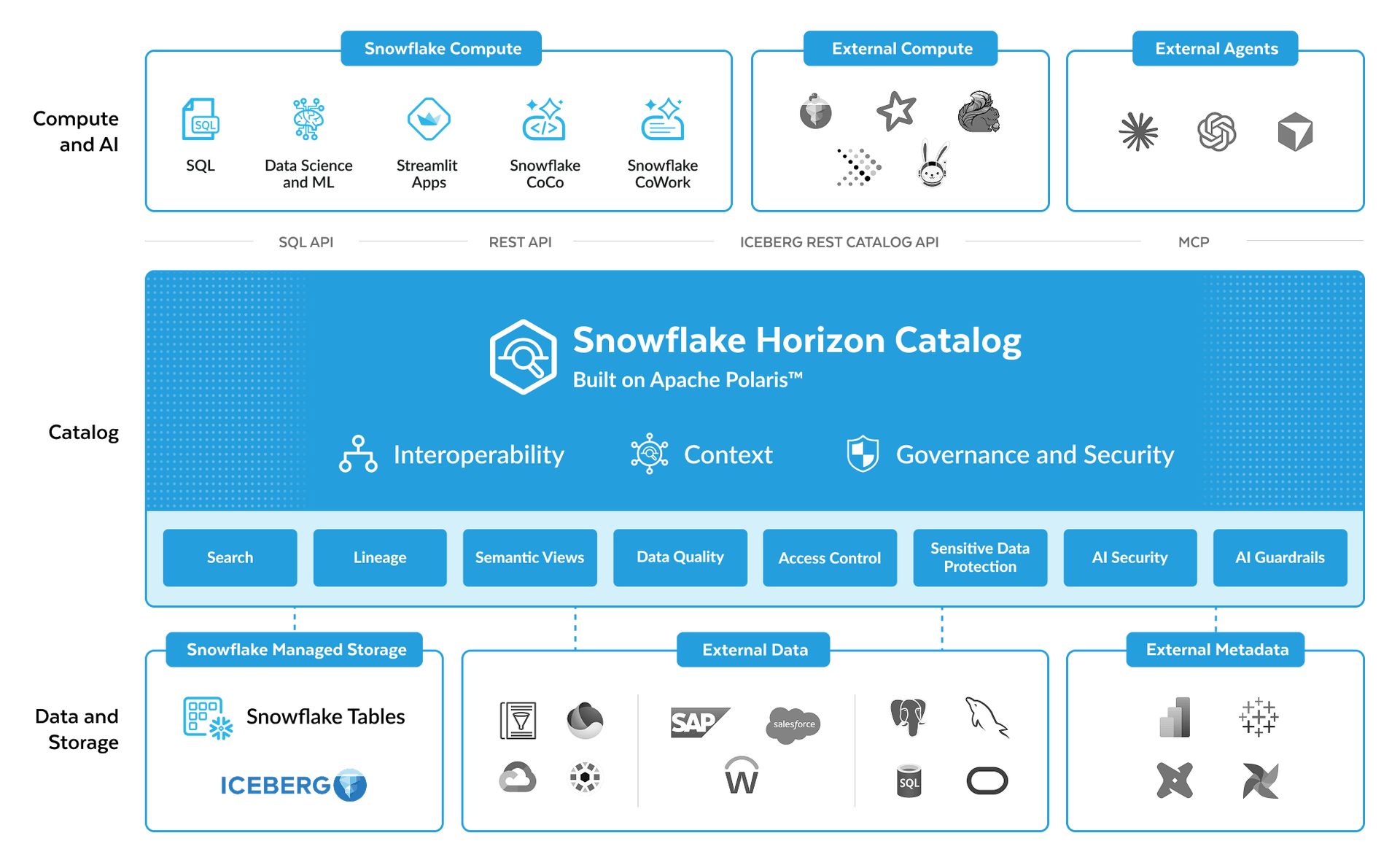
One trust boundary and governed context across all your data
Modernization efforts always promise organizations a clean slate, but they often fail to deliver that fresh start. Modernizing on Snowflake, however, starts from a different premise: Multiple platforms are the enterprise reality. Connecting platforms using interoperable open standards meets customers where they are, giving them agency over their data. With Snowflake, customers can define trust once, then extend it to their data estate.
We believe that is the reason that Snowflake was ranked No. 1 (4.29/5) for the use case in the Gartner companion Critical Capabilities report. Customers bring warehouses, lakes and lakehouses under a single trust boundary instead of moving into another silo.
That shared environment is Snowflake Horizon Catalog, based on Apache Polaris for Iceberg interoperability. Horizon Catalog brings governance capabilities and business context together to deliver a single trust boundary for all your data. Snowflake enables masking and row-access policies on queries on supported tables, including federated data in external catalogs, data accessed through zero-copy integrations and data shared across accounts and partners, while role-based controls govern access to models and agents. Teams define business metrics and relationships in semantic views that people and agents can reuse, then extend that governed foundation as their data estate grows.
Insurance tech company Klarent put this approach into practice by defining each customer, policy, trip and claim just once on Snowflake. Agents, reports and applications use those shared definitions so that marketers and support teams can follow an insurance customer from lead to claim and get consistent answers. Read the full case study here.
Unifying security and governance doesn't require moving everything, though. That brings us to the second principle.
Connect where you can, move data when you must
Most data teams don't have a data problem so much as a copy problem, where every new use case starts with another extract and another pipeline to maintain. The reality is that the fastest path to unified analytics is leaving data where it already lives.
Snowflake is also ranked #2 (4.23/5) for the Unified Analytics Data Platform use case in Critical Capabilities. Customers get one analytics platform across all their data because Snowflake connects to that data where it lives.
Horizon Catalog works with Iceberg tables across external catalogs, and deep zero-copy integrations reach systems of record such as Workday, Salesforce, SAP and more.
When data does need to move, streaming and batch tools built to enhance engineering productivity land it with far less pipeline work. This results in a single place to analyze any data, with fewer copies to store and fewer pipelines to govern.
Compute and cost you control
AI changes the economics of a data platform. When agents query data around the clock, cost has to be designed into the platform from the start. Customers have told us clearly that predictability matters as much as performance, and we took that feedback seriously.
The simplest way to control cost is to need less infrastructure. Snowflake brings compute to the data for nearly any workload, from transactional applications on Snowflake Postgres to analytics and read-heavy workloads on interactive tables. Compute adapts to each workload and optimizes resources automatically, which matters more as machine-led workloads become the norm.
On top of that sit unified cost controls for every workload and AI that happens on Snowflake. Budget alerts at the organization, account and object levels set the standard for granular controls, while per-user quotas, which can even block new requests across supported AI services when users reach their limits, help teams contain unexpected AI spending. Anomaly detection can flag unexpected spikes early.
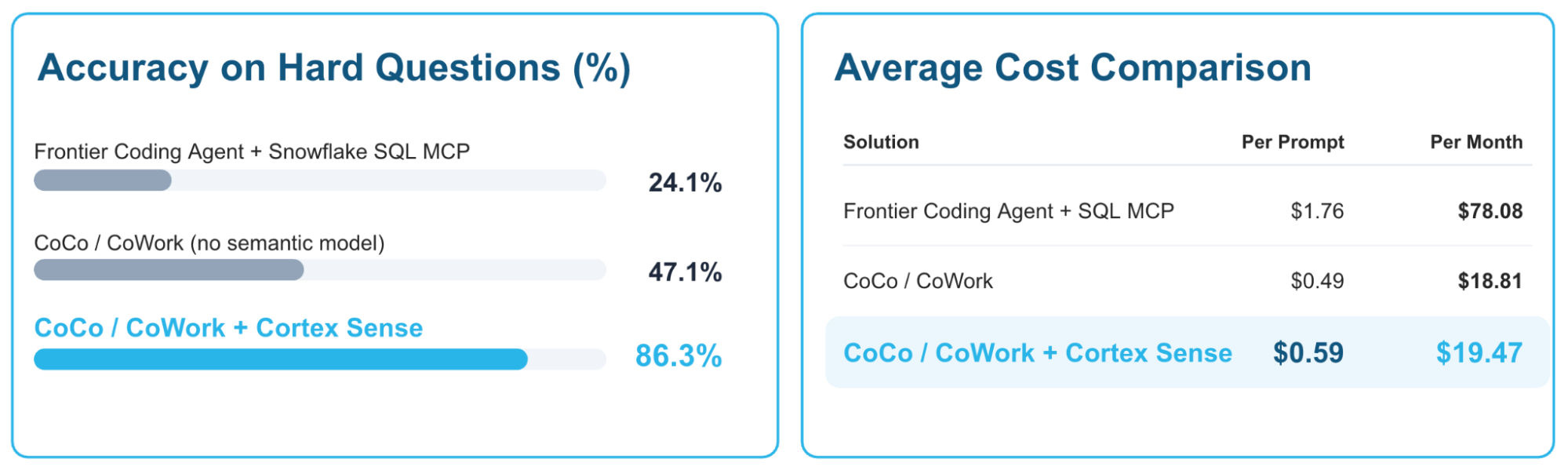
For builders looking for better intelligence efficiency, Snowflake CoCo provides a data-native harness that reduces cost while improving accuracy.
At Indeed, the global hiring platform, adopting Snowflake interactive tables and warehouses let the team consolidate employer-facing analytics from 10 computing clusters to four. Average query response times improved by 60%, while infrastructure costs fell a further 45% — giving employers faster dashboards with less infrastructure to maintain. Read the full case study here.
Choice of model, cloud and interface
The AI landscape will look different next quarter than it does today. A platform that ties you to one model or one cloud forces a rebuild every time the ground underneath you shifts. Today’s reality is that data lives across clouds, and new models arrive constantly. Snowflake makes it easy to match each task to the right model, with leading models available inside the Snowflake security boundary. Agents get access to the tools they need to do real work through built-in model context protocol (MCP) servers, or teams can bring their own.
The platform runs across clouds and regions, with governed sharing. Builders work in Snowflake CoCo, and knowledge workers get answers in Snowflake CoWork, all on the same governed foundation.
What this means for CDOs
Taken together, these principles change what modernization asks of a data organization. You modernize by unifying instead of migrating, under one trust boundary for data, models and agents. You connect to data where it lives and move it only when the work requires it. Compute adapts to each workload, with controls that keep cost predictable, and teams choose the model, cloud and interface that fit the task. The whole platform becomes the agentic control plane, so data teams can take data to production AI faster.
What comes next
We believe this is what the market now demands: one platform, one trust boundary, open and interoperable at every layer. It's the transformation this recognition marks for us.
Thank you to our customers, whose feedback shaped every step of our transformation, to our partners and the open source community, and to the Snowflake teams who made that transformation real.
Read the full Gartner Magic Quadrant for Data Lakehouse Platforms report:
- Gartner, Magic Quadrant for Data Lakehouse Platforms, Aaron Rosenbaum, Michael Gonzales et al., 4 November 2026.
- Gartner, Critical Capabilities for Data Lakehouse Platforms, Michael Gonzales, Ramke Ramakrishnan et al., 5 November 2026.
Gartner and Magic Quadrant are trademarks of Gartner, Inc. and/or its affiliates.
Gartner does not endorse any company, vendor, product or service depicted in its publications, and does not advise technology users to select only those vendors with the highest ratings or other designation. Gartner publications consist of the opinions of Gartner’s business and technology insights organization and should not be construed as statements of fact. Gartner disclaims all warranties, expressed or implied, with respect to this publication, including any warranties of merchantability or fitness for a particular purpose.
- Based on internal benchmarks, CoWork with Cortex Sense improves accuracy from 24.1% to 86.3% and reduces cost from $1.76 to $0.59 per query (a 66% reduction) compared to an ungrounded frontier agent. Learn more by reading: Intelligence Efficiency in Action: Lower Cost per Trusted Outcome with Snowflake CoCo and CoWork ↩