Jun 4, 2026/6 min readPartner & Customer Value
OpenAI and Snowflake: The Future of Business-Native AI

When Snowflake and OpenAI announced a $200 million strategic partnership earlier this year, the vision was clear: Bring frontier intelligence directly to the enterprise data that matters most — securely, at scale and without compromise. Today, that vision is production-ready.
OpenAI frontier models are now generally available directly within Snowflake Cortex AI, giving organizations across cloud providers the ability to empower every employee with an AI-powered expert who is fluent in your business and ready to act.
This means any Snowflake customer — on Amazon Web Services (AWS), Google Cloud or Microsoft Azure — can access frontier OpenAI intelligence today, through a Snowflake-managed experience that keeps data, governance and compliance controls in one place.
From frontier intelligence to business-native AI
Frontier models like OpenAI GPT-5.5 bring powerful reasoning that understands what you’re trying to do and carry more of the work itself. These capabilities eliminate the bottleneck between data and action. But raw intelligence alone is not enough — nor is governed data alone. The real value emerges when frontier reasoning meets enterprise context: Snowflake's semantic layer gives models the business definitions, relationships and logic they need to reason correctly on the first attempt — dramatically reducing errors, eliminating redundant discovery steps and reducing the token consumption requirement to deliver the right answer.
When OpenAI models connect to that foundation, the experience changes. It feels less like querying a system and more like consulting an expert because the context is already there.
Snowflake CoWork: An AI-powered expert for every business user
Snowflake CoWork puts this directly in the hands of business users, analysts and executives. Ask a question in plain language — “Which campaigns drove the most pipeline in EMEA last quarter?” — and get a trusted, governed answer. No SQL. No dashboards to build. No waiting on the data team.
Behind the scenes, Snowflake CoWork automatically takes the steps needed to retrieve and analyze your business data, grounded in semantic context and enforced by the access controls already in place. OpenAI reasoning capabilities make those answers richer: multi-step analysis, synthesis across data sources and proactive insights that surface what matters before you think to ask.
The result is that data-driven decision-making is no longer bottlenecked by technical teams pulling reports and doing analysis. Every employee — from a regional sales manager to a VP of supply chain — can work with AI that understands their business and helps them move from question to insight to action.
Snowflake CoCo: An AI-powered expert for every developer
For developers and data teams, Snowflake CoCo delivers the same depth of understanding purpose-built for the technical workflow. Snowflake CoCo is deeply aware of Snowflake schemas, metadata, account context and documentation, providing AI assistance that is not just intelligent but relevant. Combined with OpenAI frontier reasoning, developers can build agents, write transformations, debug pipelines and deploy applications faster with confidence that the AI understands the full context of what it is working with.
The agentic control plane that makes it all work
Snowflake CoWork and Snowflake CoCo are powered by the same underlying capability: Snowflake’s platform as an agentic control plane providing built-in governance, comprehensive observability, semantic-rich context and cost management capabilities.
What makes this possible architecturally is a fundamental shift in how OpenAI models are delivered. Rather than routing through a third-party cloud AI service — where your data and prompts flow outside your control plane — Snowflake now manages the endpoint directly. The intelligence is contained within the control plane itself, subject to the same role-based access control (RBAC), encryption and audit controls as the data it reasons over.
That semantic-rich context is what makes frontier models dramatically more effective. Rather than repeatedly discovering tables, inferring joins and guessing at schema meaning, OpenAI models reason in business terms from the first interaction — reducing token consumption, eliminating multi-turn discovery loops and delivering answers that are not just intelligent but trustworthy.
Snowflake and OpenAI: Meeting customers where they build
With OpenAI models delivered through a Snowflake-managed experience, this means any Snowflake customer can access frontier intelligence, regardless of their underlying cloud provider or region.
For AWS customers, this story is expanding. In April, OpenAI and AWS expanded their partnership to bring its frontier models to AWS. Because a majority of Snowflake customers already run Snowflake on AWS today, the addition of OpenAI models will extend naturally into the same managed experience Snowflake customers rely on — no new security reviews, no new compliance frameworks.
Enterprises like Nissan Motor Corporation and Luminate are already bringing AI to production with Snowflake and AWS. As OpenAI models are available on AWS, they will be positioned to introduce frontier intelligence while maintaining trusted, established governance frameworks.
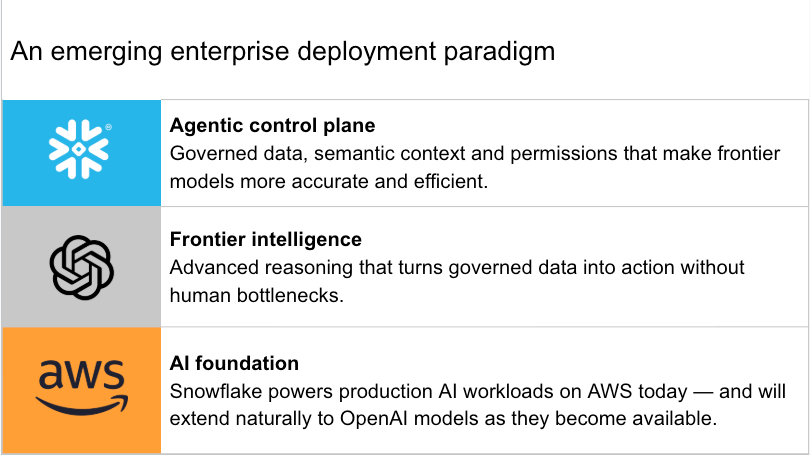
For Snowflake customers on AWS, this creates a three-layer architecture optimized for each partner’s strengths.
Snowflake: The agentic control plane: Governed data, semantic context and enterprise permissions — unified in a single layer that makes frontier models more accurate and efficient. Business logic is defined once and applied consistently, so agents reason correctly without reconstructing context on every interaction.
OpenAI: The frontier intelligence layer: Advanced reasoning, multimodal understanding and the latest model innovation — the capabilities that turn governed data into action without human bottlenecks. When grounded in Snowflake’s semantic context, these models can understand user intent and carry more of the work more accurately and more efficiently.
AWS: The AI foundation: Snowflake’s security boundary already operates on AWS, powering a significant portion of customers’ AI workloads today. As OpenAI models are available on AWS, they will arrive within that same governed architecture — no new security model to learn, no new compliance review.
What this means for customers
The practical benefit is accuracy, efficiency and security. Because Snowflake provides semantic context upfront, OpenAI models spend fewer tokens discovering schema and more tokens reasoning about the actual problem — delivering higher first-shot accuracy at lower cost. When Snowflake manages the endpoint, customers benefit from unified governance across their existing cloud infrastructure. These are the same controls that organizations in regulated industries use to help protect their most sensitive workloads.
A financial services team can build fraud detection agents that reason across transaction data in Snowflake, all within consistent security controls and compliance frameworks. A retail team can deploy inventory optimization that connects live operational data to autonomous decision-making. A healthcare organization can build clinical decision support tools that support robust compliance capabilities while delivering intelligent, context-aware recommendations.
In every case:
- Your data is governed with consistent access controls, semantic definitions and policies across every interaction.
- Your intelligence is frontier, eliminating bottlenecks between question and action.
- Your infrastructure does not change. No new security model to learn, no new compliance review.
Putting business-native AI to work
Every industry has high-stakes questions that require both frontier intelligence and deep business context to answer. These organizations are preparing to put that combination to work.
"Organizations are moving quickly to adopt AI across the business, and doing that securely requires the right combination of trusted data, secure cloud infrastructure and protected AI innovation. Partnerships across the technology ecosystem are critical to helping enterprises move faster and more securely with AI, and the collaboration between Snowflake, AWS and OpenAI reflects that momentum."
Daniel Bernard
Chief Business Officer, CrowdStrike
“The biggest challenge in enterprise AI is not access to powerful models — it’s giving those models the right context. Snowflake’s partnership with OpenAI — and its expansion to AWS — is an important step toward bringing frontier intelligence to governed enterprise data at scale. For Glean, this also builds on our partnership with Snowflake and creates an even bigger opportunity to connect Snowflake’s structured data platform with Glean’s enterprise search and context layer. Together, we can help users move seamlessly between structured analytics and unstructured knowledge, with the trust, governance and security enterprises require.”
Emrecan Dogan
Chief Product Officer, Glean
Get started
The era of AI-powered experts — grounded in your business data, fluent in your context and ready to act — is here.
Try it now: Access OpenAI models in Snowflake Cortex AI. Start a free trial or enable OpenAI models in your existing Snowflake account.
Talk to an expert: Contact Snowflake to design your enterprise AI strategy with Snowflake, OpenAI and AWS.
Forward-looking statements: This blog post contains forward-looking statements, including statements about products, features and capabilities that are under development, not yet generally available or otherwise not yet available. These forward-looking statements are subject to risks and uncertainties that could cause actual results to differ materially. Please refer to Snowflake’s SEC filings for a more detailed description of the risks that could cause actual results to differ.