
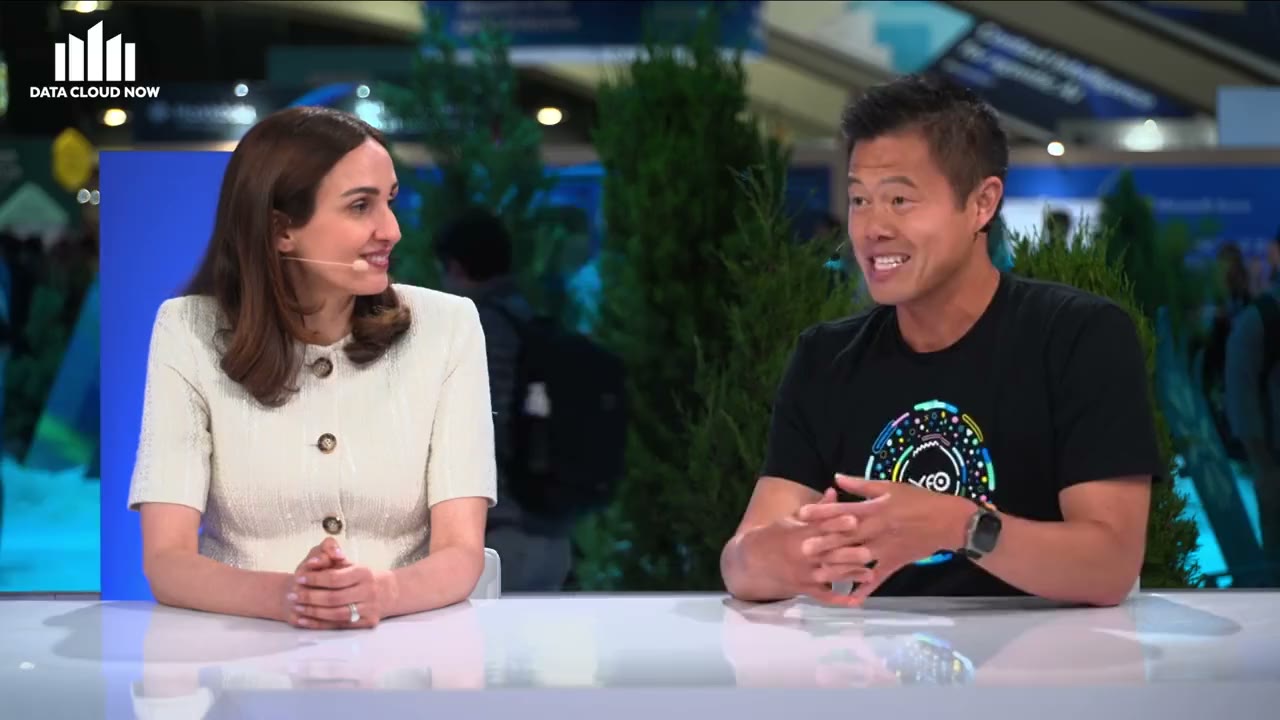
A request for another variation on a dashboard can look like healthy demand for a data team. James Hsu, VP of Product and Data Science at Xero, sees work that AI can take on — and a reason to ask what data scientists should spend their time doing instead.
Hsu tracks how often business users query data and how widely they explore it. But he also considers the nature of the questions coming to specialists. Anahita Tafvizi, Chief Data and AI Officer at Snowflake, brings a related test: whether automation frees people for work that requires human judgment. Together, those perspectives give leaders a way to look beyond usage when assessing what AI is changing.
In this conversation:
What happens to access controls when an AI agent joins the workflow
How to serve business questions outside a specialist agent’s remit
How to plan for data demand that Hsu expects to grow faster than headcount
What comes after employees can get their own answers
“That is ultimately the measure of success: Are we seeing full end-to-end automation coming out of these AI agents in a trustworthy, enterprise-grade way so you can open up human bandwidths for higher-level tasks?” Anahita Tafvizi, Chief Data and AI Officer, Snowflake
Transcript
Click to viewJames Hsu: Over the next 12 months, will not only be the self-service, but also the automation of action. Because at the end of the day, intelligence is just one piece, and action has to be the second half. And how do we make this automation change happen?
Anahita Tafvizi: With Snowflake, all of that comes natively, right? So with the semantic layer, you can define the right definitions and the business context to your AI agents. So that you can reduce hallucination, and you can have the right governance and access control. So things like role-based access control, the masking policies, the you know the auditability, the freshness of data, all of that comes natively with with Snowflake, and all of that now comes as part of your AI as well.
Ryan Green: Hello, everyone, and welcome back to Data Cloud Now. We’re currently in San Francisco, where we are delighted to be joined by James Hsu, VP Product and Data Science at Xero, along with Anahita Tafvizi, Chief Data and AI Officer at Snowflake, and I’m delighted to be joined by my international correspondent, Jason Teetz. Really looking forward to this conversation. Thank you both for making the time.
Anahita Tafvizi: Excited for being here.
Ryan Green: We’re excited. Looking forward to diving in, James. Let’s start with you. Xero serves over four million small businesses globally, and your team drives the data and AI requirements for the entire product group. Take us back briefly to the beginning. How did Snowflake become the core of the Xero analytics data environment, and what role does it play today across the organization?
James Hsu: Yeah, definitely. So Xero, to to everyone that doesn’t know Xero, has been around for 20 years and has been public for 10 years. And because of that, we have to really support our customers and support everyone across the business. It’s super important that we bring all the data in one place, and it doesn’t take that much manual engineering overhead in order to bring data to connect with each other. So, over the last four years, we’ve brought everything together, and we were able to drive much more interesting behavioral insights, financial insights, as well as marketing insights, and drive the business much more quickly forward.
Jason Teetz: Anahita, from Snowflake’s vantage point, what are we seeing as the common inflection points when customers like Xero move from digital data warehousing into this AI data cloud model, and what’s changed about how you think about your own platform’s role in that transformation?
Anahita Tafvizi: Yeah, for sure. I mean, we are seeing a lot of our customers now not only using Snowflake as a data warehousing solution, but really, truly, as an AI company. In fact, we have more than thirteen thousand six hundred of our customers that are now using our AI products on a weekly basis, and our Cortex Code agents are now being used by seventy-two hundred of our customers. So we are certainly seeing this happening across the industry and across our customer base, and that has created a significant tailwind for us as a business. We’re seeing more and more customers bringing their data to Snowflake to have it ready for AI. We’re seeing our CoCo and CoWork products growing more than faster than any product in the history of our company, and we’re seeing that the more customers like Xero are using these AI products, the more consumption on Snowflake it results in. Because now it’s not you; you can’t just You don’t have to just be a data team member or have a SQL or Python knowledge to access your data. You can now use natural language to interact with your data. And having your data on Snowflake gives you the advantage of governance and security, you know, trust and accuracy of everything that customers love about Snowflake is now also coming with you into this AI layer as well.
Ryan Green: Very well said, Anahita. Thank you. And now, James, I want to jump back to you. Your team is presenting at Summit on Xero’s move to being agentic first. Give us the sneak preview, if you don’t mind, of the impressive work your team will present on.
James Hsu: Of course. So, for one thing, our team has always been one of the early adopters of a lot of Snowflake’s products, from Cortex Analyst to Snowflake Intelligence, and this is. This is kind of like the next level of where we’re going. So we know that in order for us to support everyone in our business, we need to not only build deep, but we also need to build broad. So when you build deep, you have like your payments bot that like takes the semantic layer and is able to extract really deep insights for a specific group. But there’s so many areas that aren’t fully covered. So we’ve built a context graph that captures the rest of the 80 percent, and it helps us be able to just say, hey, we’re going to be able to deliver 90 percent of insights to most people. Beyond just that specialization of each of the different product areas, so we’re really excited to share with you guys this.
Jason Teetz: Anahita, this of course is exactly where Snowflake CoWork and CoCo come in, right? From your perspective as CDAIO, how is Xero’s architecture being multi-agent, multi-platform, but Snowflake as the connective tissue representative of what you see as the future of how enterprises build AI?
Anahita Tafvizi: That’s a very good question, and it like really speaks to a lot of the conversations we are having now on this AI control plane, where Snowflake plays the best with its new product announcements, as CoCo and CoWork, really having this one UI, one destination for the customers to have their data in a trusted and governed way. Access to the variety of AI models that are available by different AI providers, and access to all of the softwares that they otherwise would have had access to. Now they can go to CoWork as their personal work agent, or to CoCo as their coding agent, and have all of that in one place at their fingertips. And being able to create solutions such as the ones that James was talking about, we’re very excited about those innovations.
Ryan Green: I love it, Anahita, and I want to dive a little bit deeper. And one of the thorniest questions in enterprise AI is when you’re building agents that touch sensitive customer data, financial transactions, tax information, cash flow forecasts. How do we build governance and evaluation frameworks that let teams move fast while maintaining trust? And what’s your answer to that from a platform perspective?
Anahita Tafvizi: This is one of the biggest value propositions of Snowflake. We’ve always been very strong with governance and trust and access control. Today, if you have a general-purpose coding agent and you just connect it to your enterprise data, you see a lot of hallucination, you see a lot of mistakes, and you potentially can get in the situation where custom, where users get access to the information that they shouldn’t have. With Snowflake, all of that comes natively, right? So, with the semantic layer, you can define the right definitions and the business context to your AI agents. So that you can reduce hallucination, and you can have the right governance and access control, as you discussed. So things like role-based access control, the masking policies, the you know the auditability, the freshness of data—all of that comes natively with with Snowflake, and all of that now comes as part of your AI as well.
Jason Teetz: I love it. It’s very much a win-win across the board. Thank you, Anahita. Absolutely, James. I wonder what does success actually look like for Xero in this space, right? You’ve got a competitive landscape that is intensifying. You’ve got accounting platforms, fintech challengers, and horizontal AI tools that are all converging at the same time. How are you measuring whether your agentic first bet is really paying off?
James Hsu: Yeah, I think there’s a couple answers to this. So I’m going to give you the metrics-focused one first, because I work in data, and then after that, it’ll be a little bit softer of responses.
Jason Teetz: Sounds great.
James Hsu: So at the first part, like data usage, it’s very obvious. We on a normal basis, we check to see how often tables are being used, how broad the table are being queried. And from that, we’ve already been able to see a significant growth in both the utilization and the breadth of tables being used by our end users within the business. So that’s fantastic news because that means that people are going beyond just hitting one team and to reach insights. The second thing I want to say is like, what are the nature of the questions that are coming towards data teams in general? In the past, it might have been something relatively basic that you you probably could have gotten from a dashboard with some permutation. AI can take care of this now. So, how do we kind of get data scientists doing what they should be doing versus light permutations of work? And finally, I think the data demands in this AI world is only going to expand dramatically over the next one to two years. Like people everywhere in the business is going to know, need to know, what are we doing? How do we like get much more granular on the the turns that you want to make on products? And I think that we won’t be scaling headcount at that same rate as the demands. And AI and great partners like Snowflake will help get us there.
Ryan Green: Very well said. Thank you for for that breakdown. Really appreciate it. And now, Anahita from Snowflake side, what are the metrics that tell us whether a customer’s AI investment is actually delivering ROI, and how do you help James’s team know they’re building the right thing?
Anahita Tafvizi: That’s a very good question, and one that we often get from the customers as well. Ultimately, it’s about like how are you automating the tasks that are automatable, so that your workforce can use tasks that require human judgment or like higher higher level work, like orchestration or deciding what work needs to get done. So it could it could be around how many workflows are you automating? How many minutes or hours or days or weeks of times that you’re saving, right? Like we are seeing workflows that used to take weeks now being done in in minutes, right? We are seeing you know both internally and within our customers the number of workflows that are getting automated, and so I think that is ultimately the measure of success: is are we seeing true automation, full end-to-end automation coming out of these AI agents? In a trustworthy enterprise-grade way, so that you can open up your human bandwidth for higher-level tasks.
Jason Teetz: Makes a lot of sense. Thank you, Anahita.
Anahita Tafvizi: Of course.
Jason Teetz: And James, so let’s say looking out for about twelve months from now, where do you see that agentic operating systems go next?
James Hsu: I think that’s really funny, just because if you had asked me twelve months ago where we’re going to be versus like today, the world has changed, and I think every single month we see new changes with AI. So I’ll only answer. I think that like right now we are we’ve gone so much more on the self-service, being able to give people the information that they need. And I think that over the next twelve months will not only be the self-service, but also the automation of action. Because at the end of the day, intelligence is just one piece, and action has to be the second half. And how do we make this automation change happen?
Ryan Green: I love that very clear and precise. Thank, thank you for that. Anahita, as we look out towards what’s next, to the data and AI leaders that are watching here, how do you examine Xero’s journey, and what patterns do you see that should inform their own roadmap for 2026 and say 2027?
Anahita Tafvizi: Yeah, I mean, I would say like we’re moving from AI being just a place that you go ask questions and get an answer to like truly end-to-end automating workflows and getting work automated, right? Especially with these announcements around CoCo and CoWork, really as your personal work agent, you can automate end-to-end workflows, right? And I think I really want data leaders to be aware of all of those interesting and exciting announcements that are coming out of this Snowflake Summit. Particularly, one that you now get access to all of your not only data and model of choice, but all the softwares that you previously had to access to now only in one destination within the CoWork, right? And you can create tasks and schedulers that you know will get the work end-to-end done for you, not just like through a chatbot. I’ll give you an example. You know, previously when a data pipeline would break, a human analyst would have to go diagnose what happened, diagnose the issue, propose a fix. Create a PR, submit the PR, then another person had to review it. What we have now able to be done with this latest innovation with CoCo and CoWork is that when that data pipeline breaks, an agent it gets triggered, does the work that I just described, diagnoses the issue, proposes a fix, submits a PR, and so in the morning when you’re when you’re awake, you just actually just have to look at it and approve it.
Ryan Green: I love it. I’m looking forward to seeing what comes next. Thank you so much for joining us here at Snowflake Summit.
Anahita Tafvizi: Awesome! Thanks for having us.
Ryan Green: Thank you. And for the audience watching, thank you so much for tuning in. We’ll see you next time.