Jun 22, 2026/5 min readProduct and Technology
Millisecond Latency at Scale: Why Our ML Feature Store Runs on Snowflake Postgres


The serving layer is almost always where things get painful for ML teams. The feature engineering part is fine: You write SQL in your warehouse. You have all the data; it works. But then you need those features at prediction time, at low latency and high throughput. Suddenly, you're stitching together a second system with a sync job in between.
When our ML team here at Snowflake built Snowflake's Online Feature Store, they wanted exactly that: compute in Snowflake, serve from Postgres, no middle layer.
Here’s why they chose Snowflake Postgres.
Production-ready from Day 1: SLA, security and scale built in
Snowflake Postgres is built on years of Postgres expertise from Crunchy Data. Its solid production foundations are designed to manage the most demanding enterprise workloads: apps and AI that require uptime commitments, security controls and continuous operations at scale.
This is where Snowflake Postgres shines. It ships today with:
Production readiness: You can operate confidently with a 99.95% uptime service-level agreement (SLA), managed connection pooling and in-place major Postgres version upgrades with minimal disruption.
Connected data: Replicate changes from Snowflake Postgres to your analytics in seconds. This is powered by pg_lake, our open source extension that writes directly to the same object storage layer Snowflake reads from, without any intermediary or hidden processes.
Streamlined developer experience: Lift and shift apps with zero code changes thanks to 100% Postgres compatibility, Postgres 18, a 64 TB storage ceiling and native logical replication.
Security and compliance capabilities: Lean on advanced controls like PrivateLink and customer-managed keys, plus one security perimeter across transactional and analytical data.
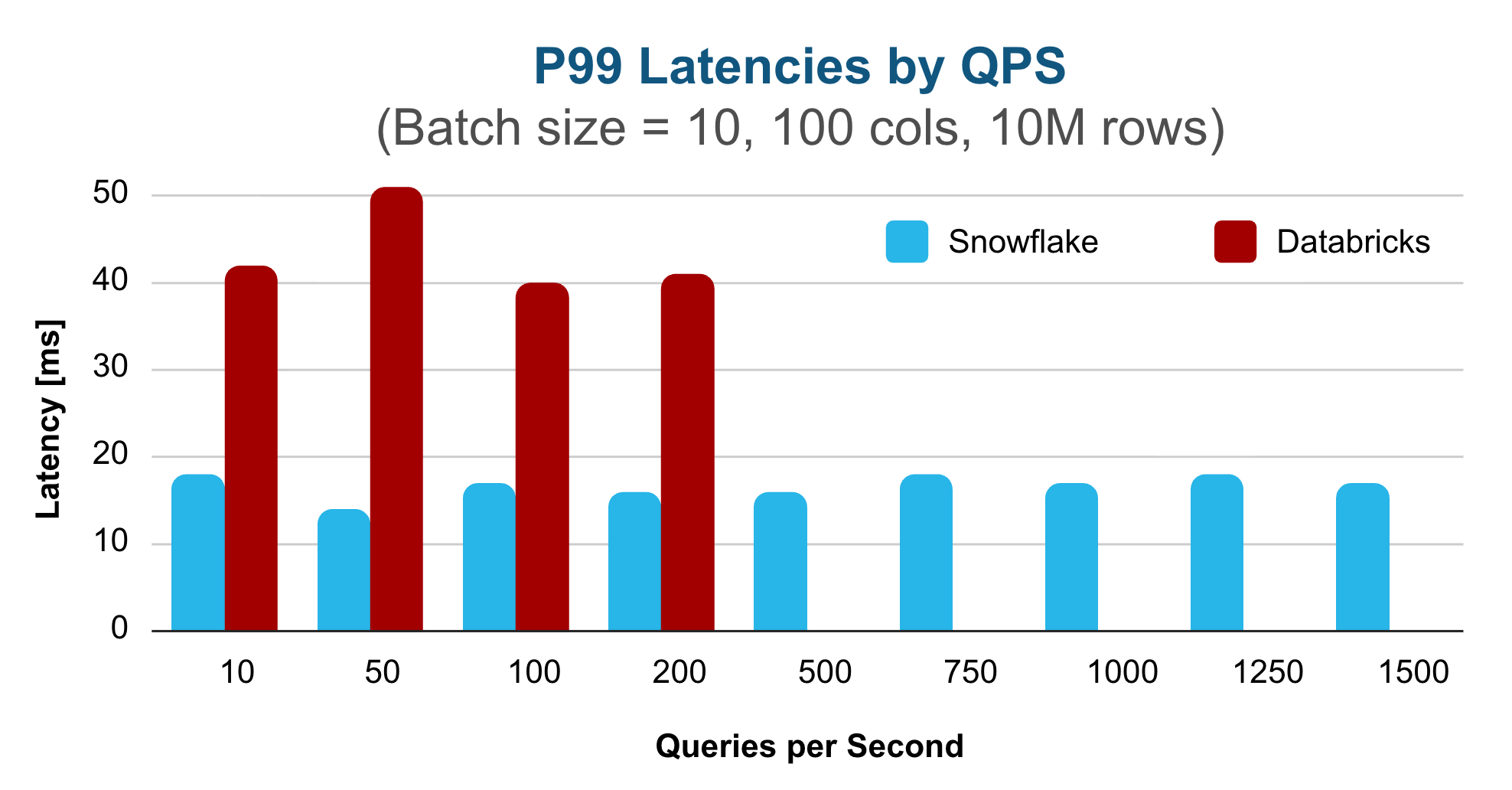
Powering ML with 2.5x lower latency and 7x higher throughput, based on production benchmarks
This is exactly why the ML team at Snowflake bet on Snowflake Postgres to build the Online Feature Store (public preview), which serves fresh, latency-sensitive ML signals — risk scores, activity patterns, behavioral features — to models at prediction time. These workloads require thousands of predictions per second, each needing features returned in milliseconds.
Snowflake Postgres enables the ML team to run complex feature engineering on the core Snowflake engine and seamlessly sync data to the online store. In initial testing, it demonstrated the necessary low latencies without any tuning and easily met the high scalability demands of Snowflake’s largest customers. Choosing Snowflake Postgres also allows the team to tap into the broader Postgres ecosystem, including extensions like pg_vector, to accelerate future feature delivery.
In production benchmarks against Databricks Online Feature Store, which is backed by Databricks Lakebase, Snowflake Postgres demonstrated:
2.5x lower latency at equivalent throughput
7x higher queries per second (QPS) on comparable instances
10ms P50 at 1,500 QPS sustained
How teams are building on Snowflake Postgres
The Snowflake Online Feature Store is just one example. Companies across the globe are leveraging Snowflake Postgres to transform how they approach data. Here’s a look at a few key use cases.
Operational store
Enterprises are consolidating fragmented database estates, retiring legacy systems and streamlining multivendor deployments with Snowflake Postgres, all without rewriting code.
Ericsson collects data across every customer network globally — software versions, hardware, licenses — powering over a thousand use cases from AI to customer support. They consolidated four legacy databases onto Snowflake Postgres, eliminated sync pipelines and cut data processing time by 99%.
SimCorp manages investment data spanning more than 40 years, handling thousands of concurrent transactional updates per minute with complex workflow states and fine-grained locking. After migrating, they saw 10x faster disk operations compared to their previous Postgres solution.
Faster analytics
Fresh operational data should be ready for analysis without the hidden tax of ETL. Snowflake Postgres makes this possible.
Sigma Computing gives their customers live analytics on the freshest transactional data, queried directly inside Snowflake with no external systems or pipeline infrastructure to maintain.
Modern AI and app development
Intelligent apps and agents need immediate access to fresh operational context. Snowflake Postgres is designed to support high-throughput transactions and large-scale analytics, simultaneously, on a single platform.
BlueCloud powers low-latency transactional workloads alongside analytics and AI on one platform, reducing infrastructure overhead and helping their clients move faster.
Superblocks lets developers build full-stack enterprise apps using Snowflake’s coding agent, Snowflake CoCo. Because Superblocks connects directly to Snowflake Postgres, developers get familiar SQL tooling to use against live data, without pipelines.
Snowflake Postgres is faster and more reliable than Lakebase
When evaluating managed Postgres offerings, the differences become especially apparent at scale. Snowflake Postgres stands out with benchmark performance that is approximately 4x faster than Databricks Lakebase.1 It provides a 99.95% published uptime SLA, whereas Lakebase has no public SLA commitment. Snowflake Postgres also supports up to 64 TB of storage, significantly exceeding the 16 TB limit that constrains Lakebase.
Operationally, Snowflake Postgres simplifies management through in-place major Postgres version upgrades with minimal disruption, avoiding painful downtime. In addition, Snowflake Postgres supports standard logical replication, giving organizations greater flexibility for data movement, migration and integration scenarios. Lakebase does not support logical replication.
Together, these capabilities make Snowflake Postgres a great choice for enterprises seeking leading Postgres performance, scalability and resilience.
Get started
Snowflake Postgres is production-ready and generally available today. Snowflake Online Feature Store is in public preview. Check out these resources to get started:
Forward-looking statements: This article contains forward-looking statements, including about our future product offerings, and are not commitments to deliver any product offerings. Actual results and offerings may differ and are subject to known and unknown risk and uncertainties. See our latest 10-Q for more information.
Performance comparisons based on internal benchmarks, April 2026. Actual results may vary by workload, configuration and region.
1 Based on PostgreSQL transactions per minute, comparing Snowflake Postgres HIGHMEM_4XL (96 WH) with Databricks Lakebase 64 CU (96 WH).

