Jun 5, 2026/8 min readCore Platform
Migrations Without the Migraine: Meet the Snowflake AIM Migration Agent


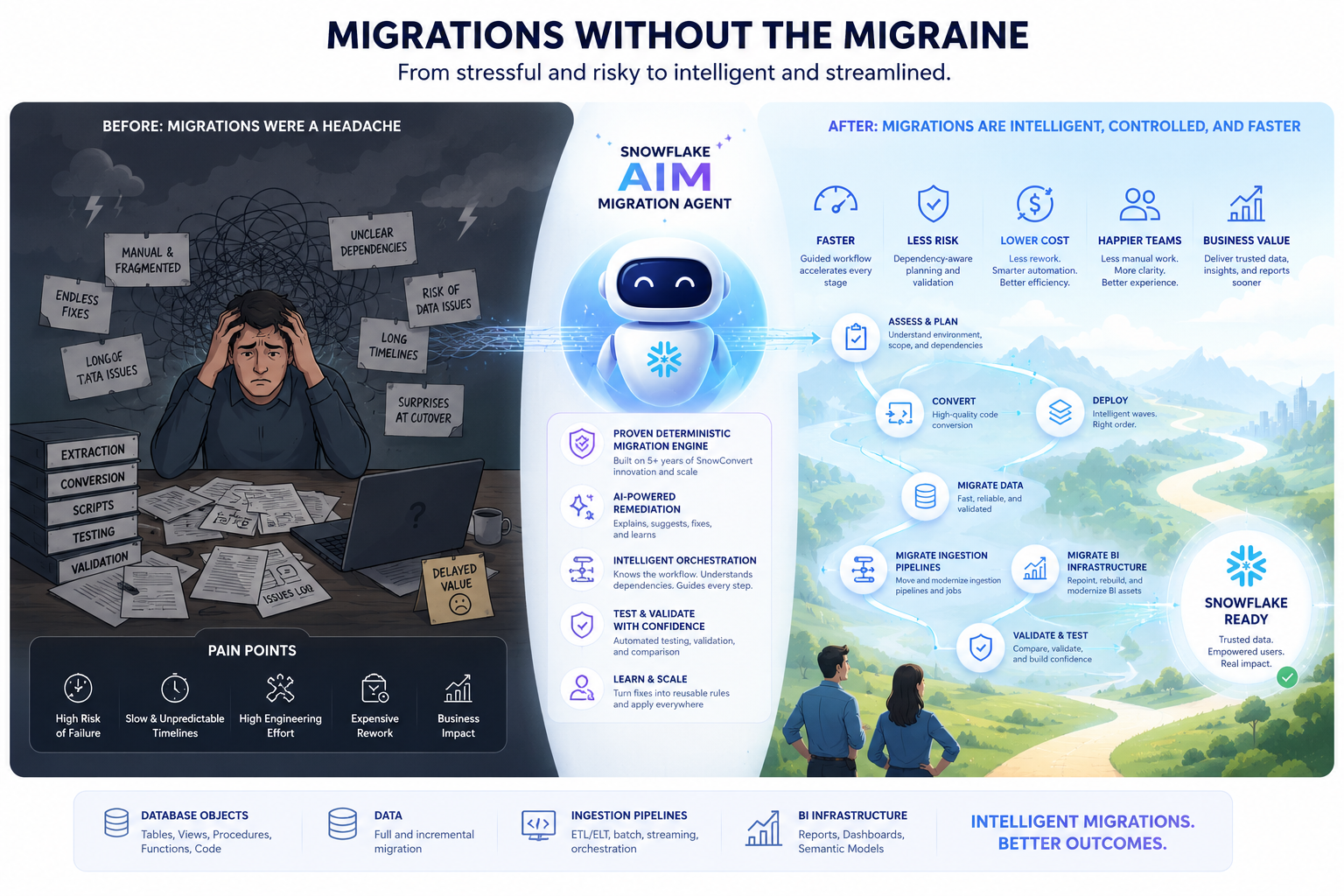
Database migrations have a reputation for disrupting weekends, delaying roadmaps and testing every assumption teams make about their systems. They've earned that reputation through years of late-night cutovers, brittle dependencies and "simple" changes that ripple across entire organizations.
What looks like a schema move on paper quickly becomes a high-stakes orchestration problem. Teams need to understand which objects are actually in scope, which dependencies must move first, which ingestion pipelines feed critical workloads, which dashboards rely on which semantic models or procedures and whether converted SQL and stored procedures will behave the same way after migration. At the same time, they are often coordinating across extraction scripts, conversion tools, spreadsheets, deployment pipelines, testing frameworks, validation jobs, issue trackers and BI migration plans; creating risk at every handoff.
And ultimately, every migration comes down to one question: can the new environment be trusted? A migration is only successful when data lands correctly, pipelines continue running, procedures produce equivalent outputs and reports point to validated, trusted data in Snowflake.
A migration is not just moving tables from one platform to another. It is the process of safely moving an entire analytical ecosystem to Snowflake while managing risk.
That is exactly why Snowflake is changing the migration experience.
The Snowflake AIM migration agent is designed to provide a guided, AI-assisted workflow to enterprise migrations. It combines a deterministic migration engine with AI-assisted remediation, dependency-aware planning, testing, validation and persistent project state in one interactive experience.
The goal is simple: Make migrations feel less like a leap of faith and more like an engineered, observable, step-by-step process.
What is the Snowflake AIM migration agent?
The Snowflake AIM migration agent is an AI-assisted migration orchestrator that guides teams through an end-to-end migration to Snowflake.
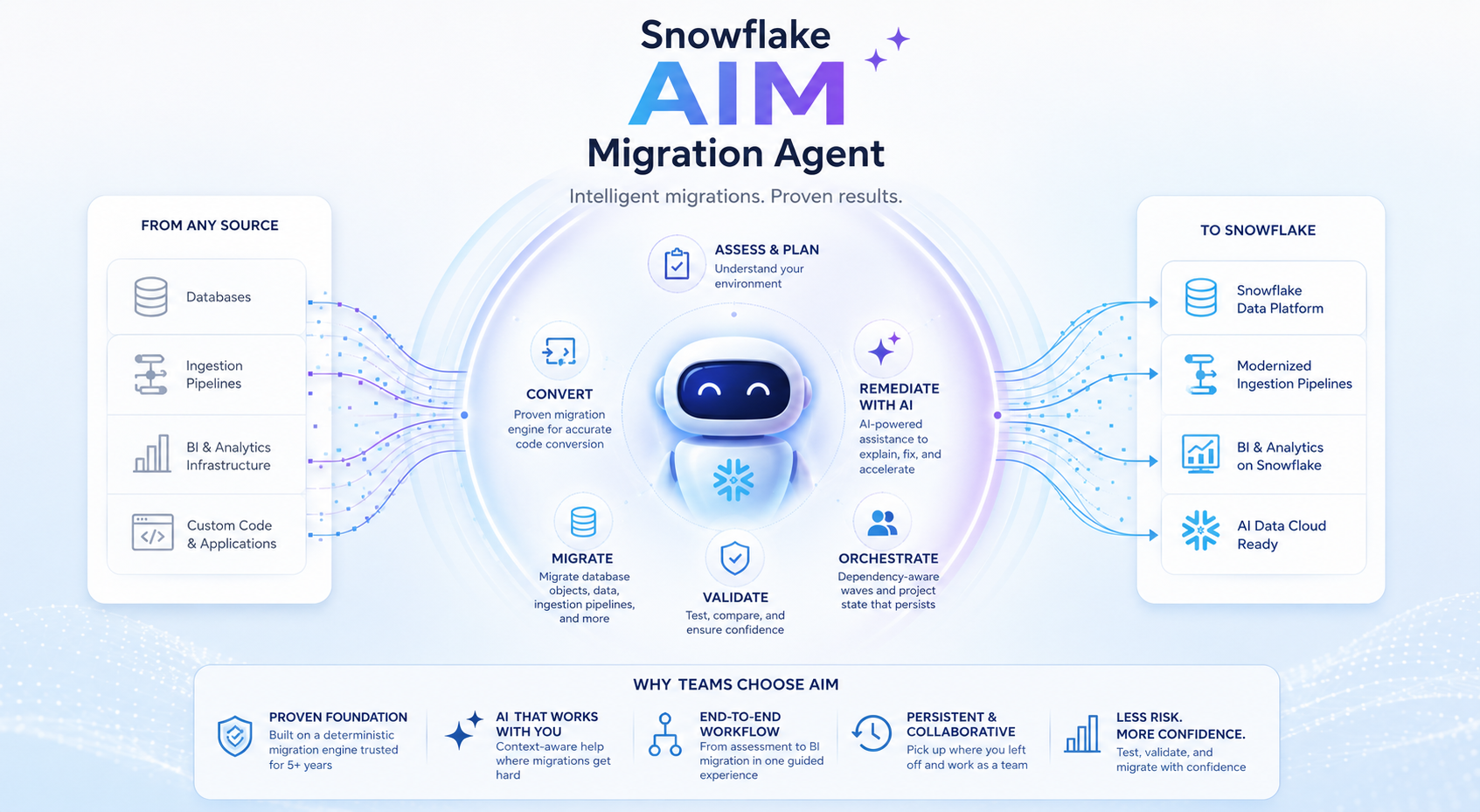
It helps with the full lifecycle: assessment and planning, code conversion, object deployment, data migration, ingestion pipeline migration, BI infrastructure migration, testing, validation and remediation.
Instead of asking migration teams to stitch together tools, remember where they left off, manually sequence hundreds of objects or rely on one-off fixes, the agent provides a structured workflow that understands the migration journey and keeps the project moving.
How does the Snowflake AIM migration agent work?
The agent guides a migration through the major stages of the journey: connecting to the source system, initializing a migration project, registering or importing code, converting SQL, assessing the workload, migrating objects and data, modernizing ingestion pipelines, validating results and moving dependent BI assets toward Snowflake.
The important design choice is that the agent does not replace deterministic migration technology with "AI magic."
At its core, the agent integrates the time-proven capabilities of SnowConvert AI, the migration engine that has been delivering enterprise migration results for more than five years. That deterministic foundation is intended to give teams consistency and repeatability. AI then helps where migrations usually get stuck: explaining remaining issues, suggesting fixes, applying remediations interactively, generating tests, validating behavior and helping propagate successful patterns.
That combination matters. Deterministic migration technology provides precision. AI adds judgment, context and speed where expert engineering time is traditionally consumed.
What makes it different?
The Snowflake AIM migration agent is not just a chat interface in front of documentation. It adds migration-specific structure and automation that a general-purpose coding agent does not have.
It knows the migration stages. It tracks project state. It connects to source systems. It analyzes dependencies. It builds deployment waves. It supports automated testing loops. It helps move data, database logic, ingestion pipelines and BI infrastructure through a coordinated migration process.
It can also help teams turn fixes into reusable rules. That is especially powerful because migrations are full of recurring patterns: a data type mapping, a procedural rewrite, a dialect-specific function, a dynamic SQL idiom, an ingestion transformation pattern or a downstream reporting dependency.
Traditionally, teams fix the same class of issue again and again. With the agent, a correction can become reusable migration knowledge that can be searched, applied and propagated across the project.
In other words, the migration gets smarter as the team works.
When should you use the Snowflake AIM migration agent?
The Snowflake AIM migration agent is a new strategic and recommended way to execute migrations to Snowflake. While the migration application and CLI remain available for targeted workflows and advanced operational control, the agent represents Snowflake's latest approach to migration execution: an intelligent, guided system that orchestrates the entire migration lifecycle from assessment through production readiness.
Customers should use the AIM migration agent whenever they are planning or executing a real migration program — especially for enterprise-scale workloads involving large numbers of database objects, procedural code, data pipelines and downstream analytics dependencies. The agent brings structure, automation and continuous validation to what has traditionally been one of the most complex and risky parts of modernization. It can assess migration scope, organize dependencies, execute migrations in deployment waves, validate outcomes, identify remediation paths and adapt dynamically as issues arise.
This approach is particularly valuable for long-running or multi-team migration initiatives where consistency, repeatability and shared project state are critical. Instead of relying on disconnected scripts, manual coordination or one-off execution patterns, teams can operate through a persistent migration workflow that captures decisions, reuses fixes and provides a transparent path from initial discovery to fully operational Snowflake deployments.
In short, the migration agent is not simply another interface on top of migration tooling — it is the future operating model for migrations to Snowflake.
Why does this matter?
The Snowflake AIM migration agent is designed to help organizations manage migration risk and improve engineering velocity. Most database migrations today are still executed through fragmented, manual and highly specialized processes. Teams often stitch together scripts, spreadsheets, assessment tools, deployment pipelines and human coordination across weeks or months of work. Validation is manual, troubleshooting is reactive and every migration wave introduces operational risk. Even when using traditional migration tooling or CLI-driven automation, the responsibility for orchestration, dependency management, remediation and execution flow still largely falls on the customer team.
The AIM migration agent changes that model completely. Instead of acting as a collection of disconnected tools, it behaves as an intelligent migration orchestrator that continuously guides the process from assessment to deployment and validation. It understands migration state, adapts to issues in real time, organizes dependencies automatically, applies fixes when possible and maintains continuity across long-running projects. The AIM migration agent enables a migration experience that is faster, more repeatable, easier to validate and dramatically less intimidating than traditional migration approaches.
Migrations are shifting from a manual engineering exercise that can slow modernization efforts to become an intelligent, guided workflow that accelerates adoption of Snowflake.
Less uncertainty
The agent makes the project state visible. It can show where you are in the workflow, what has already been done, what still needs attention and what should happen next.
That helps teams replace migration anxiety with a concrete path forward.
Less manual orchestration
Instead of manually coordinating assessment, extraction, conversion, deployment, data movement, ingestion pipeline migration, BI migration, testing, validation and remediation, teams get a guided workflow that moves through those stages.
This is a major shift. The agent helps bring the full migration surface into one coherent process.
Better validation
The combination of deterministic migration technology, dependency-aware planning, baseline testing, validation and AI-assisted fix loops gives teams more confidence that migrated workloads behave correctly.
That confidence matters across the whole stack: database logic, data movement, ingestion pipelines and BI assets.
Better developer experience
Migration work is often repetitive and cognitively expensive.
The agent reduces that burden by guiding the process, preserving state, surfacing issues, suggesting remediations and turning fixes into reusable migration knowledge.
Better economics
Migration cost is not only infrastructure cost. It is engineering time, rework, delays, duplicated fixes, prolonged dual-system operation and business disruption.
By reducing manual effort and helping teams resolve repeated patterns faster, intelligent migration can reduce the operational drag that makes migrations expensive.
Getting started
After installing the prerequisites, teams can create a migration project directory, launch the agent and begin a guided database migration. From there, the agent helps initialize the project, connect to source systems, register migration assets, assess the workload, convert code, deploy objects, migrate data, validate results and continue into related ingestion and BI migration work.
For teams that already have source SQL or previous migration artifacts, the agent can also import existing files into a project and continue from there.
The bigger shift: migrations as intelligent systems
The most exciting part of the Snowflake AIM migration agent is not just that it automates steps. It changes the model.
A migration is no longer a pile of scripts, spreadsheets, tribal knowledge and disconnected workstreams. It becomes a stateful, guided system that combines deterministic migration technology, AI-assisted remediation, dependency planning, testing, validation, ingestion migration and BI migration.
That is the future of migration work: less guesswork, fewer migraines and more engineering confidence.
Migrations may never be trivial. But with the Snowflake AIM migration agent, they no longer have to be scary.
