The Horizon • 6 MIN READ
The industrialization of intelligence will redefine competitive advantage
In the agentic era, what will set a business apart? Snowflake CEO Sridhar Ramaswamy explains why the edge goes to enterprises where people and agents work from the same understanding of the business.


For a long time, companies were organized around a practical constraint: The people who understood a business problem were rarely the people who could build the software to solve it.
AI is beginning to remove that constraint. A marketing leader can move from a question about lead quality to a working tool. Engineers are still indispensable, but instead of translating every request into software themselves, they can build the foundations that let many more people create.
This shift represents the industrialization of intelligence. The ability to build software and apply powerful reasoning is spreading throughout the enterprise. At the same time, the distance between the data platform, the application and the services where work gets done is collapsing. An idea can move from a question about the business to a working application within minutes or hours, and from that application into a workflow, with far fewer handoffs than ever before.
You might expect that to make competitive advantage more evenly distributed. If everyone can put powerful AI to work, surely everyone has the same opportunity to benefit from it.
We have seen something like this before. When the internet made it easy for everyone to publish content, the barriers to creating and distributing fell dramatically. But easy publishing did not put every publication on equal footing. Organizations that understood their audiences earned their trust and consistently gave them something worth returning to became more valuable.
AI is producing a similar shift. As everyone across the enterprise can now access critical data and build with AI, what matters is what AI knows about your customers, your products and the way your business works, and whether it can use that knowledge to do something useful.
Consider asking an agent which overdue invoices need to be chased. It needs to distinguish a missed payment from an approved extension or an unresolved dispute. And to send a reminder, it must know who is authorized to contact the customer. The same business context that makes its answer accurate has to guide the action it takes.
“What matters is what AI knows about your customers, your products and the way your business works, and whether it can use that knowledge to do something useful.”
Disney illustrates the scale of this challenge. A single company spans Disney+, Hulu and ESPN, an advertising business, and parks and resorts, each with its own customers, its own definitions and its own rules about who can see what.
Today at Expedition, Andre Rohe of Disney Entertainment & ESPN described how Disney is putting AI to work across that portfolio. Over time, Disney has built a shared, governed data foundation across its businesses, and its data engineers are now using Snowflake CoCo to build AI operational workflows on that foundation.
The lesson I take from Disney’s journey is that the data and governance foundation becomes more important as more people and systems depend on it. For an enterprise to work this way, people and agents need to share the same understanding of the business. If the definition of an active subscriber changes, it should change at the same time for the analyst, the advertising team and the agent answering questions about it.
“This is where we’re headed: agents and people working hand in hand.”
This is where we’re headed: agents and people working hand in hand. Agents are going to take on substantial work, while people will provide the judgment, oversight and relationships that give that work purpose. As agents begin carrying decisions forward, people will need to determine and define which trade-offs are acceptable, when to intervene and who remains accountable. Getting that relationship right is an organizational challenge as much as a technical one.
Software development is giving us a preview of what this looks like. As software creation becomes industrialized and everyone can build, the next evolution of development is about so much more than writing code faster. It’s about enabling technical teams to hand off substantial development work to agents that have the right context and operate within the right controls.
And today at Snowflake Expedition, we’ve taken the next step toward this future to enable agentic development without limits.
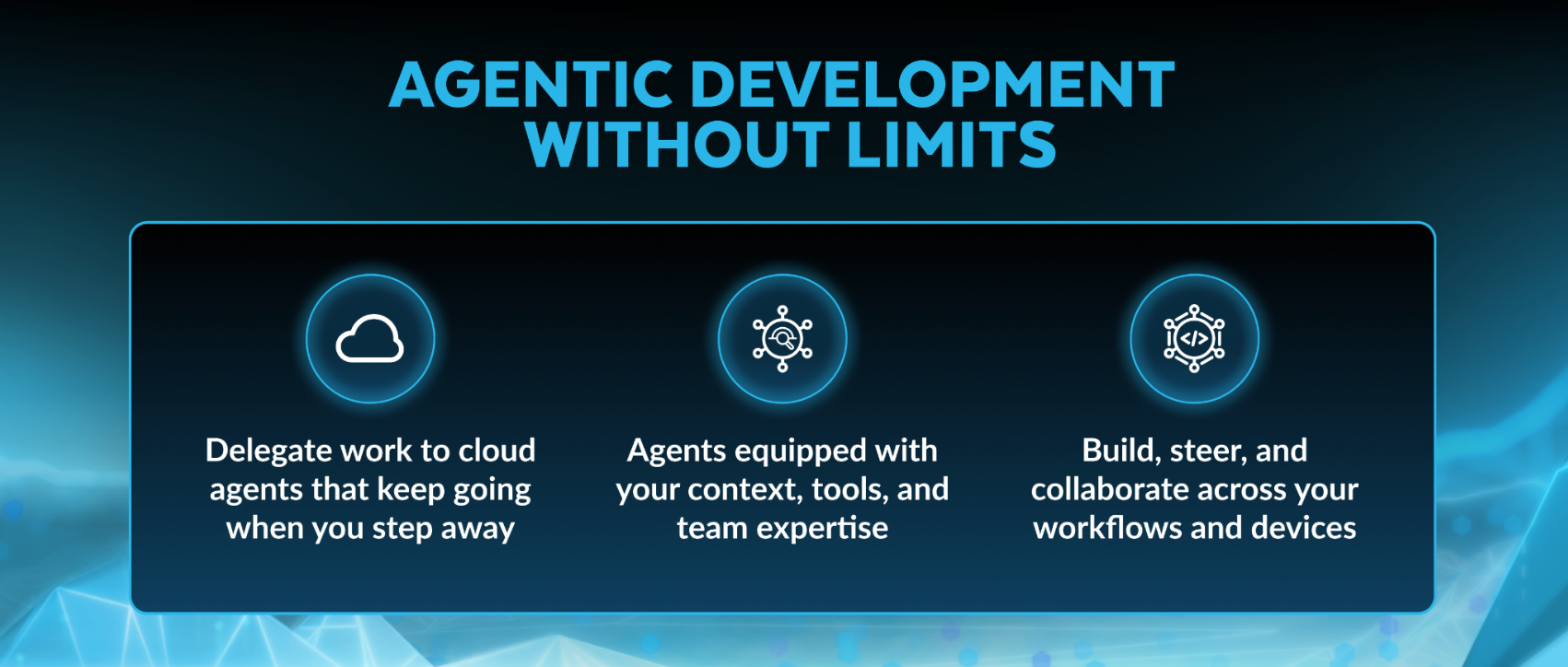
Snowflake CoCo is becoming an autonomous, enterprise-aware development environment. Builders will be able to delegate complex work to agents running in the cloud, and those agents will keep working after they step away. The agents will come equipped with the organization’s context, tools and team expertise. And builders will be able to steer the work and collaborate across their workflows and devices.
That future depends on making business knowledge available to agents and carrying permissions through the work they do. And our latest capabilities strengthen that foundation.
Business Ontology, which will be in public preview soon, makes business meaning available alongside enterprise data. An agent shouldn’t have to guess what “active customer” means from a table name. Today that definition usually lives in people’s heads or in a dashboard someone built years ago. Business Ontology puts it in the data layer, along with the business relationships and governance policies that go with it. When an agent touches that data, it already knows what the data means and what it is allowed to do with it.
And Cortex AI Gateway brings model and tool access under a common set of controls, with traceability and visibility into usage and cost. Now, we’ve added new capabilities that let organizations control tool access and check calls against the user’s permissions. That is a concrete step forward for agentic AI: The question isn’t merely whether an agent can complete a task, but whether it’s authorized to take each action on a person’s behalf.
These capabilities provide the context and controls people need to delegate more work to agents across their everyday business work in Snowflake CoWork and development work in CoCo, while retaining responsibility for the decisions and relationships that matter.
Putting this approach into everyday use also requires better performance and efficiency. Snowflake’s own Frontier Engineering team is advancing both, helping leading enterprises accelerate return on investment for their AI initiatives. As our teams identify how to make evolving model capabilities increasingly useful within the context of a business, their learnings are channeled into Snowflake’s products to benefit all users.
The industrialization of intelligence will fundamentally change how every person across the enterprise operates. I am optimistic that enterprises will be able to put their collective knowledge to work more effectively, with people and agents coordinating across the boundaries that have traditionally slowed them down. And as we embark on this next phase, the advantage will belong to organizations that can carry what makes their business distinct — from data to application to action — and give their people good reason to trust the result.