Jun 2, 2026/11 min readGen AI
ArcticSwarm: Transforming Hybrid Deep Research for Enterprise Intelligence


Summary
- The enterprise AI challenge: Enterprise AI struggles to bridge hard metrics (SQL databases) and messy context (documents/web) without falling into confirmation bias or groupthink.
- The ArcticSwarm solution: A multi-agent system that prevents premature consensus by forcing AI agents to explore data in strict isolation before collaborating to verify findings via a central Bulletin Board System.
- Proven results: In our study, ArcticSwarm achieved higher accuracy than the evaluated single-agent baseline configurations by over a third (64.18% vs. 47.08%) on our hybrid deep research benchmark and drove massive improvements across both structured and unstructured deep research workloads.
- Production-ready: ArcticSwarm concepts are being incorporated into Snowflake CoWork through Deep Research Mode, enabling secure, high-confidence analysis exactly where your governed data lives.
Disclaimer: Results depend on benchmark design, model selection, orchestration strategy and evaluation conditions.
The reality of modern business data: It's hybrid
In today's corporate landscape, enterprise intelligence is fundamentally hybrid. Why? Because the reality of business operations cannot be captured in a single format. Hard operational metrics, such as revenue, inventory counts and usage logs, are locked tightly inside structured relational databases. However, the vital context explaining why those metrics move, whose root cause may include competitor actions, market trends, financial filings and internal strategy memos, is scattered across unstructured webpages and private corporate documents.
This makes hybrid deep research significantly harder than standard deep research tasks. Standard deep research typically focuses heavily on web and document search, navigating massive, messy text corpora. While complex, it relies almost entirely on a single modality: natural language processing. Hybrid deep research, on the other hand, requires an intelligence system to cross a deep structural and linguistic divide. An AI must seamlessly context-switch between the rigid, mathematically exact syntax of SQL and the nuanced, ambiguous reasoning required for unstructured prose, actively reconciling conflicting signals across both domains.
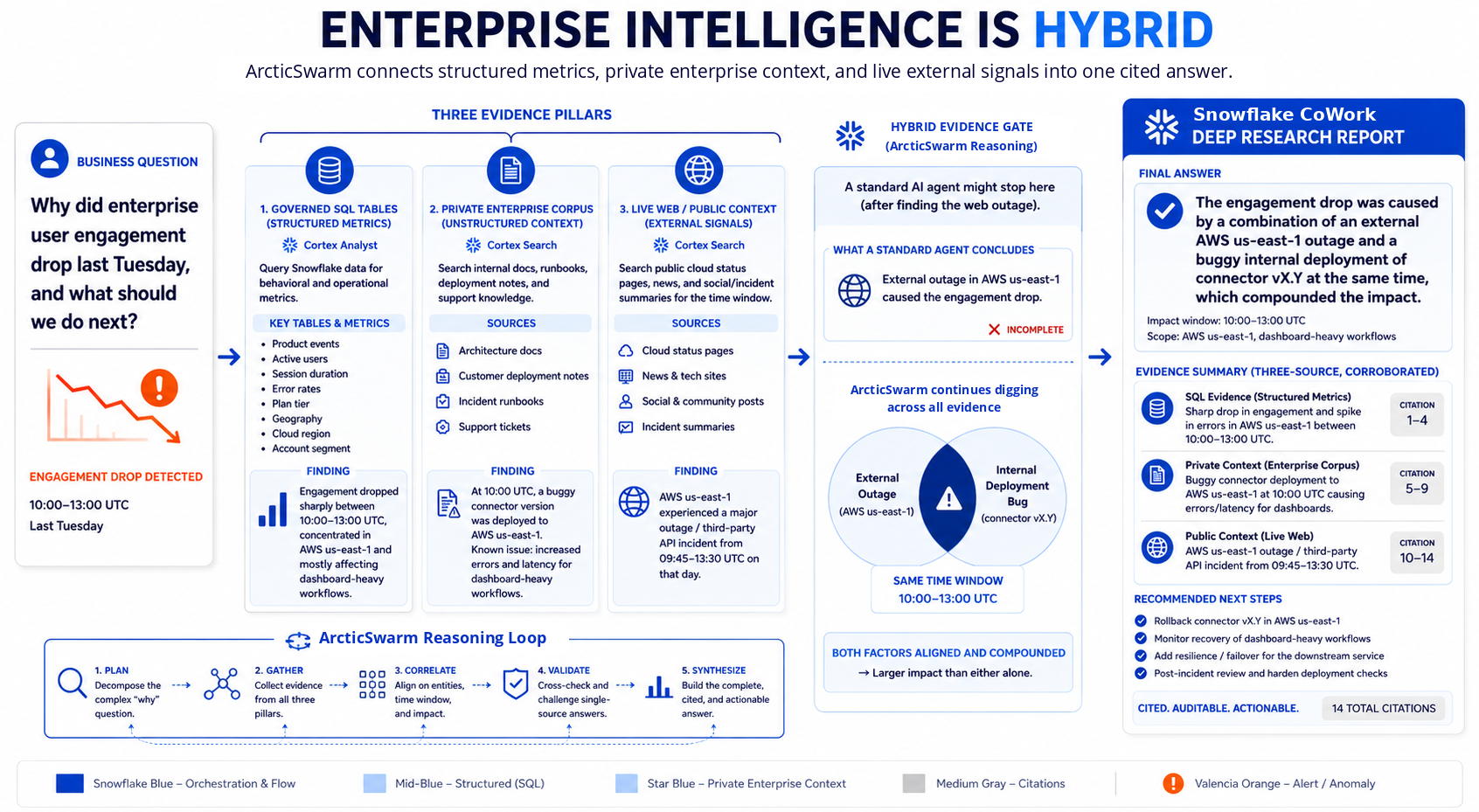
Consider a concrete example of a typical question a business executive might ask during an operational review:
"Why did user engagement drop, and what is the root cause?"
Crucially, a standard AI agent will often stop the moment it finds a convenient answer. If it browses the web and finds a major third-party dependency outage matching the timeline, it anchors on that single source of truth, files the report and closes the case. It completely misses the real story: that a buggy internal deployment went live at the exact same hour, compounding the issue.
Instead, an enterprise-grade system must execute and cross-examine two entirely distinct workflows:
- The internal data track: A coding agent dives into production databases to inspect error rates, active user sessions and deployment timelines to map exactly which customer segments were impacted and when.
- The external signal track: Simultaneously, a browsing agent tracks public status pages, incident reports and news to map external disruptions.
A definitive, trustworthy answer is only achieved when these two lines of evidence meet. By forcing both tracks to run independently before collaborating, the system helps ensure that an external outage isn't used to paper over an underlying internal failure, giving leadership the full, unvarnished truth.
Why traditional AI agents fail at hybrid deep research
Long-horizon deep research is notoriously difficult for standard agent setups that rely on a single, solitary AI model to orchestrate an entire investigation. While this single AI bot can be equipped with web browsers and database query tools, it evaluates all incoming information through one static working memory. In practice, the moment it uncovers its first partial lead, it tends to aggressively anchor on it. Every subsequent web search or database probe becomes an exercise in confirmation bias, spinning around that initial guess rather than objectively evaluating alternatives.
To solve this bottleneck, developers often try distributing the workload, allowing specialized AI workers to run database queries and browse the web simultaneously. However, simply pooling multiple agents together without rigorous coordination rules creates a whole new set of problems. In a hybrid enterprise research environment, traditional, unstructured multi-agent setups inevitably fracture across three critical structural traps:
- The exploration trap (premature consensus): If parallel AI workers share leads too early, they fall into groupthink. Instead of searching independently, the swarm collapses onto the first plausible guess, magnifying one agent's mistakes rather than exploring diverse paths.
- The exploitation trap (low confidence): Without a structured way to evaluate findings across both SQL and unstructured text, agents cannot confidently commit to an answer. Lacking a rigorous audit layer, the system gives up and defaults to answering "Unable to identify".
- The reliability trap (unverified cross-source merges): Bridging messy web prose and rigid SQL rows is difficult. Without an explicit reconciliation layer, orchestrators silently force these sources together. This unverified merge leads to dangerous hallucinations, such as bending database rows to match a faulty web search or executing queries based on blind schema guesswork.
Introducing ArcticSwarm: Teamwork engineered for trust
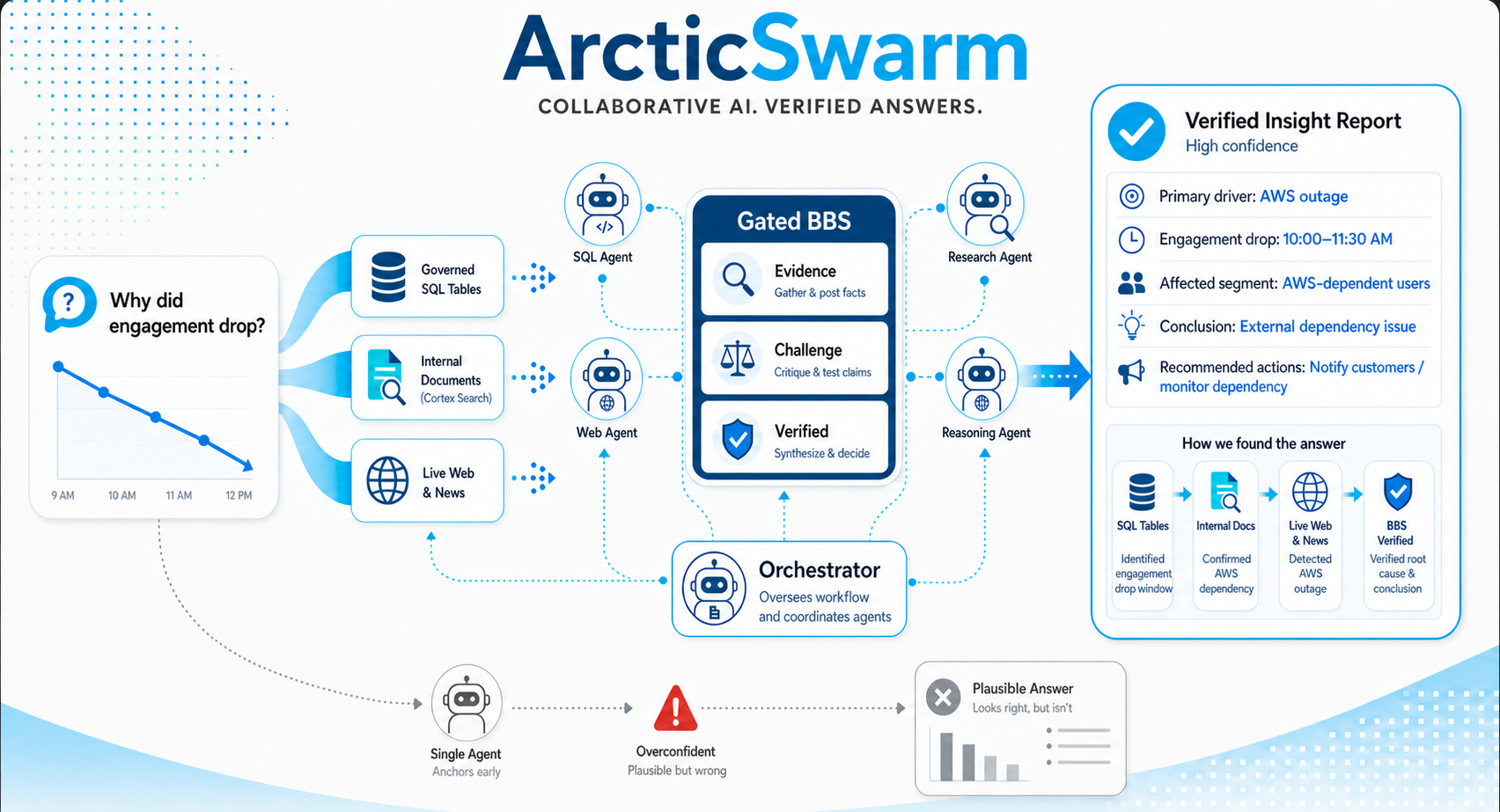
To solve these structural traps, Snowflake AI Research is proud to introduce ArcticSwarm, a dynamic multi-agent system built specifically to unite structured database precision with unstructured web depth. Instead of relying on a single agent or a rigid, sequential pipeline, ArcticSwarm operates as a coordinated team. A central orchestrator automatically spawns up to 16 specialized subagents operating under distinct functional profiles:
- Browsing agents: Highly optimized for web navigation, deep document extraction and search-heavy open-world investigation.
- Coding agents: Specialized in direct database introspection, executing precise queries, parsing complex schemas and supporting precise database querying and structured analysis.
- Reasoning agents: Conditioned for extended thinking, cross-domain reconciliation, candidate comparison and high-fidelity synthesis.
Three traps, three governance modes
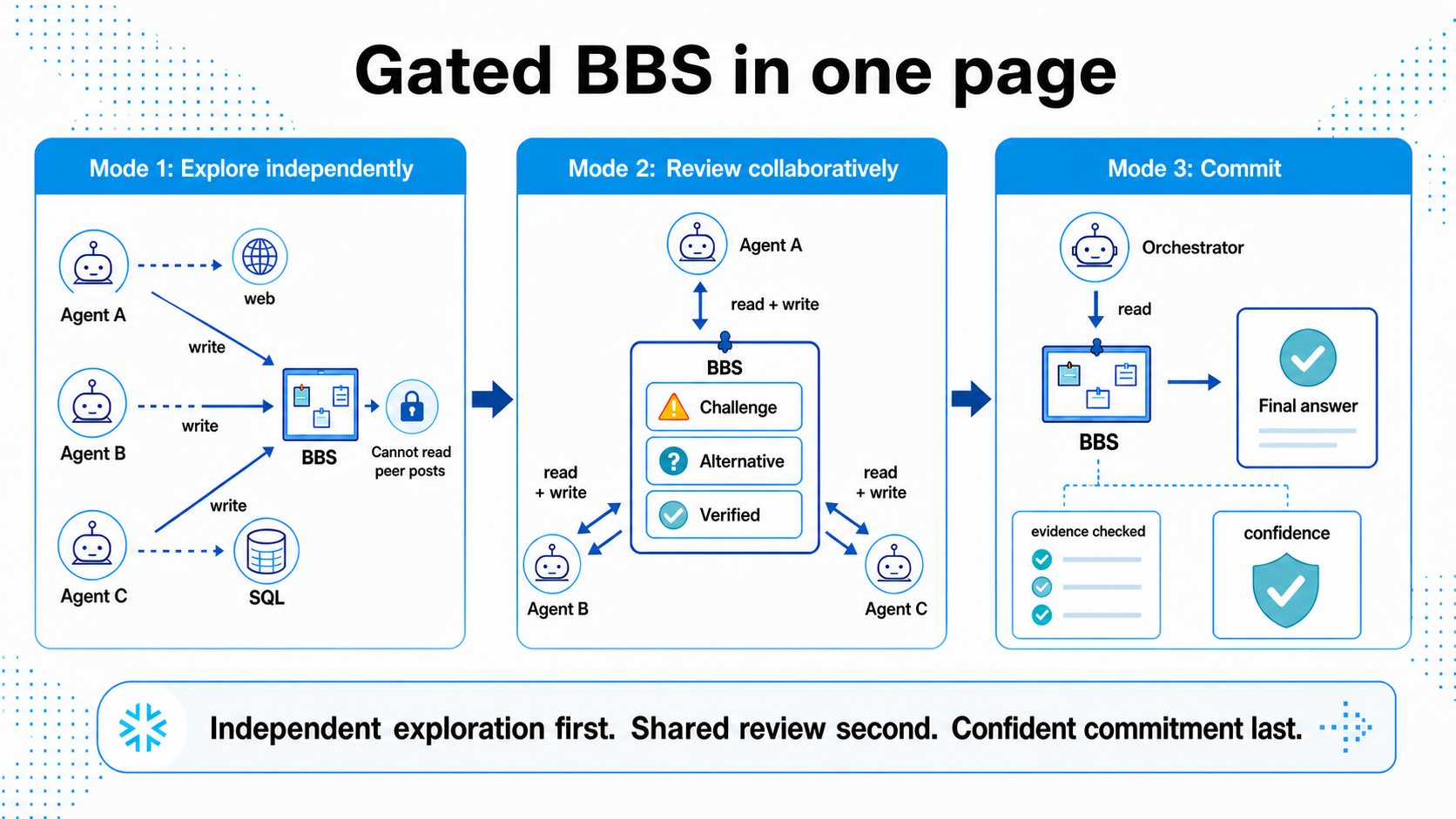
The true innovation of ArcticSwarm lies not in the number of agents, but in how and when they communicate. To prevent premature consensus and groupthink, ArcticSwarm strips away unstructured peer-to-peer chatting. Instead, all communication is strictly governed through a single centralized framework: a Gated Bulletin Board System (BBS). Rather than forcing the entire system into a rigid chronological timeline, the orchestrator dynamically applies three distinct governance modes to subtasks throughout an investigation's lifecycle:
Mode 1: Explore in isolation (defeating the exploration trap)
Whenever the system needs to cast a wide net or attack a problem from fresh assumptions, the orchestrator spawns exploration tasks flagged as strictly isolated. Subagents assigned to these tasks can write to the BBS but cannot read it. This forces them to hunt for evidence independently without being influenced by what is already on the board, guaranteeing diverse perspectives and preventing premature consensus. A coding agent queries internal metrics while a browsing agent combs external filings simultaneously. Because they cannot see each other's early guesses, their trajectories remain structurally independent.
- Database discovery over guesswork: To ensure this isolation yields high-accuracy data, coding agents are barred from guessing schemas. Before writing a decisive query, they must use dedicated lookup and introspection tools to discover the organization's exact business formulas, posting these assumptions transparently to the board. If two parallel data workers pull conflicting definitions, the discrepancy surfaces instantly for the cross-modal review state, rather than silently running a hallucinated query.
Mode 2: Collaborative review and consensus (defeating the exploitation trap)
The moment an individual exploration task concludes, the subagent's role dynamically shifts to a reviewer. Armed with read-access to the BBS, workers begin a rapid, cross-modal audit of each other's hypotheses to reconstruct the incident.
For instance, a coding agent can immediately challenge a web agent's global outage theory by posting database telemetry that isolates the error spike strictly to the us-west-2 region. Simultaneously, a private-corpus agent might surface internal support tickets showing an unannounced microservice deployment in that exact zone, while a browsing agent steps in to verify if the external dependency's public incident logs perfectly overlap with our regional telemetry gap. Finally, a reasoning agent evaluates these moving pieces, drafting a cross-domain synthesis that attempts to reconcile the conflicting signals.
Mode 3: Verify and commit (defeating the reliability trap)
This final state transitions the draft findings from a collection of strong claims into a confident enterprise asset. Before any analysis is officially committed, the orchestrator acts as an uncompromising gatekeeper, enforcing a strict architectural checkpoint: The Hybrid Evidence Gate.
- The hybrid evidence gate: The orchestrator strictly blocks the deployment of the final answer until the BBS satisfies rigid verification milestones. The gate requires that at least two distinct structured SQL evidence posts must be recorded, at least two distinct unstructured browsing posts must be verified and a reasoning agent must provide a final consensus synthesis explicitly reconciling the constraints of both domains against one another.
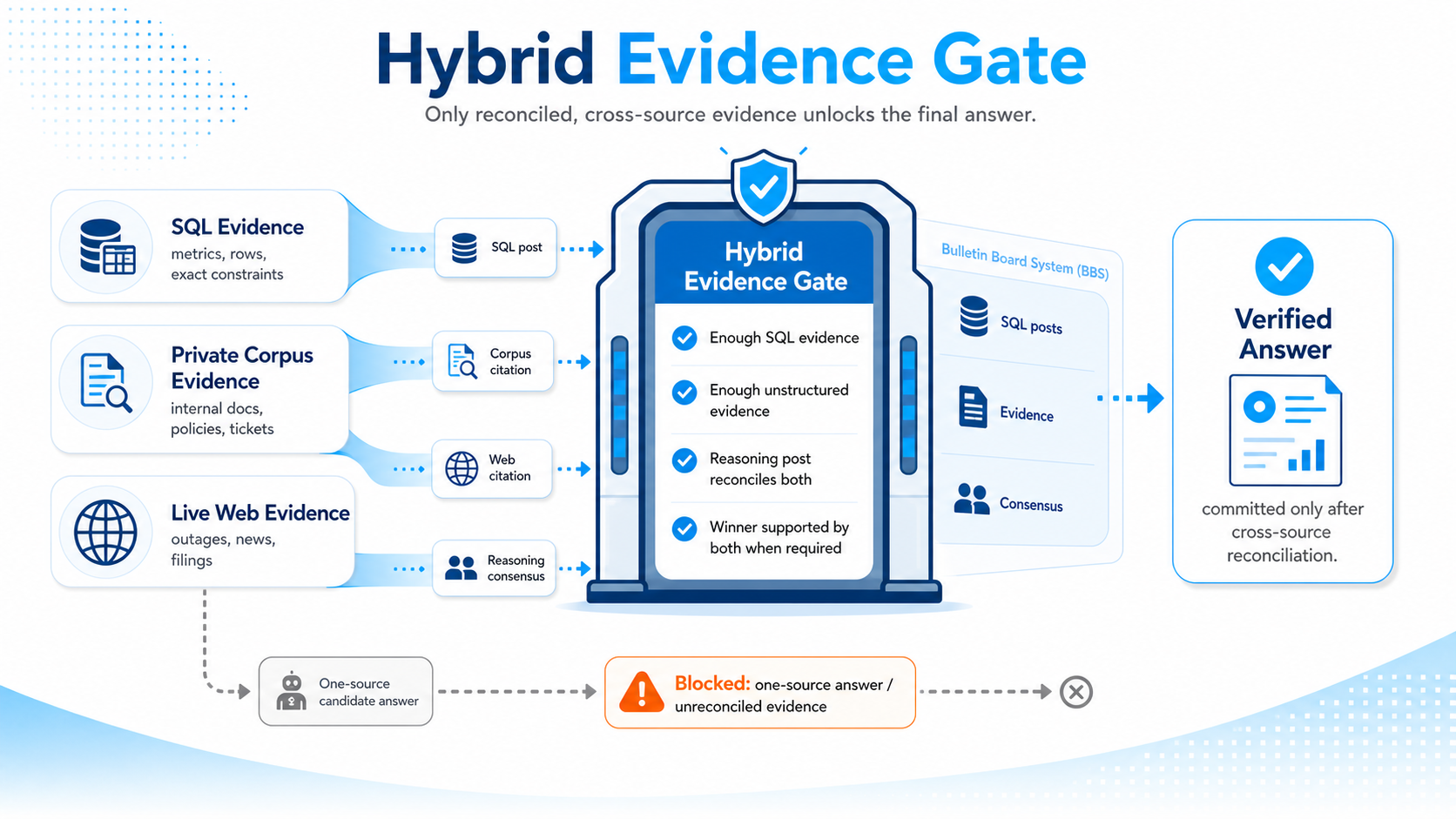
The orchestration layer is configured to require these validation milestones before generating a final synthesized response, delivering a traceable research workflow designed to improve confidence and transparency in enterprise analysis.
Proven performance on benchmarks
To rigorously evaluate these capabilities, we tested ArcticSwarm across three distinct styles of deep research workloads: hybrid, purely unstructured and purely structured. Across all three setups, we compared ArcticSwarm against various other industry solutions and standard single-agent baselines to demonstrate the clear advantage of its coordinated architecture.
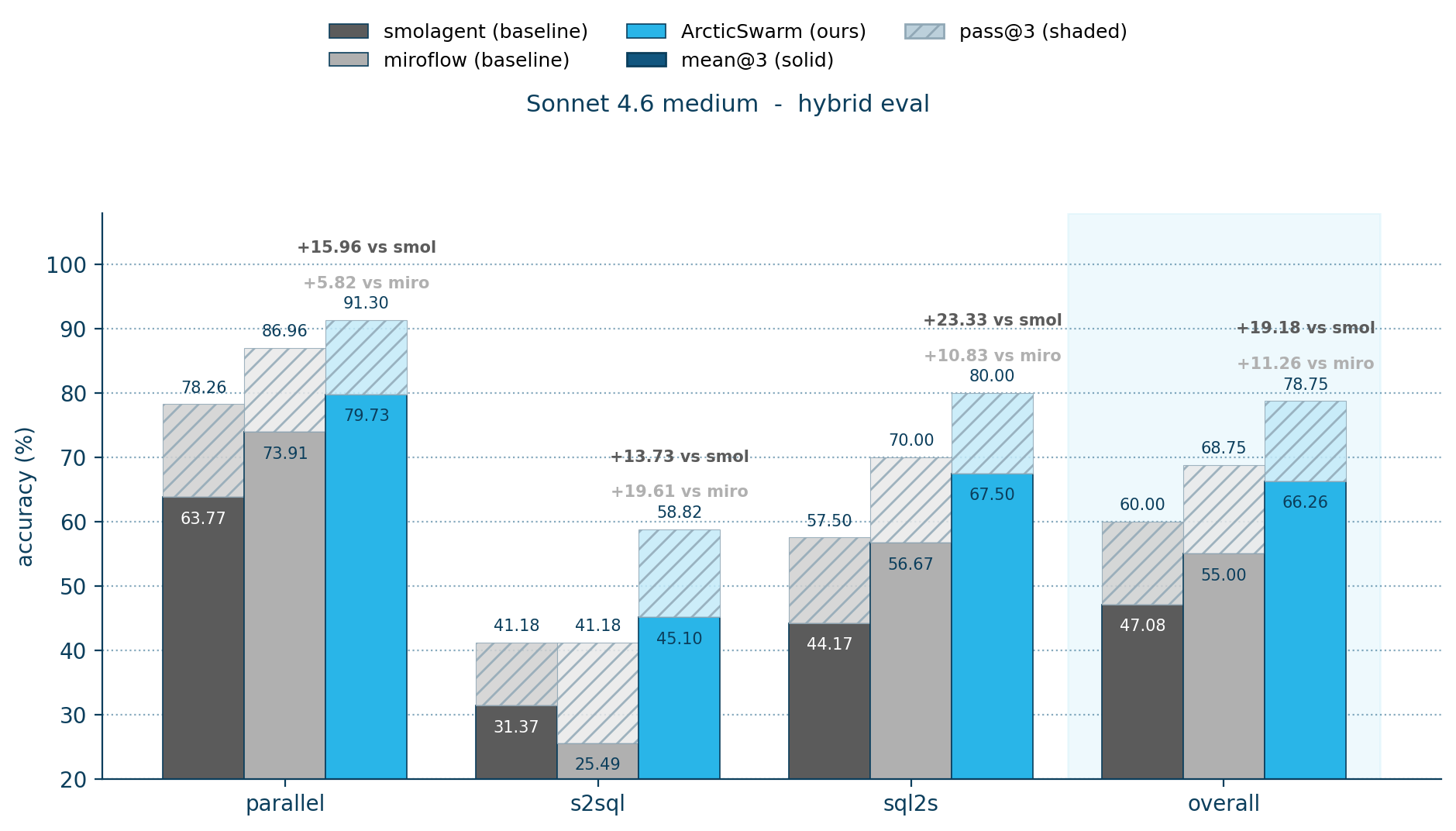
First, to evaluate these capabilities under rigorous conditions, we measured ArcticSwarm on our new Hybrid Deep Research standard (HybridDeepResearch). This benchmark features complex, real-world style tasks that are strictly impossible to solve using either isolated SQL execution or web search alone.
The evaluation shown in Figure 5 highlights how heavily a model's reliability depends on its surrounding coordination architecture: In the evaluated benchmark configuration, ArcticSwarm achieved higher measured accuracy than the tested single-agent (smolagents) and free-communication multi-agent (MiroFlow) reference implementations by 19.18% and 11.26% respectively.
While these results show that ArcticSwarm's architecture excels at conquering complex hybrid scenarios, real-world enterprise workloads are inherently unpredictable. We cannot assume that every question thrown at an intelligence agent will neatly bridge both worlds at all times. To be truly enterprise-grade, a deep research agent must be completely robust even when a task leans entirely into a single modality — whether that means navigating massive, messy web text or performing intense, multi-step code and schema analysis over internal databases.
To validate ArcticSwarm delivers strong performance across diverse workloads, we also stress-tested the system on purely unstructured and purely structured deep research workloads.
A) Unstructured modality: Web and corpus deep research
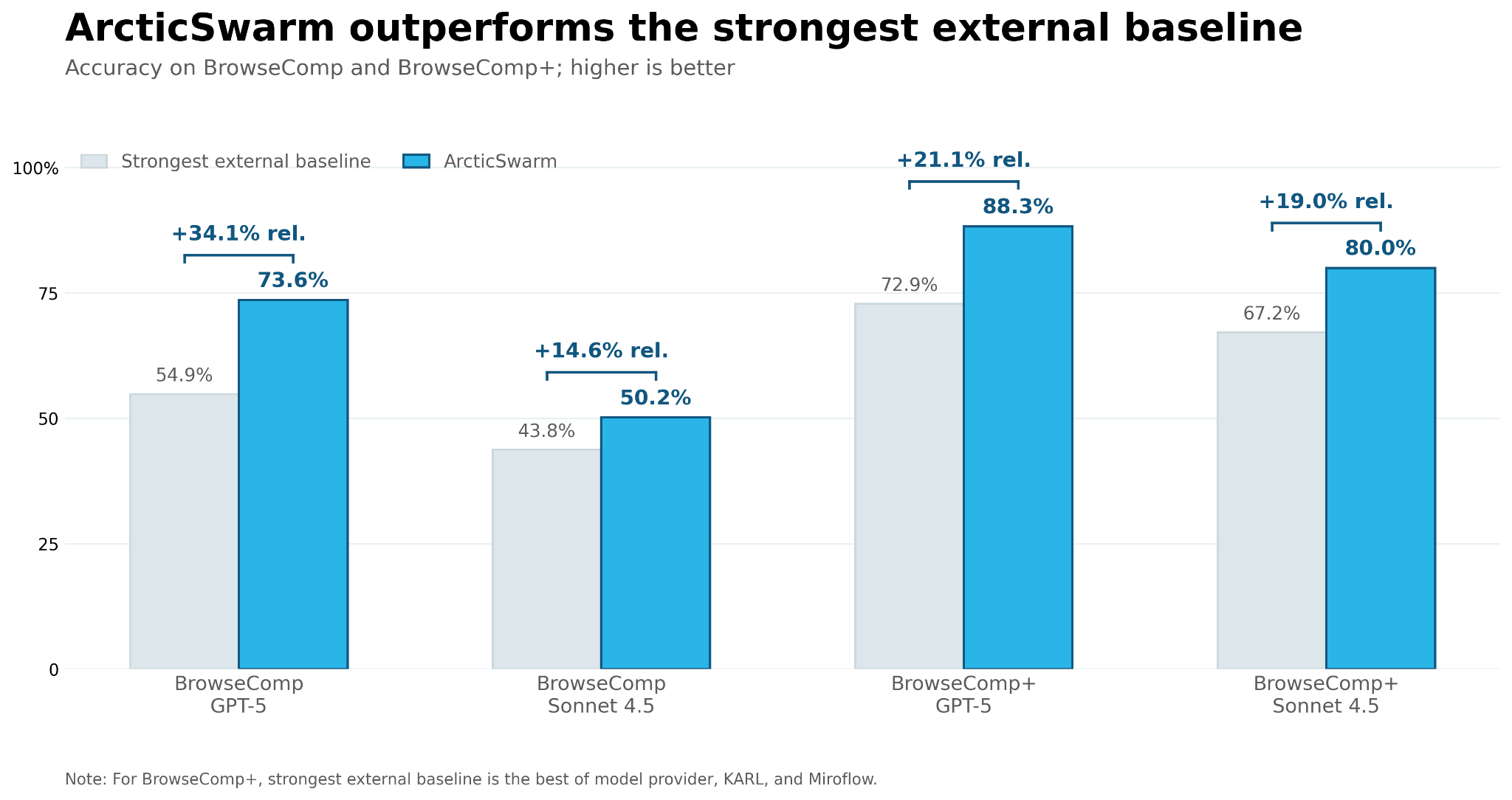
To measure open-world text retrieval and long-horizon synthesis, we evaluated ArcticSwarm on the BrowseComp (live web searching cross-referencing four to seven live properties) and BrowseComp-Plus (retrieval against a massive curated corpus of ~100K documents) benchmarks. Models evaluated here are GPT-5 and Claude Sonnet-4.5, which are chosen due to better availability of publicly available benchmarking results.
In our evaluated benchmark configurations, ArcticSwarm also achieved higher measured performance than the referenced comparison systems across the tested unstructured research benchmarks: As shown in Figure 6, ArcticSwarm demonstrated relative performance improvements ranging from 14.6% to 34.1% compared with the tested reference systems.
B) Structured modality: Deep database analytics
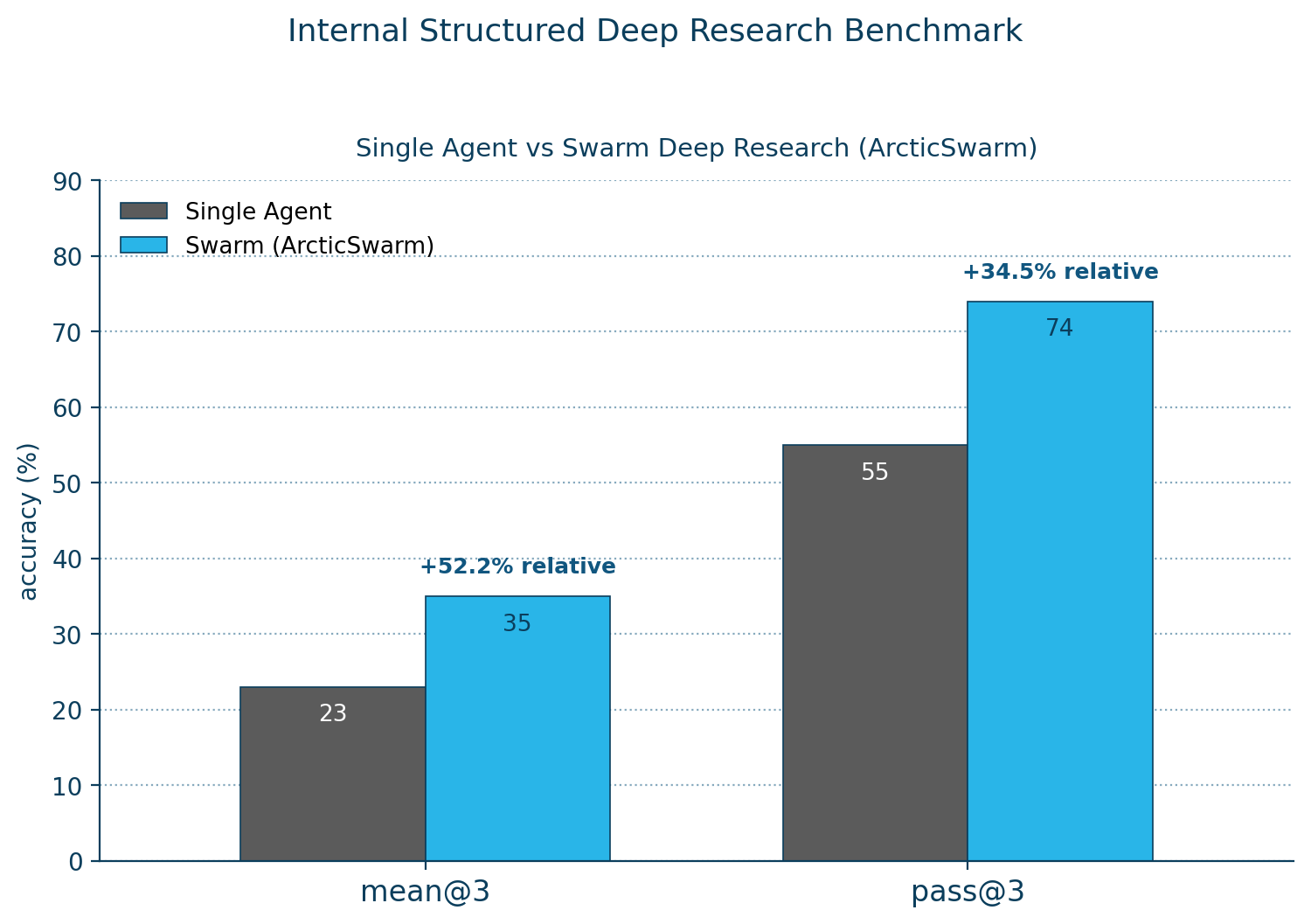
On the other side of the data spectrum, we tested ArcticSwarm production implementation against our internal benchmark for structured deep research that focuses on deep investigation inside databases. This evaluation targets complex, purely database-driven questions that require intensive schema exploration, writing intricate multi-layer SQL joins and executing code chains without any web dependencies.
Traditional single agents struggle here because they lack the guardrails to double-check their schema assumptions, resulting in syntactically correct queries that output completely incorrect data points.
By forcing coding workers to use dedicated introspection tools and cross-verify schema formulas openly on the BBS, ArcticSwarm achieved a 52.2% relative improvement in analytical accuracy over the evaluated single-agent baseline configuration, as shown in Figure 7.
Bringing deep research to Snowflake CoWork
Moving beyond a mere research preview, we are thrilled to bring this precise multi-agent architecture directly into customer hands via the new Deep Research Mode in Snowflake CoWork (as captured in the session snapshot in Figure 8). Rebuilt from the ground up for production scale, this mode satisfies three uncompromising enterprise requirements:
- Native data integration: ArcticSwarm operates natively over the structured tables, secure internal documents and Cortex Search corpora already sitting inside your Snowflake perimeter. Deep research operates directly against supported enterprise data environments, helping reduce operational overhead while supporting existing governance controls.
- Server-side security and privacy: The Gated BBS infrastructure is implemented entirely on the server side via high-performance Redis caches. Every intermediate agent finding, SQL query row and cross-agent challenge remains within supported enterprise governance boundaries and deployment architectures, and it supports encryption controls consistent with Snowflake platform architecture.
- Actionable, visual reporting: Deep enterprise analysis shouldn't conclude with a dense wall of text or an unreadable code transcript. Deep Research Mode seamlessly translates its final synthesis into dynamic, visual executive reports and presentation-ready charts.
By implementing diversity by design, which is designed to encourage independent exploration during early investigation and structured reconciliation before final synthesis, ArcticSwarm offers secure, high-confidence insights enterprise leaders can act upon.
Forward-looking statements
This content contains forward-looking statements, including about our future product offerings and capabilities, which are subject to change without notice and are not commitments to deliver any functionality. Actual results and offerings may differ materially and are subject to known and unknown risks and uncertainties.