Oct 22, 2026/7 min readAnalytics
Agentic Analytics: Building a Data Foundation for AI Agents

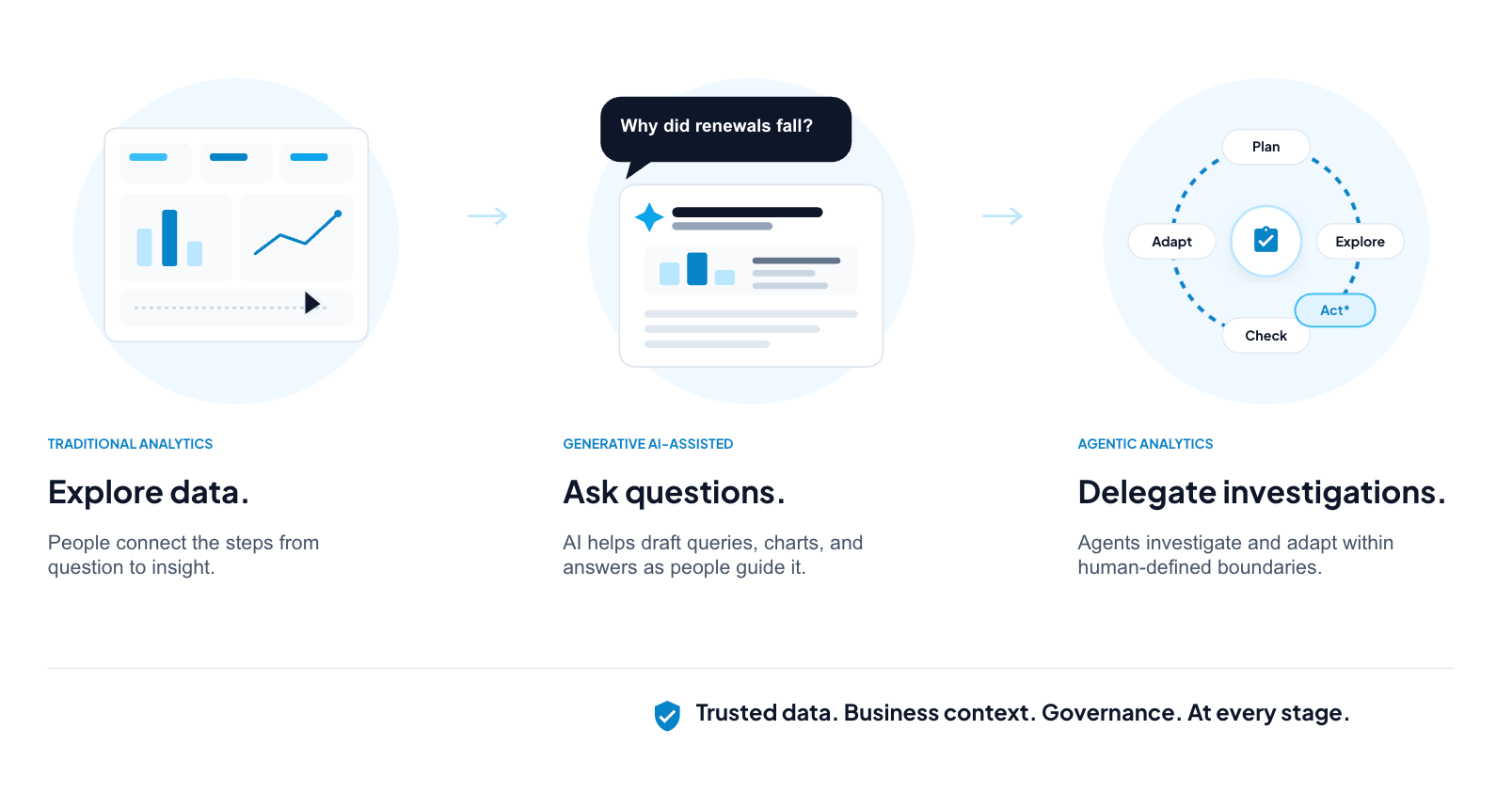
For decades enterprise analytics depended on people to drive every step. Then dashboards started showing what happened, and generative AI made it easier to summarize and explain. Now agentic analytics is the next shift: An AI agent investigates a business question by deciding what data to examine, learning from each result and choosing what to do next until it can provide an answer or take an approved action.
Consider a team investigating an increase in customer churn. An agent could compare customer segments, examine changes in product usage and investigate support issues within the affected accounts. If one explanation does not hold up, it can pursue another. It can then bring the findings and a recommended response into a retention workflow. The team delegates the investigation rather than directing every query.
That changes what the data platform must provide. The agent needs to know which sources and business definitions to trust. Each finding can lead to a different query, so analytical execution must support an investigation whose path is not known in advance. Access and action boundaries must hold throughout.
Snowflake brings these requirements together where enterprise data lives, providing business context to guide the investigation, query optimization and compute options to support its changing workload, and governed interfaces to carry outcomes into business workflows. This foundation supports agents built on Snowflake or connected from other platforms.
Most enterprises will not standardize on one agent platform
Sales, finance, engineering and support teams may each adopt different assistants and automation frameworks.
Requiring every agent to live inside one application stack would limit choice and often lead to unnecessary data movement. A more durable approach is to keep business context, analytical execution and governance close to the data while making them available through interoperable interfaces.
Standards and governed interfaces, including the Model Context Protocol (MCP), semantic views and SQL objects, can allow authorized agents to discover trusted context and analyze enterprise data without duplicating it into every AI platform.
Snowflake's platform pillars, wrapped in governance
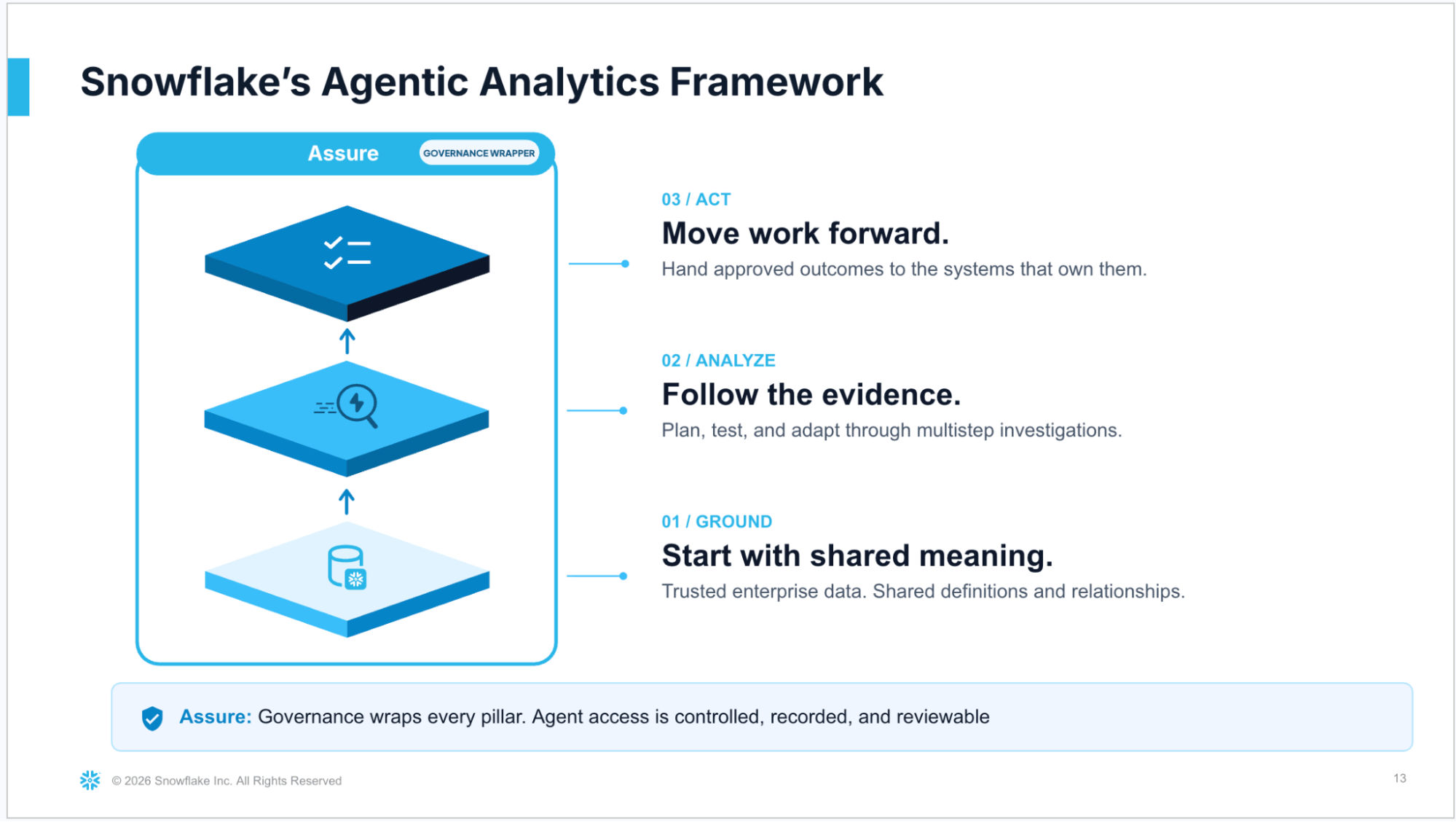
Snowflake's approach to agentic analytics is built on three platform pillars: Ground, Analyze and Act. Agents must be able to ground their work in a trusted business context, analyze data at machine speed and act on an approved decision. Wrapped around all three is governance, which we call Assure. Here, Snowflake controls manage access to data, set limits on what agents can spend and record agent-driven queries and data access. As agents move from answering questions to initiating actions, a mistake can reach a business process and the customers it serves. Data access controls must therefore work alongside the permissions and approval rules configured in the business workflow. Snowflake applies its data controls, which are attached to the data, whether access comes from an agent built on Snowflake or connected from another platform. Each pillar helps this happen, as described below.
1. Ground: Provide machine-readable business context
Agents can access a table without knowing what its numbers mean, how the business defines revenue or whether the data is current and reliable.
An agentic analytics platform must have authoritative definitions of business entities, relationships and metrics, alongside information about data freshness and quality. Snowflake brings trusted data discovery, shared business definitions and relevant business knowledge together through Snowflake Horizon Context, semantic views and Snowflake Cortex Search. Verified queries give agents tested examples of how metrics should be answered, and certification tags point them to the tables the team trusts. Data Metric Functions monitor quality dimensions such as completeness and uniqueness, while Dynamic Tables refresh derived data toward a configured freshness target. These capabilities help teams assess whether the data is suitable for an agent's analysis.
In Ground, Assure works by keeping access policies attached to the data itself, so any agent or BI tool using a semantic view sees only what it is permitted to see.
2. Analyze: Gather evidence at machine scale
An agent's investigation changes as it learns. It may begin with a broad comparison, narrow to a customer segment, join another source and revisit an earlier finding. Supporting this work means more than handling additional queries. It requires efficient execution as query patterns change, with capacity for concurrent investigations.
Snowflake's compiler and optimizer plan how each query executes. On Gen 2 and Adaptive Warehouses, Snowflake Optima uses observed workloads to improve query planning and data access automatically, reducing the need for manual tuning. Eligible repeated queries can reuse persisted results rather than repeat the computation.
Different analytical steps also have different performance needs. Snowflake Interactive Analytics supports low-latency, high-concurrency execution for highly selective queries, while standard warehouses handle complex, compute-intensive analysis. As concurrency grows, multi-cluster warehouses add capacity within configured limits. Together, these capabilities help support agents' iterative workloads without requiring teams to anticipate every query in advance.
In Analyze, Assure allows configured policies to recognize agent-active sessions and restrict the data available to an agent, even when the user's role permits broader access. Resource monitors and budgets track agent compute spend and can trigger actions at thresholds you set, and statement timeouts stop runaway queries.
3. Act: Carry the decision into the business process
An agent's work has limited value if an approved outcome cannot reach the application or team responsible for carrying it out.
An agentic analytics platform must be able to persist that outcome or hand it off through governed interfaces, while leaving the existing business application in control of the process. Workflows can store approved outcomes and their supporting evidence in Snowflake, making them available to the systems that own the business process. In practice, the agent recommends a possible next step and shows its evidence. A person reviews it and decides whether it goes forward and whether the agent hands it off or they act on it themselves. Approved outcomes can reach the owning application through an MCP connector or a Snowflake table, and that application stays in control. Consequential actions go to a person for approval, while routine ones can run under rules people approved in advance.
In Act, Assure provides records of agent-driven queries and data access that teams can combine with workflow records to review the resulting action.
What sets Snowflake apart in agentic analytics
The value of agentic analytics lies in carrying a business question through investigation to a useful response with less manual coordination between steps.
Snowflake's advantage is connecting the capabilities that work requires. Shared business definitions guide the investigation. Automatic query optimization, result reuse and workload-appropriate compute support analytical execution. Workflows can persist outcomes and supporting evidence for the applications responsible for acting on them. Assure applies access controls, supports spending controls and records agent-driven data activity across that work. Agents built on Snowflake or connected from elsewhere can use this common foundation rather than assemble separate analytical foundations for each platform.
People set the goals, the definitions and the actions agents may take on their own. Agents apply that knowledge repeatedly and escalate consequential decisions through review workflows. The goal is more agent autonomy within boundaries people define.
Join us for Expedition to see the latest in agentic analytics.
Forward-looking statements
This article contains forward-looking statements, including about our future product offerings, and are not commitments to deliver any product offerings. Actual results and offerings may differ and are subject to known and unknown risk and uncertainties. See our latest 10-Q for more information.