Inference-Time Distillation with KL Clipping on Snowflake
Overview
Duration: 5
This quickstart walks you through a single self-contained Snowflake Notebook that trains a small student LLM using two on-policy distillation methods, evaluates them with paired statistics, and exposes the gradient-geometry intuition behind why one method needs a stability trick.
You will run, on a Snowflake GPU compute pool:
- OPD (On-Policy Distillation) — student samples its own rollouts; a frozen Mixtral-8x7B teacher provides per-token reverse-KL signal on those rollouts.
- OPSD (On-Policy Self-Distillation) — same student plus a self-teacher: a frozen copy of the student that is given the gold answer in its system prompt (the "privileged information" trick).
- KL clipping — the small change that stops OPSD from collapsing.
- Unified meta-algorithm — one
unified_stepfunction that reproduces SFT-RS, RL-outcome, OPD, and OPSD by toggling three knobs(alpha, lambda, pi_T). - A calibrated PRM judge over the Cortex REST API — process reward model with deterministic step segmentation, hash-keyed cache, and Spearman / AUROC calibration against verifier ground truth.
- A statistically honest evaluation suite — Wilson 95% confidence intervals, McNemar paired tests, bootstrap CIs on the gap, pass@k, and difficulty bucketing.
Prerequisites
- A Snowflake account with Cortex REST API access (
/api/v2/cortex/inference:complete). - A GPU compute pool with at least 40 GB VRAM (A100-40GB, A100-80GB, H100-80GB, or
GPU_NV_M-class). The notebook auto-detects VRAM and falls back to 4-bit + LoRA when memory is tight. - A Snowflake Notebook environment configured against that compute pool. Default hint in the notebook is
DISTILL_GPU_POOL. - Network rule + External Access Integration that allows egress to
huggingface.co. The studentmistralai/Mistral-7B-Instruct-v0.2is downloaded from HF; no HF token required, the model is ungated. - Familiarity with Python notebooks. No prior knowledge of distillation theory is assumed.
What You Will Learn
- The mathematical relationship between OPD, OPSD, SFT, and RL as four settings of a single objective
(alpha, lambda, pi_T). - Why on-policy reverse-KL signal is concentrated on a small set of "pivot tokens" under OPSD and why that destabilises training without clipping.
- How to call the Cortex REST API directly (HTTP, not SQL) from inside a Snowflake Notebook for teacher rollouts and PRM judging.
- How to evaluate a small LLM with paired statistics (Wilson, McNemar, bootstrap CI) instead of point estimates.
- How to graduate a PRM judge from skeleton to calibrated, against AUROC and precision/recall on student rollouts.
What You Will Build
A Snowflake Notebook (inference_time_distillation_kl_clipping.ipynb) shipped with this guide, organised as:
| Section | Topic |
|---|---|
| 0 | Setup, bitsandbytes preflight, model load |
| 1 | Task and verifier (GSM8K) |
| 2 | Helpers — rollout, logprobs, per-token KL, eval statistics |
| 2.4 | Eval methods quick reference |
| 2.5 | Cortex REST API teacher evaluation |
| 2.5b | Local Mixtral-8x7B teacher evaluation (the OPD ceiling) |
| 2.6 | PRM judge — deterministic segmentation + hash-keyed cache |
| 2.6b | PRM calibration — Spearman rho + AUROC vs verifier |
| 2.7 | Pass@k for the student |
| 2.7b | RS-SFT filter quality |
| 3 | Student baseline |
| 4 | OPD step with the local Mixtral teacher |
| 5 | OPSD step with the privileged-info self-teacher |
| 6 | Gradient geometry — diffuse OPD vs concentrated OPSD |
| 7 | KL clipping demonstration |
| 8 | Gradient taxonomy |
| 9 | Unified meta-algorithm with (alpha, lambda, pi_T) |
| 10 | OPD vs OPSD trend summary |
| 11 | Takeaways |
The notebook is included as an asset of this guide:
Setup the Notebook
Duration: 10
Configure your compute pool
Create or reuse a GPU compute pool with at least 40 GB VRAM. The notebook prints the detected GPU and decides at runtime whether to use 4-bit + LoRA.
Bitsandbytes preflight
Snowflake Container Runtime ships an older bitsandbytes than current transformers expects. Section 0 of the notebook installs bitsandbytes>=0.43.1 and a few peer pins, then runs a hard preflight that prints the torch CUDA build, the bitsandbytes import status, and transformers' is_bitsandbytes_available() verdict. If any of these fails, the cell raises a RuntimeError with the specific cause (no GPU, broken bnb wheel, stale lru_cache).
After the install completes the first time, restart the kernel so transformers re-imports the new bitsandbytes.
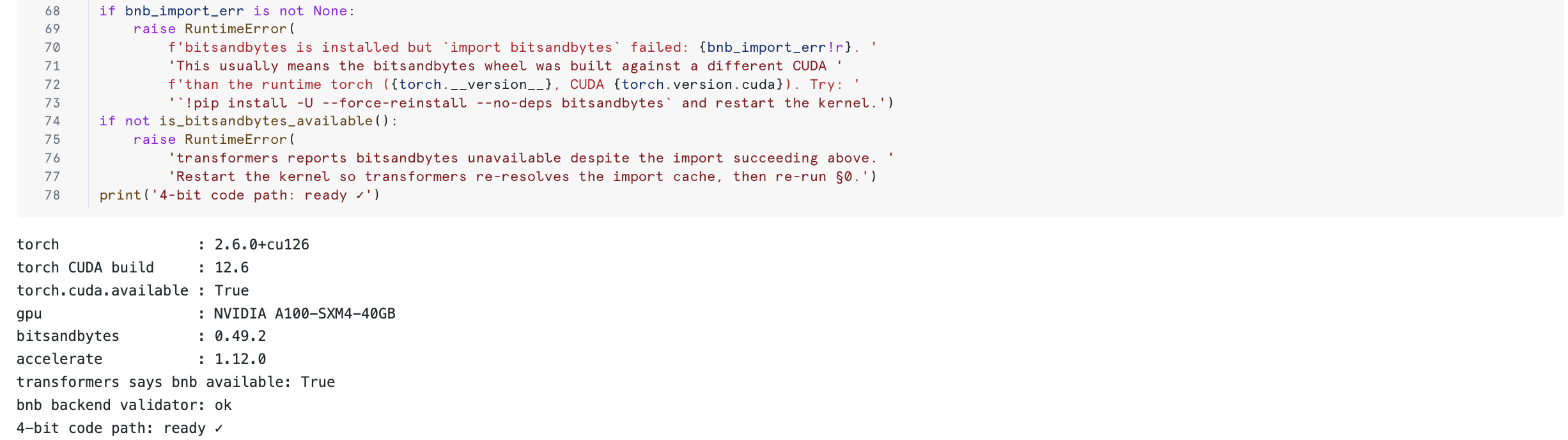
The preflight also surfaces the device and dtype the rest of the notebook will use:

Load the student and teacher
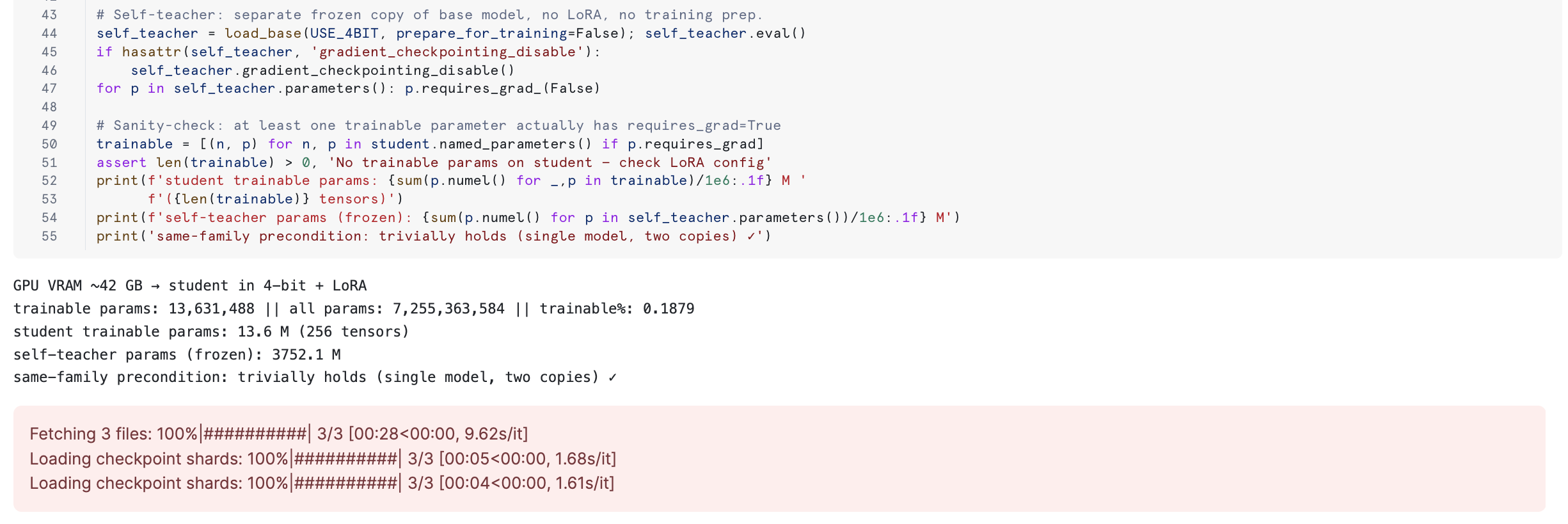
The student is mistralai/Mistral-7B-Instruct-v0.2 loaded in 4-bit + LoRA (~5 GB on the GPU). The optional same-family teacher is mistralai/Mixtral-8x7B-Instruct-v0.1 in 4-bit (~24 GB). Tokenizer match is enforced at runtime — per-token reverse KL is undefined across vocabularies.
Task and Helpers (GSM8K)
Duration: 5
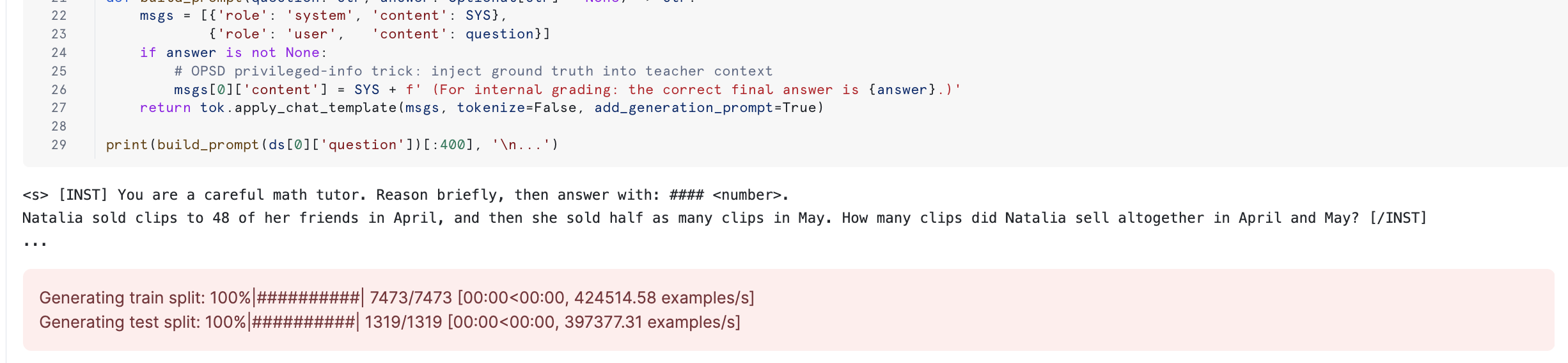
Section 1 loads a small slice of GSM8K, defines gold_answer, extract_pred, correct, and build_prompt. The OPSD privileged-info trick is implemented inside build_prompt: when called with answer=... the gold answer is injected into the teacher's system prompt only.
Section 2 defines all per-token machinery (rollout, logprobs_at, per_token_reverse_kl) plus the eval statistics (wilson_ci, fmt_acc, mcnemar_p, bootstrap_gap_ci, difficulty_bucket, evaluate, pass_at_k). Everything that the slow eval cells call lives here, so re-running this cell is sub-second and safe to inspect.

Evaluate Cortex Teachers via REST
Duration: 15
The notebook hits the Cortex REST API directly (not the SQL SNOWFLAKE.CORTEX.COMPLETE() function). The single entrypoint is client.complete(messages, model, max_tokens, temperature), which POSTs to /api/v2/cortex/inference:complete with Authorization: Snowflake Token="<session-token>" and parses the Server-Sent Events response into one {content, usage, model} dict.
POST https://<account>.snowflakecomputing.com/api/v2/cortex/inference:complete
Authorization: Snowflake Token="<session-token>"
Content-Type: application/json
Accept: text/event-stream

{
  "model": "<model>",
  "messages": [{"role": "system", "content": "..."},
               {"role": "user",   "content": "..."}],
  "max_tokens": 160,
  "temperature": 0.0
}
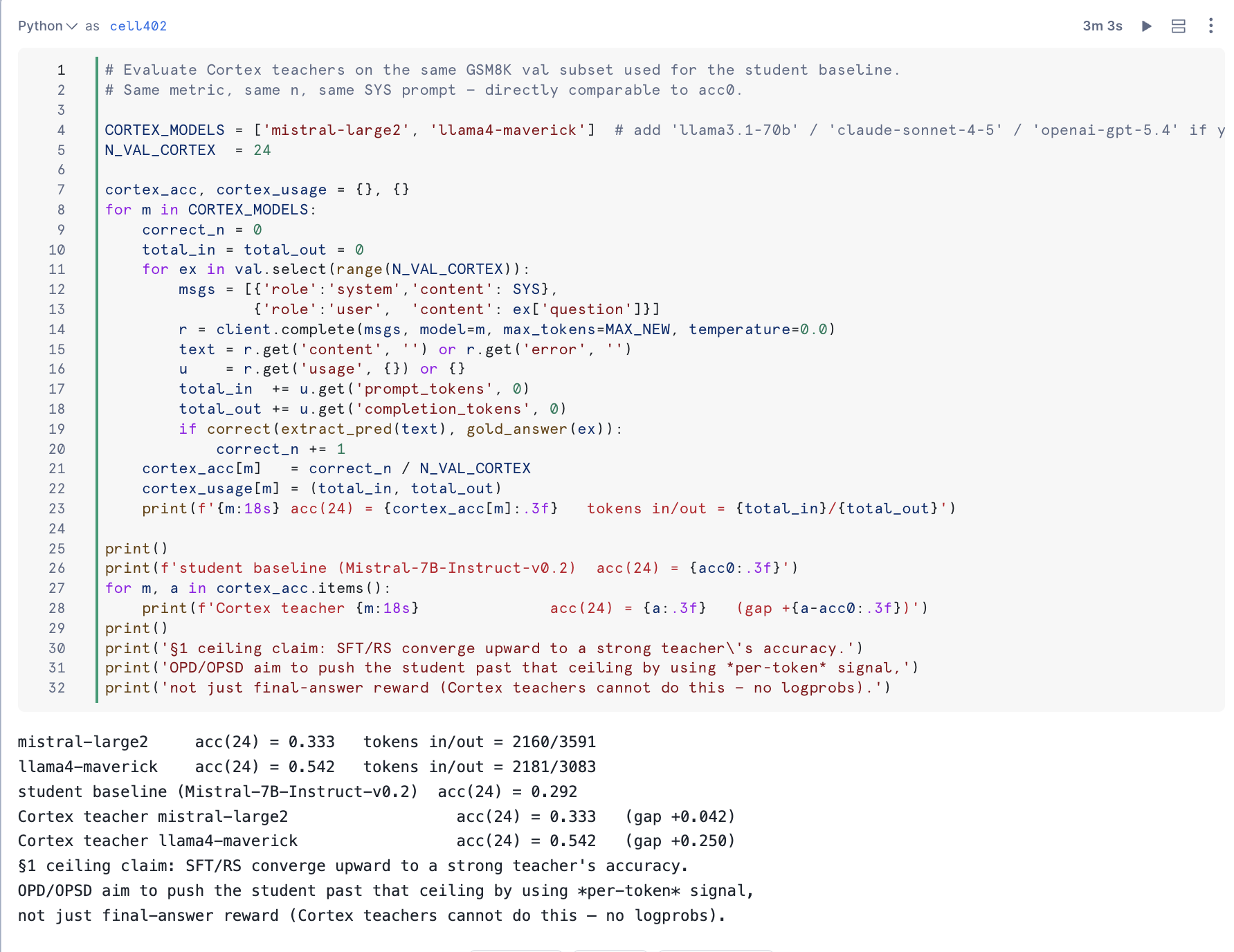
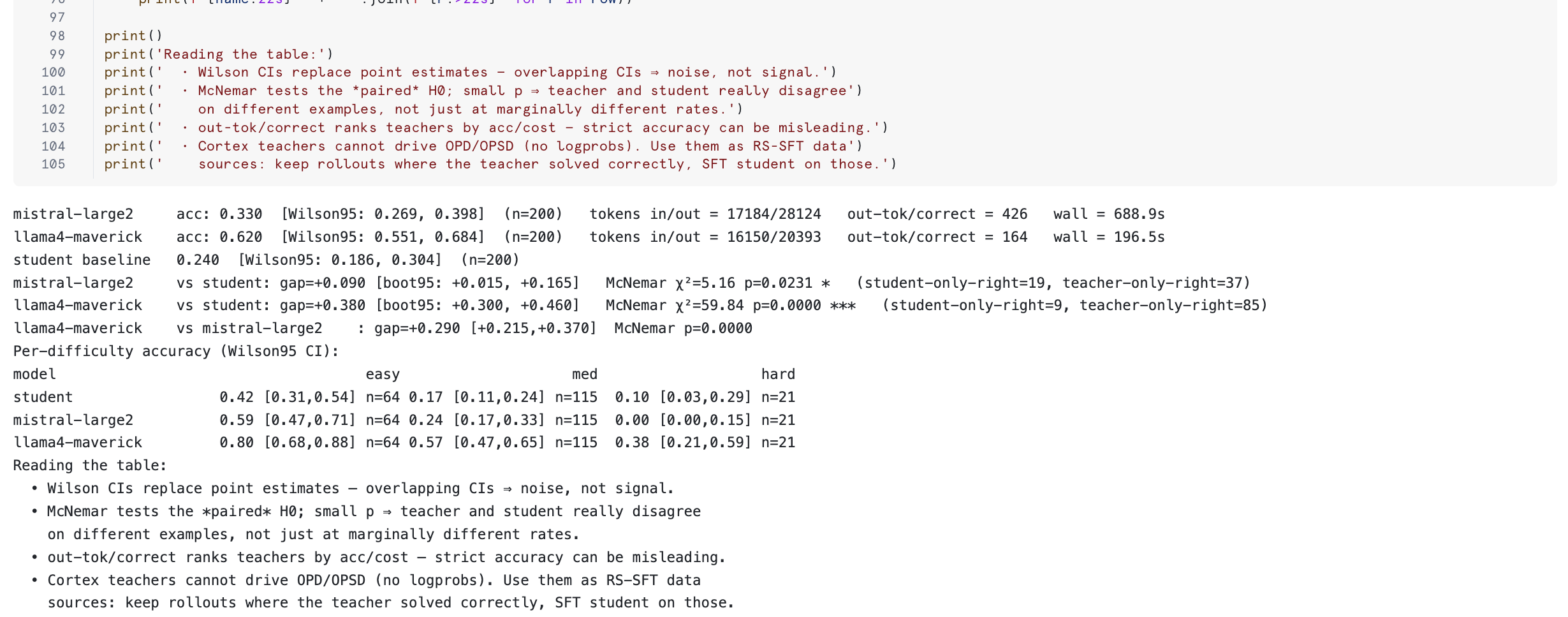
Section 2.5 evaluates each teacher in CORTEX_MODELS (default: mistral-large2, llama4-maverick) on the same 200-example GSM8K val slice the student is graded on. For every teacher it reports:
- Wilson 95% confidence interval on accuracy
- Out-tokens per correct answer (cost-adjusted accuracy)
- McNemar paired test against the student
- Bootstrap CI on the gap
- Per-difficulty bucket Wilson CI (easy / medium / hard by gold-chain length)
This is the test that proves whether a Cortex teacher is worth distilling from. Initial small-n runs typically look like this — note the wide gaps that vanish under proper CIs:
After bumping N_VAL to 200 and adding paired statistics, the table becomes interpretable:
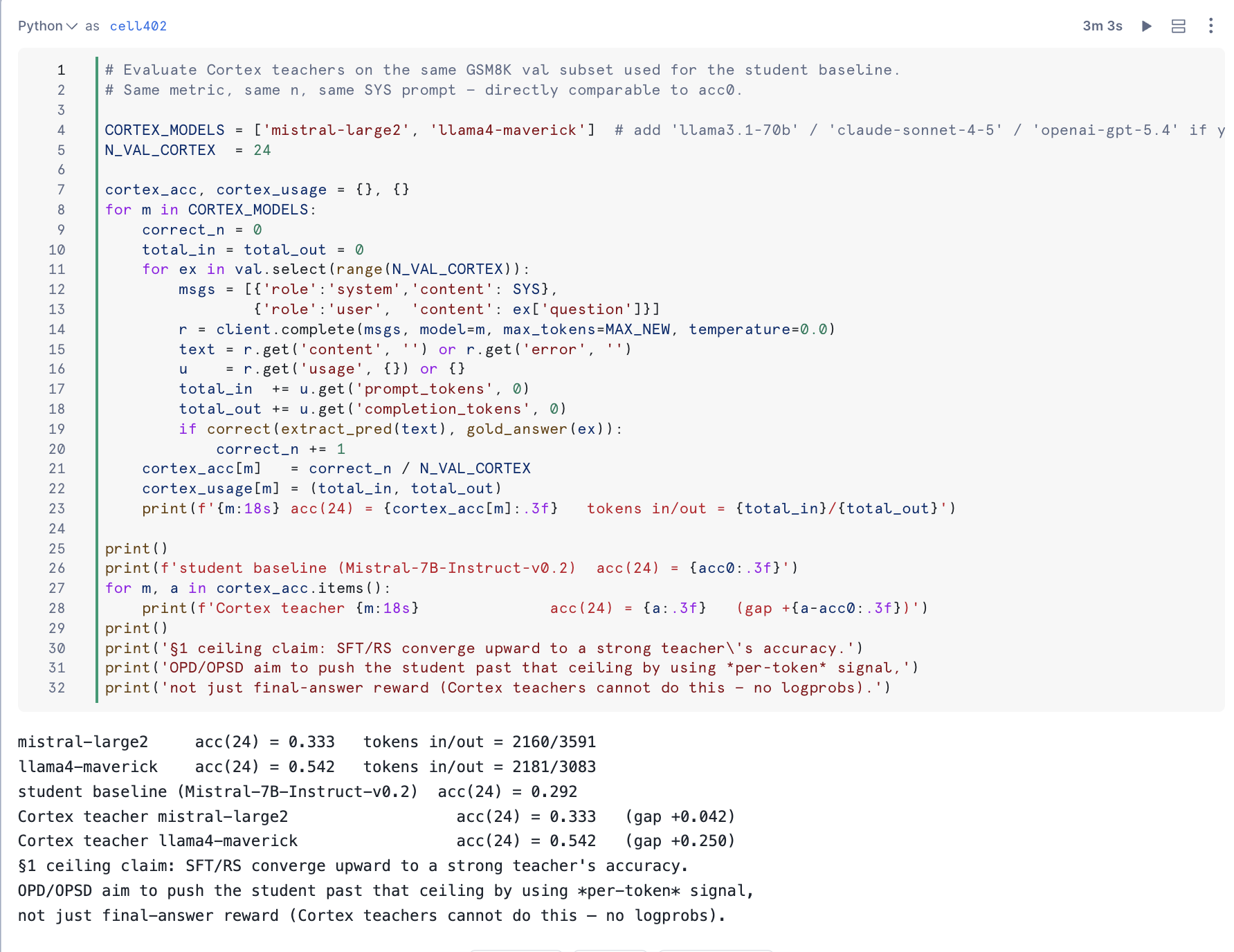
aside negative
Cortex teachers cannot drive logit-KL OPD — the REST API does not expose
logprobs, so per-token reverse KL is undefined. They can still be used as text-output teachers for rejection-sampling SFT or as the judge inside the PRM (next section).
PRM Judge and Calibration
Duration: 20
Section 2.6 implements a calibrated process reward model that scores chain-of-thought reasoning step by step.
Deterministic segmentation
split_steps(rollout_text) runs before the judge ever sees the rollout, splitting on numbered-step regex, blank lines, and sentence boundaries. The judge receives a fixed (step_id, step_text) list and returns one 0/1 per step — no segmentation decision left to the model. This stabilises min / mean aggregation across runs.
Hash-keyed cache
_prm_cache memoises results by md5(judge_model, rubric, question, steps). Re-running with a different aggregation (min, mean, last) costs zero extra Cortex calls. Iterating on the rubric invalidates the cache automatically.
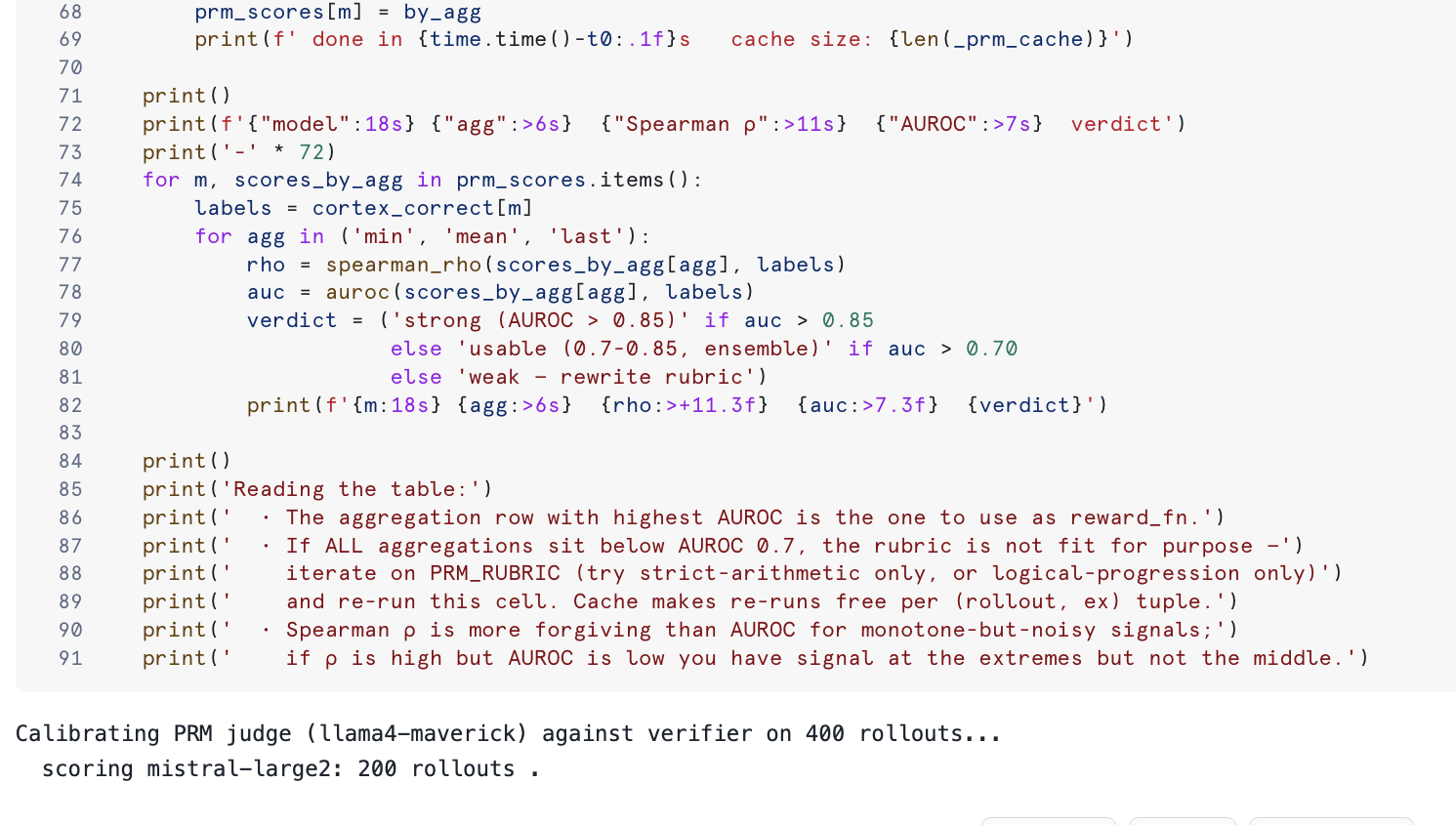
Smoke test
After definition the cell runs the judge on a single student rollout and prints the segmented step count, all three aggregations, and the cache size — sub-5-second sanity check.
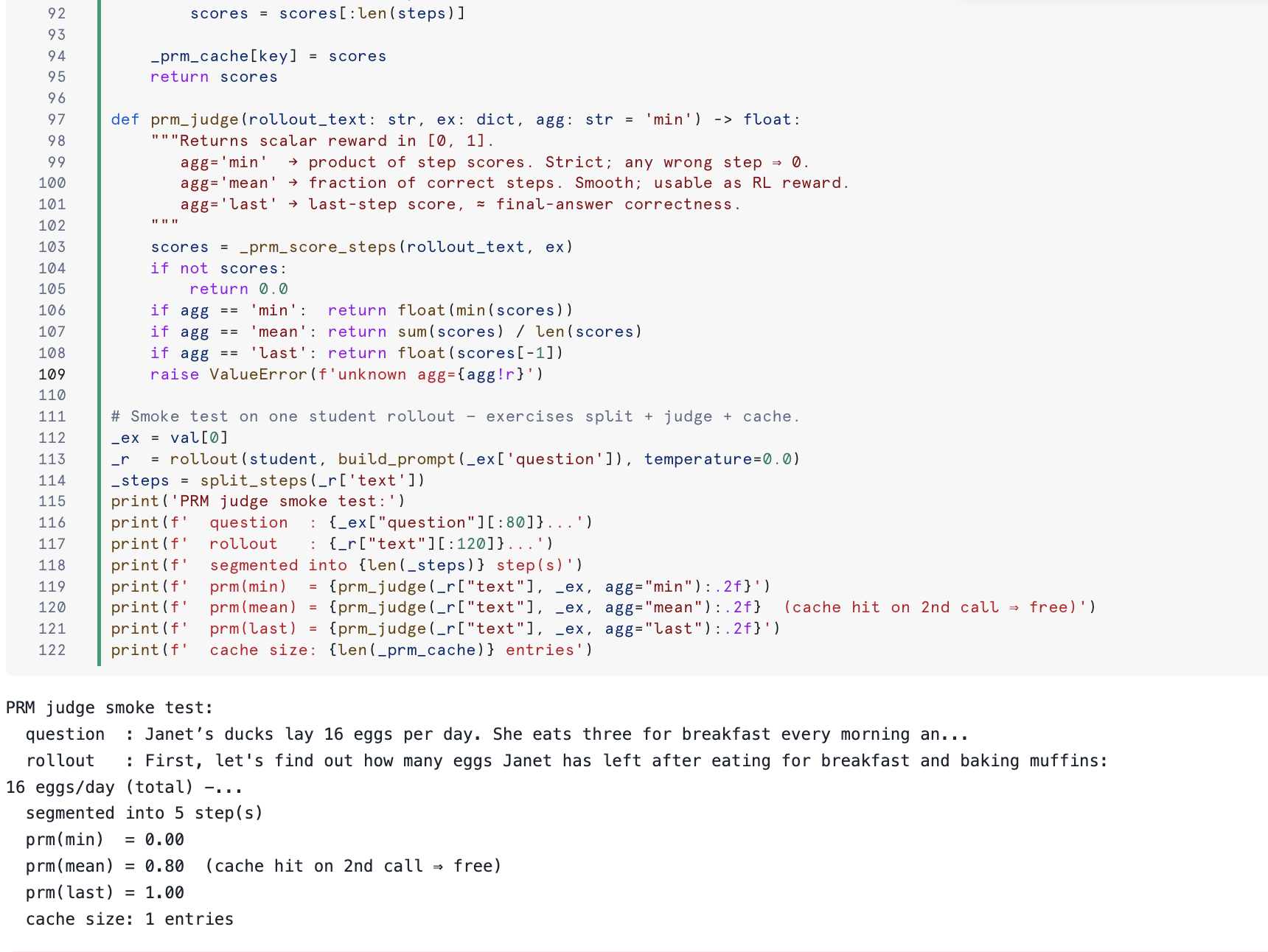
End-to-end behavior of the PRM judge across multiple rollouts:
Calibration (Section 2.6b)
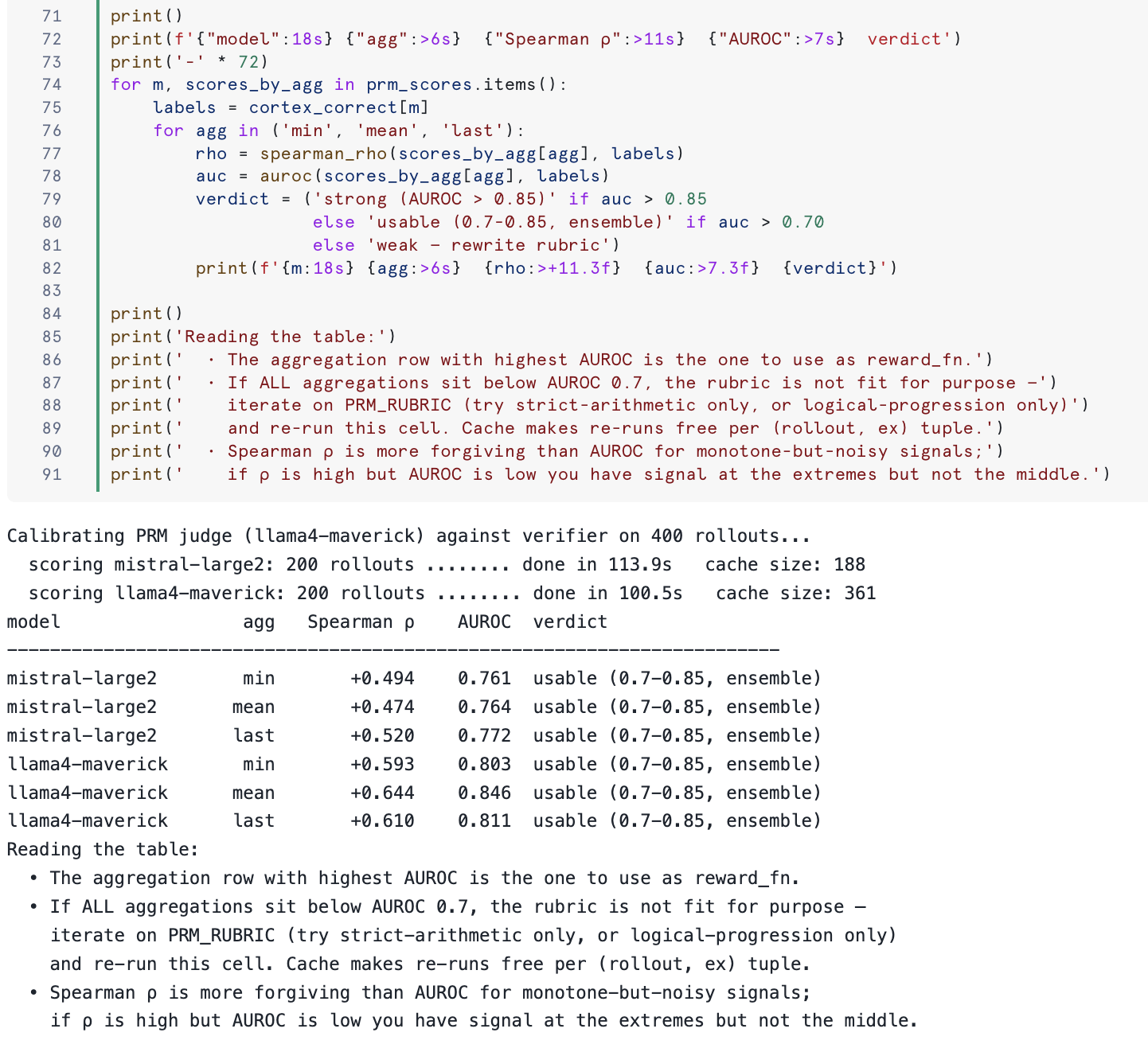
Section 2.6b is what graduates the PRM from "stub" to "non-stub". It runs prm_judge over every existing cortex_pred[m] rollout from Section 2.5 and reports Spearman rho and AUROC against the verifier ground truth, for each judge model and each aggregation:
Decision rule:
- AUROC > 0.85 — judge separates correct from incorrect well; safe as a reward function.
- AUROC 0.70 - 0.85 — usable, but ensemble it (
temperature=0.5, majority vote across 3 judge calls) before wiring into training. - AUROC < 0.70 — rubric is not fit for the task; rewrite
PRM_RUBRICand re-run (cache makes per-rollout cost free).
In a typical run, llama4-maverick + mean lands at AUROC ≈ 0.846 — borderline strong, ensemble or rubric tweak likely pushes it past 0.85.
Pass@k and RS-SFT Filter Quality
Duration: 10
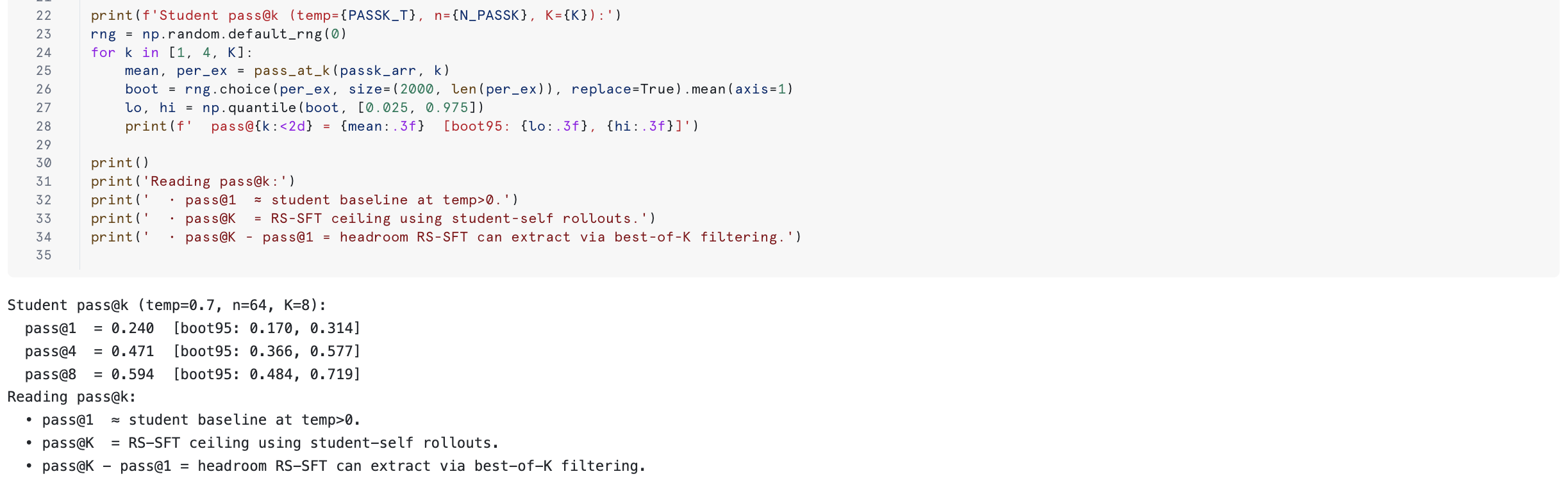
Section 2.7 computes pass@k for the student under its own distribution at temperature 0.7. This is the upper bound for any rejection-sampling SFT loop that uses student-self rollouts:
pass@1≈ student baseline at temp > 0pass@K= best-of-K SFT ceilingpass@K - pass@1= headroom RS-SFT can extract
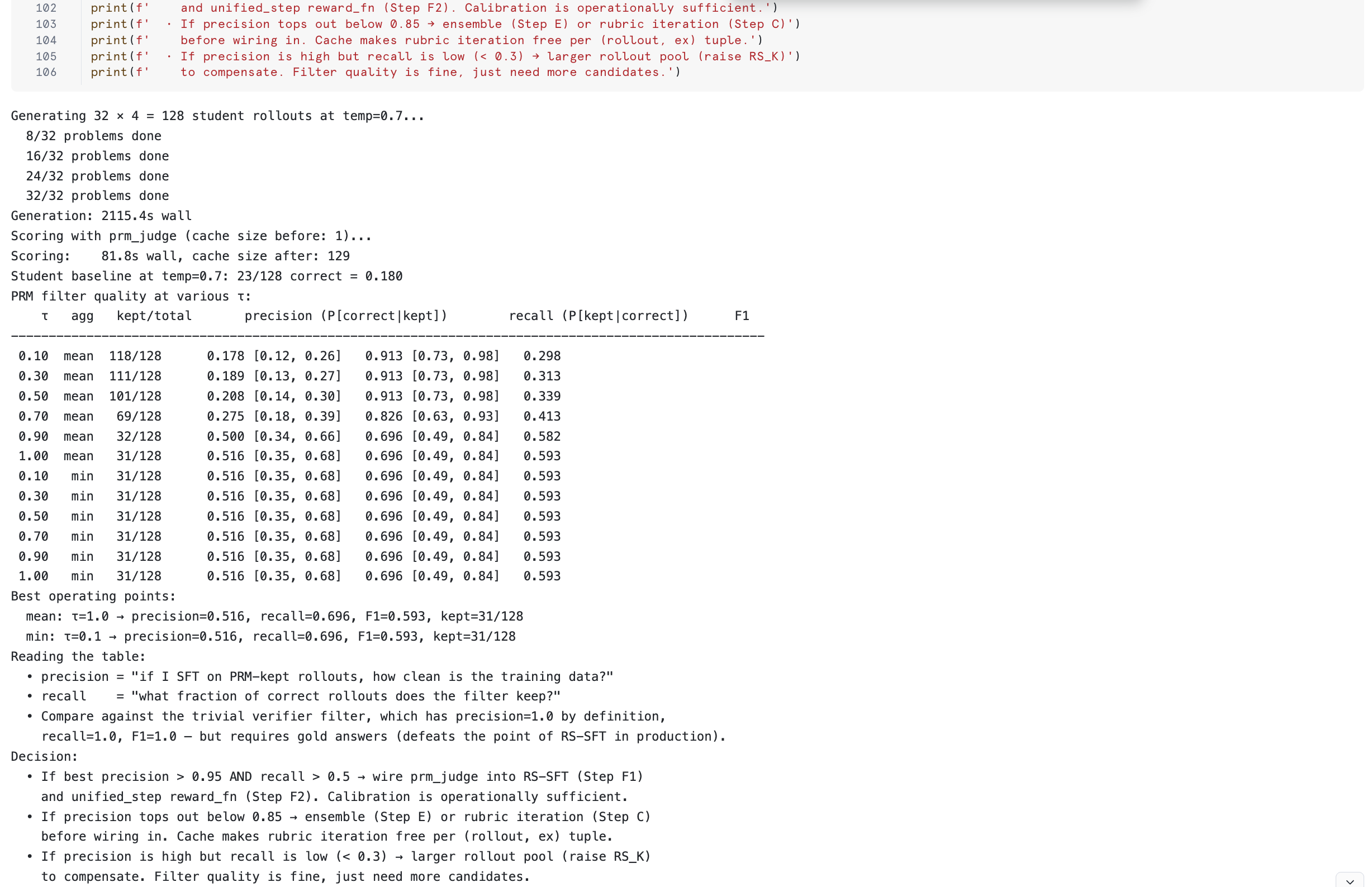
Section 2.7b answers the operational question: does the PRM judge approximate the verifier well enough to filter SFT data without gold answers? It generates a fresh sample of student rollouts, computes both verifier ground truth and prm_judge scores, sweeps τ across agg ∈ {min, mean}, and reports precision / recall / F1 with Wilson CIs. If precision > 0.95 with recall > 0.5 at some τ, the PRM filter is operationally usable.
Run OPD and OPSD
Duration: 20
Section 4 demonstrates OPD with the local Mixtral-8x7B teacher: the student samples a rollout, both the student and the teacher compute logprobs at the generated positions, and the per-token reverse-KL KL(p_T || p_S) is summed over generated tokens as the loss.
Section 5 demonstrates OPSD with the same student model played as its own teacher, but with the gold answer injected into the teacher's system prompt. The student samples without the gold answer; the teacher's distribution sharpens around answer-consistent tokens. The same per-token reverse-KL kernel runs on these logprobs.
Section 6 plots the per-token KL distribution side-by-side. OPD's signal is diffuse — spread across many tokens. OPSD's is concentrated on a small number of pivot tokens that determine the answer. The max / mean ratio quantifies the concentration.
KL Clipping and the Unified Meta-Algorithm
Duration: 10
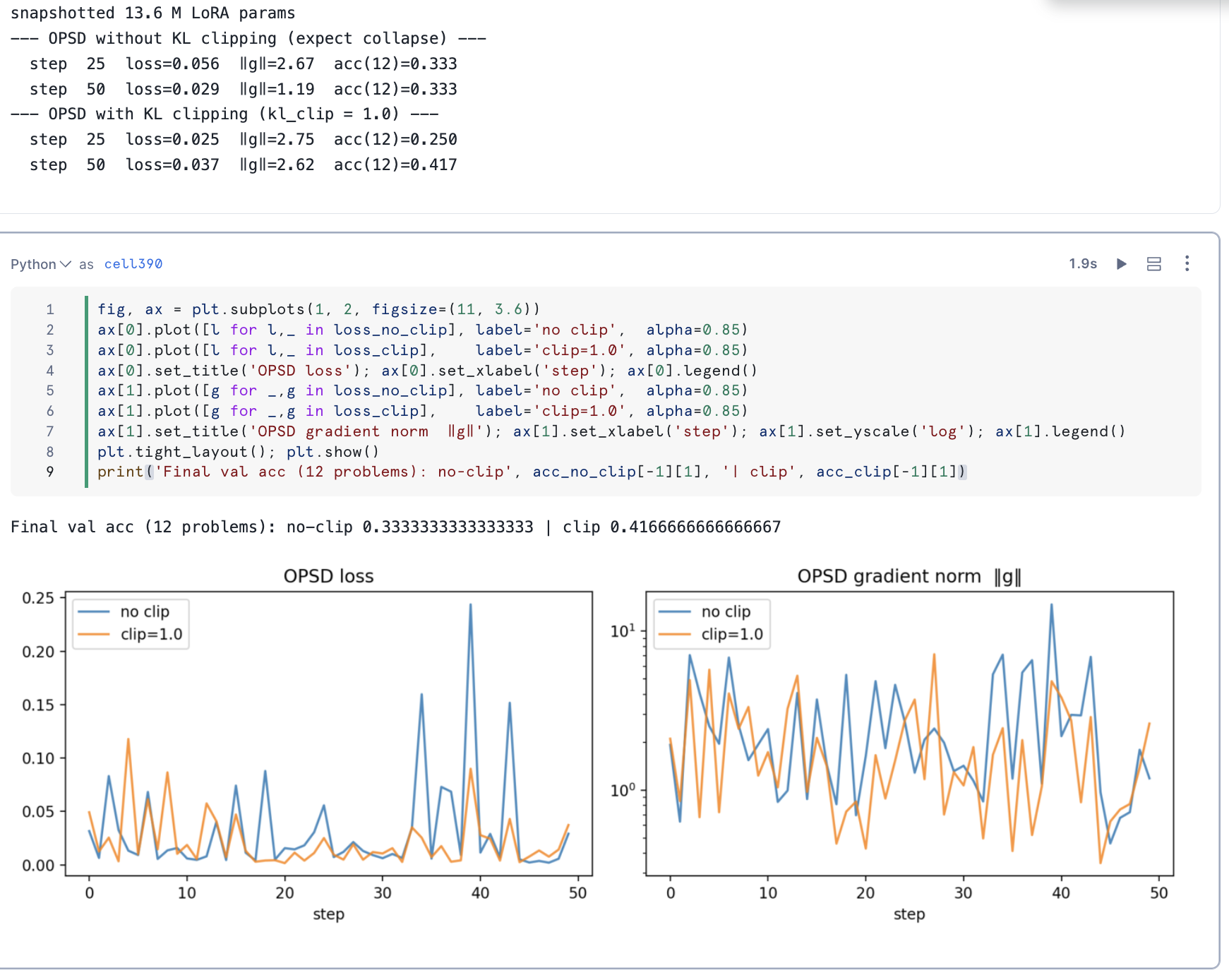
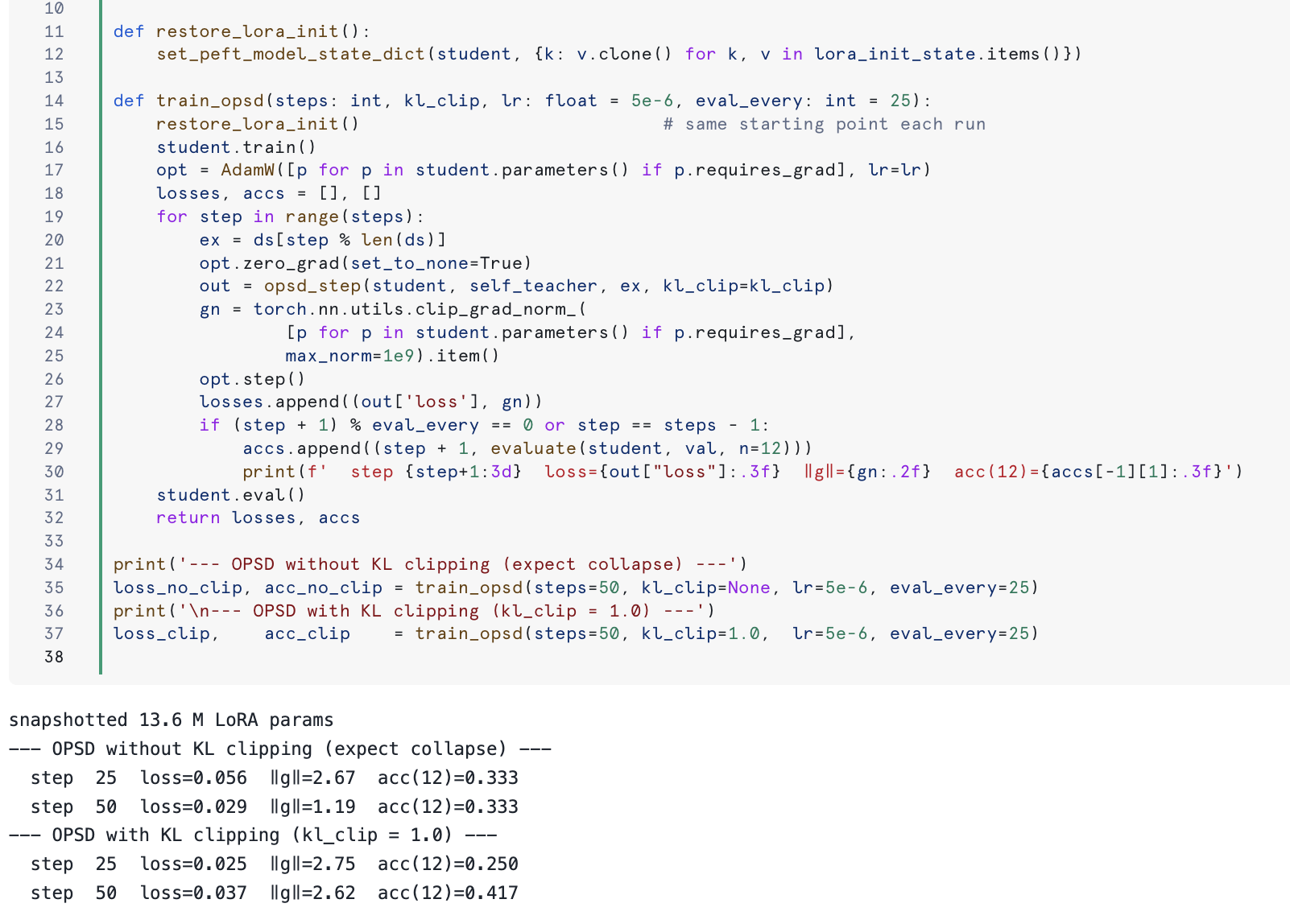
Section 7 runs OPSD with and without kl.clamp(max=1.0). Without clipping, the pivot-token gradients drive the LoRA update into a regime that destabilises training within ~100 steps — losses blow up and the student collapses. With kl_clip=1.0, only the long tail of the per-token KL distribution is truncated; the bulk of the signal is preserved. The exact same code, just one flag.
Section 9 generalises everything into one function:
def unified_step(student, ex, alpha, lam, teacher_policy, sampler,
                 reward_fn, kl_clip=None):
    r = sampler.rollout(ex)
    logp_S = logprobs_at(student, r['full'], r['plen'])
    with torch.no_grad():
        logp_T = logprobs_at(teacher_policy, r['full'], r['plen'])
    kl, _ = per_token_reverse_kl(logp_T, logp_S, clip=kl_clip)
    R = reward_fn(r['text'], ex)
    loss = lam * kl.mean() - alpha * R * logp_S.gather(...).mean()
    loss.backward()
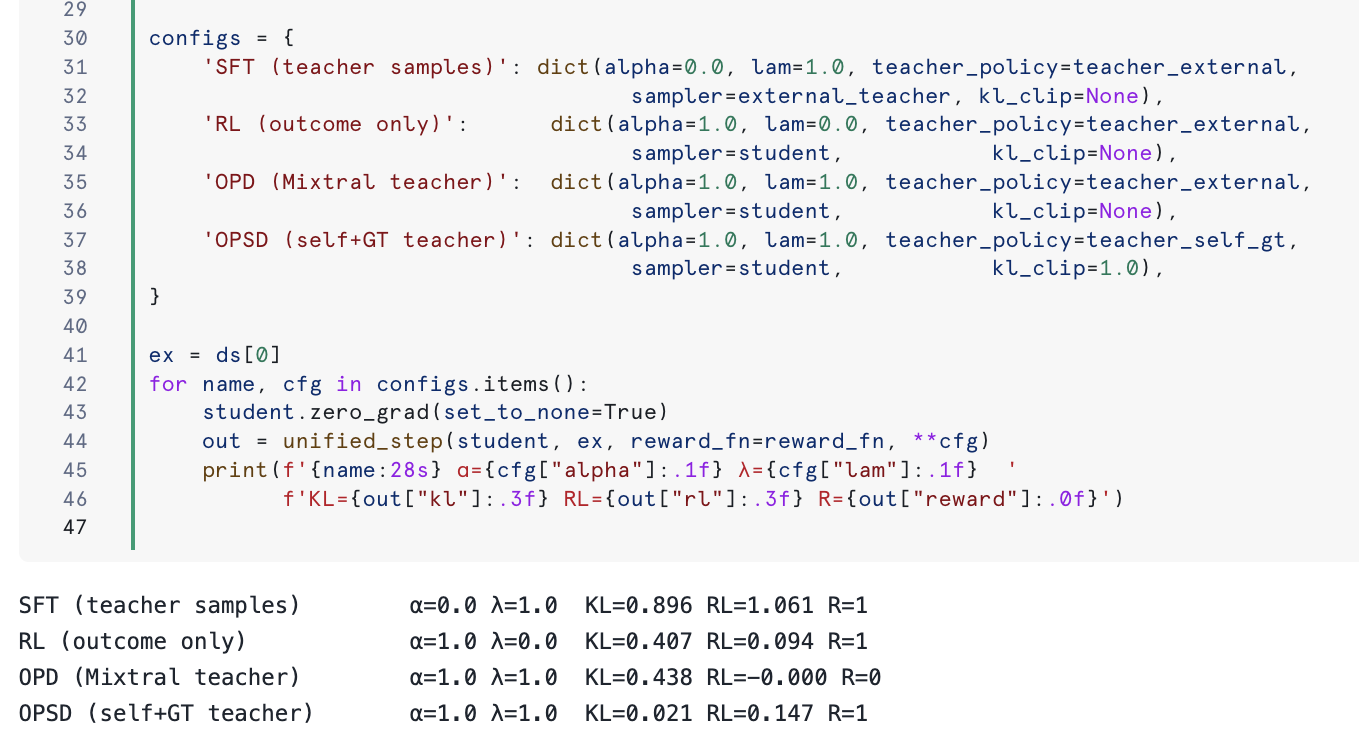
Four configurations of (alpha, lambda, pi_T) instantiate four classical algorithms:
| Method | alpha | lambda | pi_T | sampler | kl_clip |
|---|---|---|---|---|---|
| SFT-RS | 0 | 1 | external_teacher | teacher | None |
| RL-outcome | 1 | 0 | student | student | None |
| OPD | 1 | 1 | external_teacher | student | None |
| OPSD | 1 | 1 | self_teacher_with_GT | student | 1.0 |
This is the single most useful diagram in the notebook: every popular post-training method is one row of this table, distinguished only by who plays the teacher and whether the per-token KL is clipped.
Conclusion And Resources
Duration: 5
What You Learned
- OPD with logits runs end-to-end on a Snowflake GPU pool: Mistral-7B (LoRA, trainable) + Mixtral-8x7B (4-bit, frozen). Tokenizer-match assertion enforces the precondition.
- OPSD with privileged info runs on the same hardware budget: a frozen copy of Mistral-7B with the gold answer in its system prompt acts as the teacher.
- OPD vs OPSD KL distributions are empirically different: OPD diffuse, OPSD fat-tailed with a small set of dominant pivot tokens. The
max / meanratio quantifies this. - KL clipping is the bright line: without it OPSD collapses inside ~100 steps; with
kl_clip=1.0it stays stable. - Unified meta-algorithm reproduces SFT-RS, RL-outcome, OPD, and OPSD as four settings of
(alpha, lambda, pi_T). - Cortex REST API is the right interface for hosted-teacher evaluation and for the PRM judge — direct HTTP, SSE streaming, no SQL roundtrip.
- PRM judges need calibration, not just rubrics. AUROC and precision-recall against verifier ground truth decide whether a judge is operationally useful or expensive noise.
- Statistical honesty matters at small n. Wilson CIs, McNemar, and bootstrap gap CIs prevent over-claiming on 24-example or 200-example evaluations.
Memory budget
Mixtral 4-bit ~24 GB + Mistral-7B LoRA ~5 GB + activations + KV cache ≈ 35–45 GB peak. Fits comfortably on an A100-80GB or H100 GPU pool.
Related Resources
- Snowflake Cortex REST API documentation
- Snowflake Notebooks on container runtimes
- Mistral-7B-Instruct-v0.2 on HuggingFace
- Mixtral-8x7B-Instruct-v0.1 on HuggingFace
- GSM8K dataset
- GKD: On-Policy Distillation of Language Models — the unifying formulation behind
unified_step - MiniLLM: On-Policy Distillation of Large Language Models — the reverse-KL framing
- Awesome On-Policy Distillation — broader curated reading list
This content is provided as is, and is not maintained on an ongoing basis. It may be out of date with current Snowflake instances
