

In April 2026, a large technology customer on Snowflake experienced something that would stress most data systems to their limits: a sudden, sustained massive increase in daily query volume. Nearly overnight, daily queries went from a baseline of 10,000–15,000 per day to a peak of over 155,000.
Typically, it would be challenging and costly for a customer to manage a system quickly scaling up so dramatically. However, this case was different: There were no pages, no cost spikes, no user-reported performance degradation. Snowflake simply optimized frequent query patterns in order to absorb the spike and keep running. This post explains how Snowflake Optima achieves this.
What is Snowflake Optima?
Snowflake Optima extends Snowflake's core principles of performance and simplicity by applying an intelligent approach to workload optimization. Optima continuously learns from the past and optimizes for the future. Over time, queries become faster and more cost-efficient — not because users tune the system, but because the system continuously improves itself by learning from past workload patterns.
As of August 2026, Snowflake Optima includes four features:
| Feature | What is it? | How to use |
|---|---|---|
| Optima Indexing | Automatically detecting scans with poor pruning creates hidden access structures. If inefficient scans emerge from new query patterns, Snowflake automatically detects them and optimizes. | Enabled by default for all Gen2 and adaptive warehouses for no additional cost. |
| Optima Metadata | Corrects inefficient query patterns (for example, functions in predicates) through additional metadata. | Enabled by default for all Gen2 and adaptive warehouses for no additional cost. |
| Optima Planning | Learn from past query execution (for example, inefficient joins) to improve query plans over time. | Enabled by default for all Gen2 and adaptive warehouses for no additional cost. |
| Optima Clustering | Reorganizes data layout to optimize for efficient query performance on a specific access pattern. | Enabled at the table-level, billed based on data volume ingested. private preview |
Identifying optimization opportunities
In this customer's case, Snowflake used Optima Indexing to optimize an inefficient query pattern. Optima identified a table central to experiment tracking workflows that was queried heavily by systems that consistently looked up results by two columns: EXPERIMENT_ID and RUN_ID.
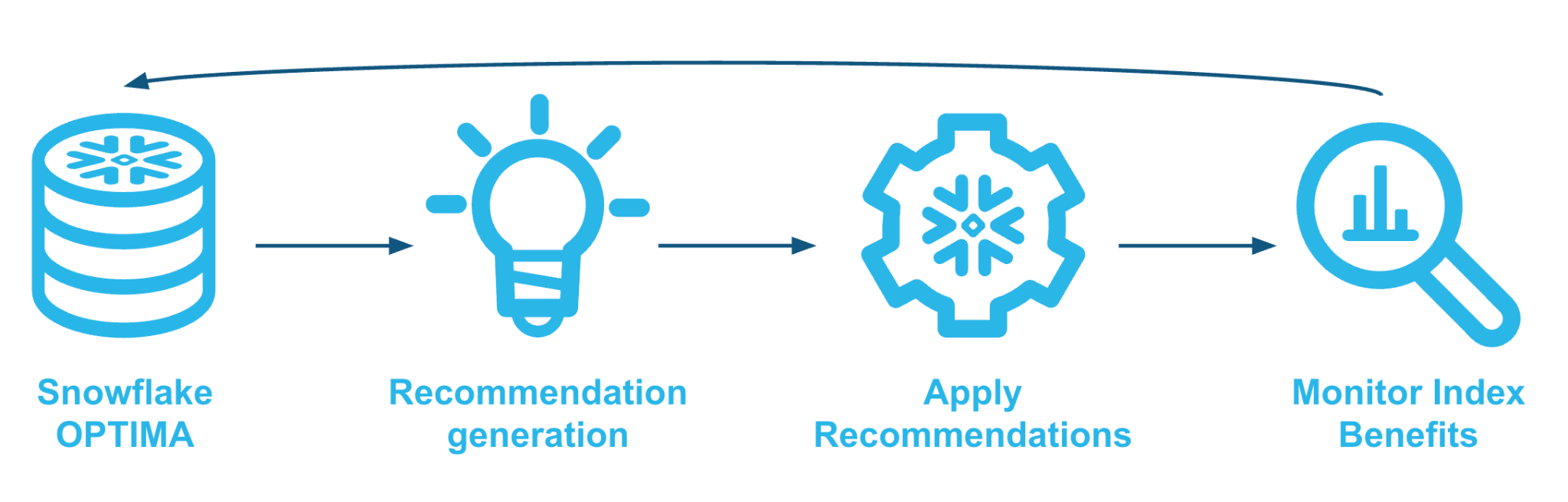
In September 2025, Optima Indexing applied a Search Optimization Index recommendation to this table, targeting optimizing the columns EXPERIMENT_ID and RUN_ID. At the time, this was a routine Optima infrastructure decision made based on observed access patterns. Optima Indexing monitored the benefits, deemed the Search Optimization Index as valuable, and kept it.
Snowflake Optima automatic performance tuning:
Usage spike
For seven months, that index improved query performance automatically and without any manual tuning. In April 2026, query volume surged sharply, reaching 16x the usual volume, but because Optima had already optimized the access pattern, query execution time stayed approximately the same. Optima didn't react to the spike. It was already prepared for it.
When Snowflake executes a query, one of the most important steps is pruning — determining which micro-partitions of data can be skipped entirely because they cannot contain the rows the query needs. The more precise the pruning, the less data gets scanned, and the faster the query runs.
When Snowflake created the EXPERIMENT_ID and RUN_ID indexes, it then only needed to scan the relevant partitions and could prune everything else. Therefore, as query volume increased, there was a dramatic increase in micro-partitions pruned, as opposed to query execution time:
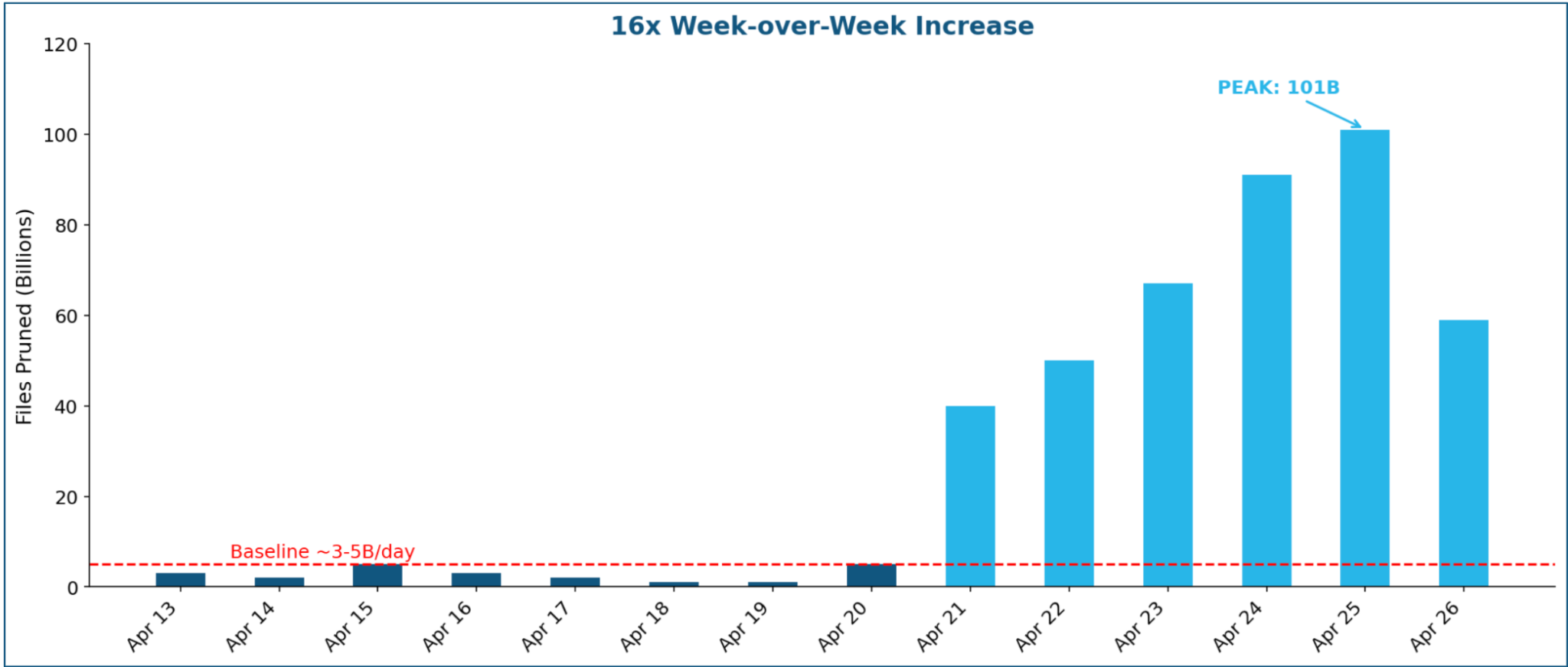
At peak, the customer pruned over 100 billion micro-partitions in a single day and sustained a rate over 99%, despite seeing such a massive and sudden scale increase. Historically, these sorts of optimizations required extensive manual tuning, especially at such a large scale. Instead, Snowflake Optima automatically optimized performance in the background — all for no additional cost!
Next steps
To experience Snowflake Optima benefits for you and your organization, start using Snowflake generation 2 standard warehouses or adaptive warehouses today. See how to monitor Snowflake Optima use for yourself.
This content contains forward-looking statements, including about our future product offerings, and are not commitments to deliver any product offerings. Actual results and offerings may differ and are subject to known and unknown risk and uncertainties. See our latest 10-Q for more information.
