
Data Governance Audit: How to Assess Your Governance Program
Most governance failures are accumulations of small gaps between policy and data operations. This guide explains what a data governance audit should assess and how to build a program that detects drift before it compounds.
- What is a data governance audit?
- Key areas of a data governance audit
- How to score governance maturity
- How Snowflake can support a data governance audit
- Moving from periodic to continuous governance auditing
- Auditing for a governance program that holds under pressure
- Resources
Governance programs erode in ways that are easy to miss. Teams still reference the policy, and the council still meets. But controls get skipped for new use cases, exceptions accumulate, and by the time anyone realizes what's happening, the gap between what the program says and what the organization does is significant — and hard to trace back to any single point of failure.
A data governance audit is designed to find that kind of drift before it compounds. Not just whether a company can produce evidence for a regulator, but whether governance is actually operating across the data estate — whether policies are attached to real assets, whether stewardship responsibilities are being exercised, whether access controls reflect classification, and whether teams can trace what changed when a definition, permission or quality threshold shifts.
This guide covers what a data governance audit should assess, how to score maturity across key domains and why many organizations are moving away from periodic reviews toward continuous governance monitoring.
What is a data governance audit?
A data governance audit is a systematic assessment of an organization's governance program. It evaluates whether policies are defined, controls are enforced, roles are accountable and governance objectives are being met across the data estate. Unlike a regulatory compliance audit, which tests whether the organization satisfies a specific legal or industry requirement such as GDPR or SOX, a governance audit tests whether the operating model behind those requirements is mature enough to work consistently over time.
An auditor or internal assessment team looks at whether data owners and stewards are assigned, whether classification coverage is broad enough to matter, whether access policies are actually attached at the data layer, whether sensitive-data access can be reconstructed from logs and whether data quality issues are measured and acted on. A governance audit can be internal or external. The audit process is also increasingly continuous, with controls and metadata monitored on an ongoing basis instead of only during an annual review.
The value of an audit is operational as much as regulatory — it helps teams find gaps before an examiner, customer or executive stakeholder finds them first. It also gives leadership a clearer way to see whether the program is ad hoc, repeatable or mature enough to support broader goals such as AI governance, data product reuse and cross-functional accountability.
Key areas of a data governance audit
A data governance audit should assess the areas where programs most commonly erode: whether policies actually cover the data that matters, whether roles carry real accountability, and whether controls are enforced at the data layer rather than assumed downstream. The following areas form the core of a thorough assessment.
Data governance audit checklist
- Policy coverage: Are governance policies defined for critical data domains such as personal, financial and operational data? Are they documented, versioned, accessible and specific about classification, access, retention and disposal?
- Roles and accountability: Are data owners, stewards and custodians assigned for each important domain or asset set? Do those roles have real decision rights, escalation paths and executive backing?
- Data classification coverage: What portion of important assets is classified? Are tags current and accurate? Is classification automated where possible, or does the program still rely on manual review for most assets?
- Access control enforcement: Are controls enforced close to the data itself, not only in downstream applications? Are masking and row-level restrictions applied where needed? Are there stale permissions, broad grants or exceptions without review dates?
- Audit trail and monitoring: Can the organization answer who accessed which data, when they accessed it and what action they took? Are logs retained long enough to support investigations and reviews?
- Data quality metrics: Are data quality KPIs defined, monitored and tied to owners? Can recurring issues be traced to a source system, transformation or control gap?
These categories test the governance program as an operating system for the policy. For example, a policy may say that sensitive fields must be masked, but the audit has to verify whether sensitive columns are actually identified, whether the right tags are attached, whether the masking logic is applied through policy and inheritance, and whether exceptions are visible enough to review. Or, in the case of monitoring, the audit should test whether the logging is detailed enough to reconstruct usage at the object level and whether the team can actually query it when needed.
How to score governance maturity
Once the audit areas are defined, the next step is to score maturity in a way that shows where the program is inconsistent, where it is repeatable and where it is operating with evidence.
A simple five-point maturity scale is often enough:
- Ad hoc: Policies or controls exist in isolated places, but they are incomplete, informal or heavily manual.
- Developing: The organization has defined some governance processes, but coverage is uneven and adoption depends on individual teams.
- Managed: Core policies, ownership roles and control mechanisms are documented and used consistently for important domains.
- Measured: Governance performance is tracked through metrics, exceptions are reviewed and leadership can see where controls are weak or incomplete.
- Optimized: Monitoring is continuous, control coverage is broad, remediation is timely and the program improves through regular feedback rather than one-off cleanup efforts.
This kind of scoring turns a vague question — "How good is our governance program?" — into something more specific. A team may be mature in policy design but weak in enforcement. It may have strong access controls but poor stewardship accountability. It may classify data well in one domain and barely at all in another. The goal is to see where the operating chain breaks.
For a more formal structure, teams often use data governance frameworks — such as EDM Council's DCAM, which outlines standards and assesses capabilities for mature data management and analytics, and DAMA-DMBOK, which defines core principles, best practices and essential functions of data management.
How Snowflake can support a data governance audit
A governance audit is only as efficient as the evidence available to conduct it. Snowflake's built-in governance capabilities map directly to the core audit areas, surfacing the metadata, policy attachment points and access records that assessments typically require.
For classification, Snowflake Horizon supports sensitive data classification and object tagging, which helps teams categorize potentially sensitive data and attach tags that can be reused across governance workflows. It also documents how tagging can be combined with masking so that controls follow classification more consistently.
For access control enforcement, Horizon supports masking policies and row access policies at the data layer, which lets reviewers assess whether protection is attached at the table, view or column level rather than assumed to exist somewhere upstream in application logic. It also exposes policy references and tag references that can help teams inspect where policies and tags are attached.
For auditability, auditing user access history can be done through the ACCESS_HISTORY view, which shows query access history for objects such as tables, views and columns.
For data quality, Snowflake provides built-in system data metric functions, and its data quality documentation describes continuous validation of data health as well as monitoring pages in Snowsight that show results and insights for associated data metric functions.
Together, these capabilities give governance teams continuous access to the evidence an audit requires — without waiting for a formal review cycle to surface gaps.
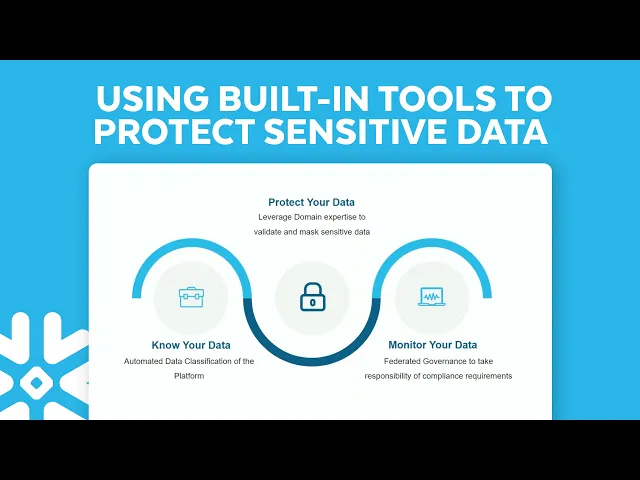
Discover how Snowflake's out-of-the-box capabilities, such as sensitive data monitoring, can effortlessly detect and provide a comprehensive view of your sensitive data:
Moving from periodic to continuous governance auditing
Many governance audits still happen on a quarterly or annual cadence. This is a familiar structure, but it has a built-in weakness: it only captures a snapshot of a program that is changing all the time.
A classification gap can appear when a new schema is created. An access exception can stay open after the original business need has passed. A masking policy can protect one object but not a replicated pattern of similar objects created two weeks later. A quality threshold can fail quietly until a downstream dashboard breaks. If the audit happens only once or twice a year, the team is always looking backward.
More organizations are treating the data governance audit program as a continuous monitoring discipline. The shift usually happens in three parts. First, teams move from manually assembled checklists to dashboards and metadata-driven reviews. Second, they move from point-in-time sampling to recurring measurements for coverage, exceptions, policy attachment and access activity. Third, they move from reactive cleanup to proactive alerting, where drift is identified while it is still small enough to fix quickly.
Continuous governance auditing does not mean a team never performs a formal review, but rather that the formal review is no longer the only time a team is looking for evidence. By the time an internal auditor, regulator or executive sponsor asks how governance is performing, the program should already have a current answer.
Auditing for a governance program that holds under pressure
The real test of a governance program isn't whether it passes a scheduled review — it's whether ownership, classification, access control, logging, and quality measurement stay connected as the data estate changes. New assets arrive, new users need access, and new use cases put pressure on the program. A point-in-time audit can establish a baseline, but it can't catch drift between cycles.
Effective governance programs are increasingly built around observable controls and measurable coverage rather than annual checkups. Frameworks like DCAM and DAMA-DMBOK provide structure for the assessment, while platform capabilities — classification enforcement, access history, policy propagation, data quality monitoring — provide the evidence. The result is a governance program the organization can verify on an ongoing basis, not just defend when it's under review.
