Apr 14, 2026/7 min read
From First Principles: The Ideas That Built Snowflake — and What Comes Next

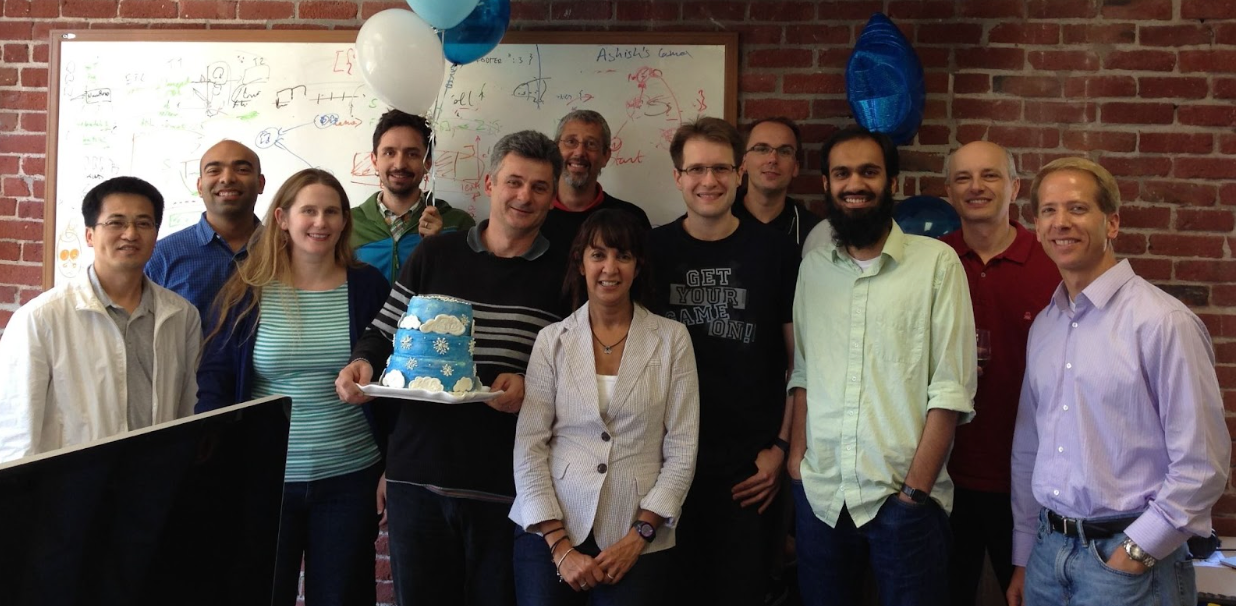
As part of the team that founded Snowflake, it's amazing to see how what we imagined over a decade ago is now the foundation of the emerging agentic enterprise. In 2016, we wrote a paper that laid out a bold vision for how the world of technology and data in the cloud could be transformed. A decade later, we’re honored that this work received the 2026 SIGMOD Test-of-Time Award, giving us the opportunity to revisit the paper and reflect on how our thinking shaped the company Snowflake is today, as well as where we’re heading next.
In our paper, we outlined three foundational principles that guided the creation of Snowflake:
Bring all data together: We wanted to build a platform that could unify structured data (traditional data warehouses) with petabyte-scale semi-structured data (big data, for example, Hadoop), allowing seamless analysis without compromising core database principles: first-class SQL, transactional integrity and real-time access.
Leverage cloud elasticity and scalability: By using on-demand compute and virtually unlimited scale, Snowflake could handle all data and workloads, eliminating traditional data silos once and for all.
Make it simple and easy to use: Delivered as a fully self-managed cloud service, we aimed to remove the operational complexity of managing data infrastructure so users can focus on insights, not maintenance.
While these ideas were bold in 2012 when we founded Snowflake, they set the foundation for the innovation and developing technology that followed for years to come.
The year we reimagined the data platform
In 2012, we started by rethinking data platform architecture from the ground up.
Existing systems were constrained by assumptions that no longer made sense in the cloud. At that time, software was bound by the hardware it ran on. Tight coupling of compute and storage created trade-offs between performance, concurrency and cost. Cloud architecture liberated it from that constraint.
At the time, we made a deliberate decision to separate compute from storage, fully and without compromise.
This was more than an architectural choice. It fundamentally removed the trade-offs that had defined data systems for decades. By decoupling compute and storage, we eliminated resource contention as a limiting factor. Compute could scale independently, remain isolated and support multiple workloads operating on the same data, simultaneously and without interference. What had previously been a constraint suddenly became a competitive advantage.
We also committed to building cloud-native from Day 1, with cloud object storage as the foundation. As semi-structured data formats such as JSON became increasingly important, it was clear that partial support would only perpetuate friction. Making this data fully accessible through SQL was essential to broaden who could work with data, not just for flexibility. This was about democratizing access in a meaningful way.
Finally, we introduced virtual warehouses, elastic and independent compute clusters that scale on demand, which shifted the model entirely. Instead of teams shaping their workloads around fixed infrastructure, infrastructure could finally adapt in real time to the needs of the business.
As my co-founder Thierry Cruanes often said, “The system should adapt to the workload, not the other way around.”
These were not optimizations but rather architectural decisions that defined the system.
Turning architecture into impact
Ideas are the easy part. It’s the execution that’s hard.
In our early days, the challenge wasn’t just building the platform; it was helping the market understand why it mattered. Many users were accustomed to tuning systems around fixed capacity and managing contention as a given, but we believed those constraints were artifacts of older designs.
Proving our approach required consistency:
Performance had to be predictable.
Scaling had to work automatically.
Users had to trust the system.
And it all had to feel simple to use. Features can always be added, but eliminating complexity requires discipline. Ultimately, it was our radical focus on simplicity that enabled Snowflake to make systems accessible, which drove broad adoption.
Over time, customer usage evolved. What began as reporting and analytics expanded into data sharing, collaboration, continuous pipelines, machine learning and AI workloads. Organizations that initially used Snowflake for analytic workloads are now building applications directly on top of the platform using the same architecture and principles we first described back in 2016.
Powering the agentic enterprise
As AI becomes embedded in every business, we are entering the next architectural shift: the agentic enterprise.
Over the past decade, Snowflake has helped organizations bring their data together on a single platform.
Many of the architectural decisions we made were once considered unconventional but are now industry standard expectations. Separation of compute and storage, elastic scaling and native support for semi-structured data are no longer differentiators; they are baseline requirements for modern systems.
The mission continues: The system now takes on more complex tasks, and the role of the data platform has expanded. We enable secure data sharing, power applications and serve as the foundation for increasingly intelligent systems no longer focused solely on storing and querying data.
Today, that data is front and center. Companies are focused on unlocking their full value, and AI is accelerating how data is used, accessed and acted on.
AI agents are already being deployed across customer support, finance, sales and operations. As adoption accelerates, a familiar challenge is emerging. These systems are often built in silos, without shared context, consistent governance or coordination, resulting in fragmentation, limited trust and constrained impact.
This is the next barrier to break down.
Today businesses require a new architectural layer: a control plane that connects intelligence to enterprise data, provides shared context, enforces governance and coordinates action across systems.
In many ways, this is a natural evolution of what we set out to build from the beginning. The importance of data as a single source of truth only increases in a world of autonomous systems. Now it is not just about separating compute and storage. It is about connecting data, intelligence and action in a coordinated way.
The next frontier is making the agentic enterprise a reality, connecting data, intelligence and action seamlessly at enterprise scale.
None of this work is the product of a single idea or a single team.
This award recognition encompasses years of engineering, product and go-to-market cross-functional team efforts, guided by collaboration with customers who continuously move the system in new directions.
From the start, customer centricity has been a core value for Snowflake, and it will continue to guide us into the future. Our customers shape how we build systems that are simpler to use and more efficient to operate, so we can unlock extraordinary value from their data to help our customers succeed.
We’d be remiss not to recognize the outstanding coauthors whose contributions were integral to this work, who are also recognized with this award: Vadim Antonov, Artin Avanes, Jon Bock, Jonathan Claybaugh, Daniel Engovatov, Martin Hentschel, Jiansheng Huang, Allison W. Lee, Ashish Motivala, Abdul Q. Munir, Steven Pelley, Peter Povinec, Greg Rahn, Spyridon Triantafyllis Phillipp Unterbrunner, and Marcin Zukowski. Thank you for your collaboration.
Reflecting on the last 10 years, there’s no question the world has changed. AI is redefining what’s possible, reshaping how we build and operate. While the landscape continues to evolve, our commitment to innovation and to our customers remains constant. I couldn’t be more excited for what’s ahead.

