Jun 30, 2026/8 min readAI & ML
Introducing Cortex Sense: Grounded Context for the Data You Never Modeled


Many of us grew up with a set of encyclopedias on a shelf at home, treated as the authority to answer almost anything. But the content in them often quickly became outdated. For example, we’d come across facts like Pluto listed as the ninth planet years after it stopped being one, and a good share of what we went looking for wasn’t included in them. As we grew older, Wikipedia became the new encyclopedia and worked the other way around. Even though some of our schoolteachers initially told us not to trust it, it ended up covering almost everything and staying current.
Enterprise data never made that transition; we still try to document it the way we did encyclopedias, with a handful of experts writing down what everything means, never quite finishing and gradually falling behind as the business changes.
Our own product data team at Snowflake set out to make our tables legible to agents, adding semantic views, so the agents read from curated, governed definitions instead of guessing. On the product side, we shipped Semantic View Autopilot to generate them faster. This certainly helped, but even so, we had only covered the tip of the iceberg — under 5% of our 9,685 tables. Anything that fell inside that 5% got a good answer, but most of what people actually asked fell outside it, on tables nobody had documented, or on data too new for any semantic view to exist.
Suppose your company launched a usage-based pricing plan two weeks ago. The tables behind it are only days old. If a PM asks an agent a direct question — “How is the new plan doing since launch?” — a Cortex Agent relying on semantic views alone will decline to answer. And other agents your team may already rely on, whether that is Snowflake CoCo, Cursor or ChatGPT, may be querying that new data directly regardless of whether a semantic view exists for it - which could lead to confident but incorrect answers.
Cortex Sense (private preview soon) is designed to work alongside semantic views, not instead of them. Where you need governed, consistent answers, the semantic view stays the gold standard, and Cortex Sense will treat it as an authoritative signal. Across the rest of your data estate, it will build that understanding on its own.
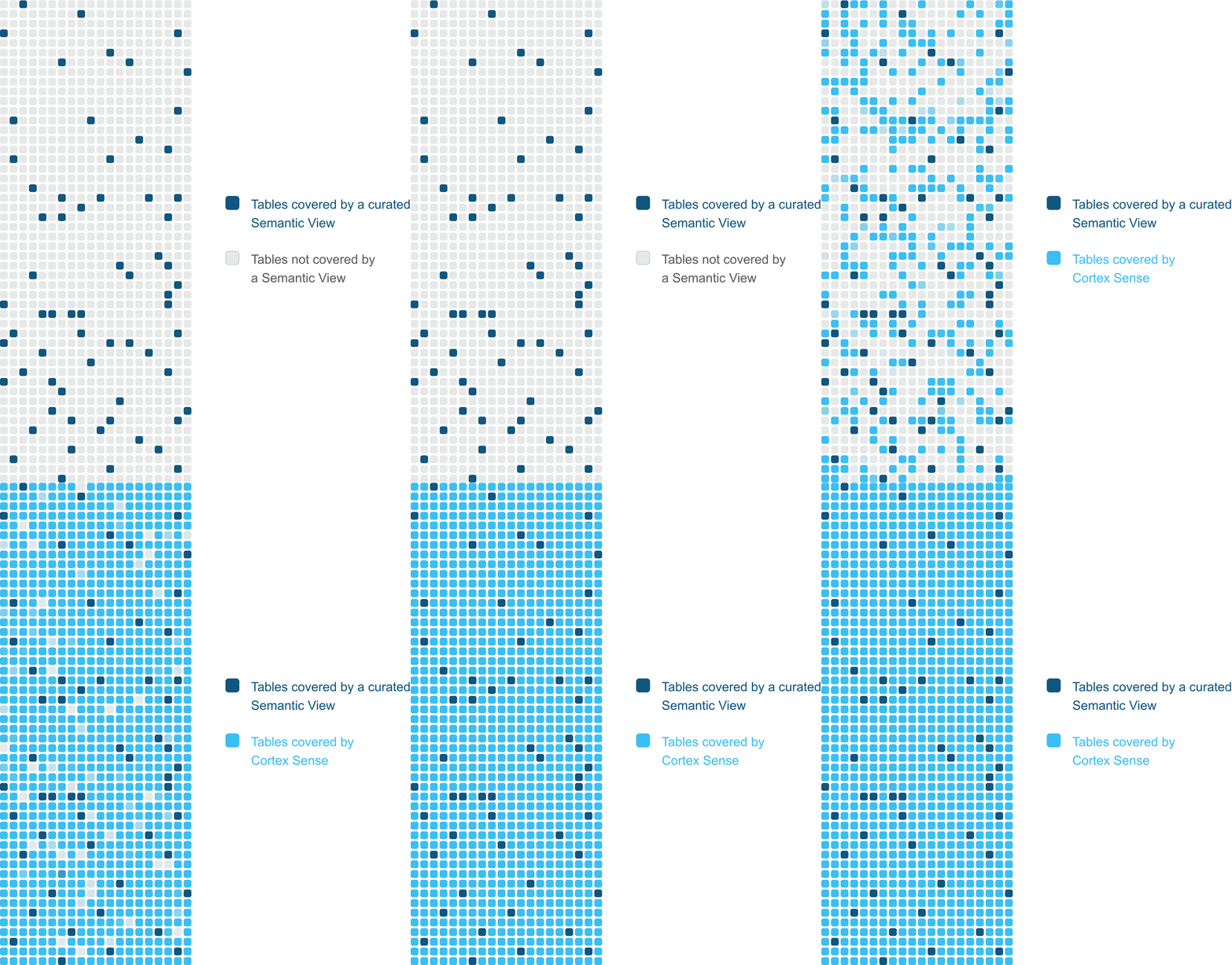
It will assemble the same kind of understanding a semantic view would, and will go further by building a working model of your entire business, not just a catalog of your tables. It will do that automatically from the signals your business already produces, such as the queries your analysts have run in the past, the models defined in your transformation tools and the metrics that already live in your BI. A lot of this context will come in through Snowflake Horizon Connectors.
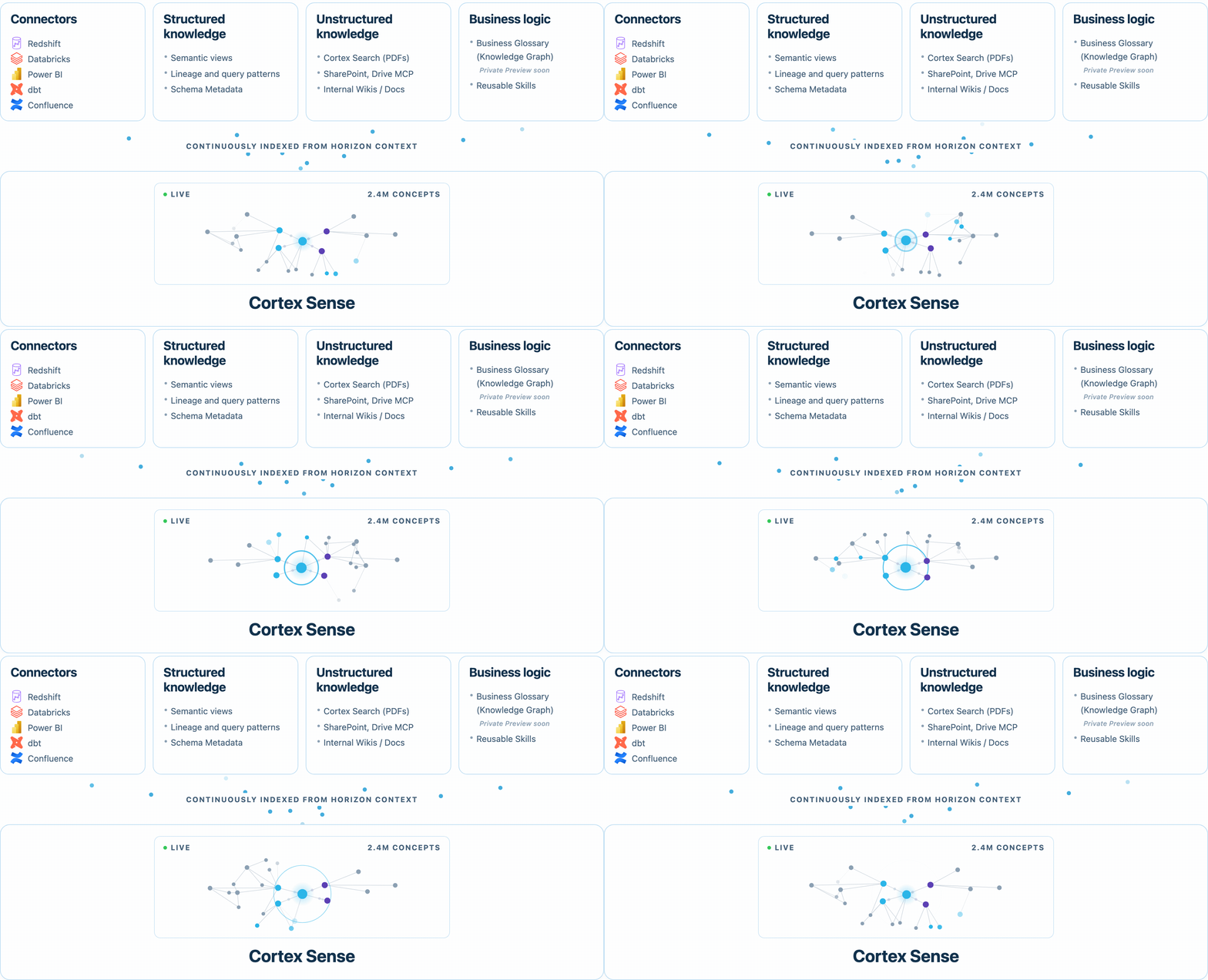
Rather than a second system of record that you have to maintain, Cortex Sense will be a managed solution that raises the accuracy floor for agentic queries.
To set a baseline, we evaluated agents on product analytics questions on Snowflake’s internal data requiring cross-table joins, metric formula lookups and filter convention knowledge. Our data team found that without any context layer, AI had around 25% accuracy, which was remarkably similar to Anthropic’s result which independently measured it at just 21%.
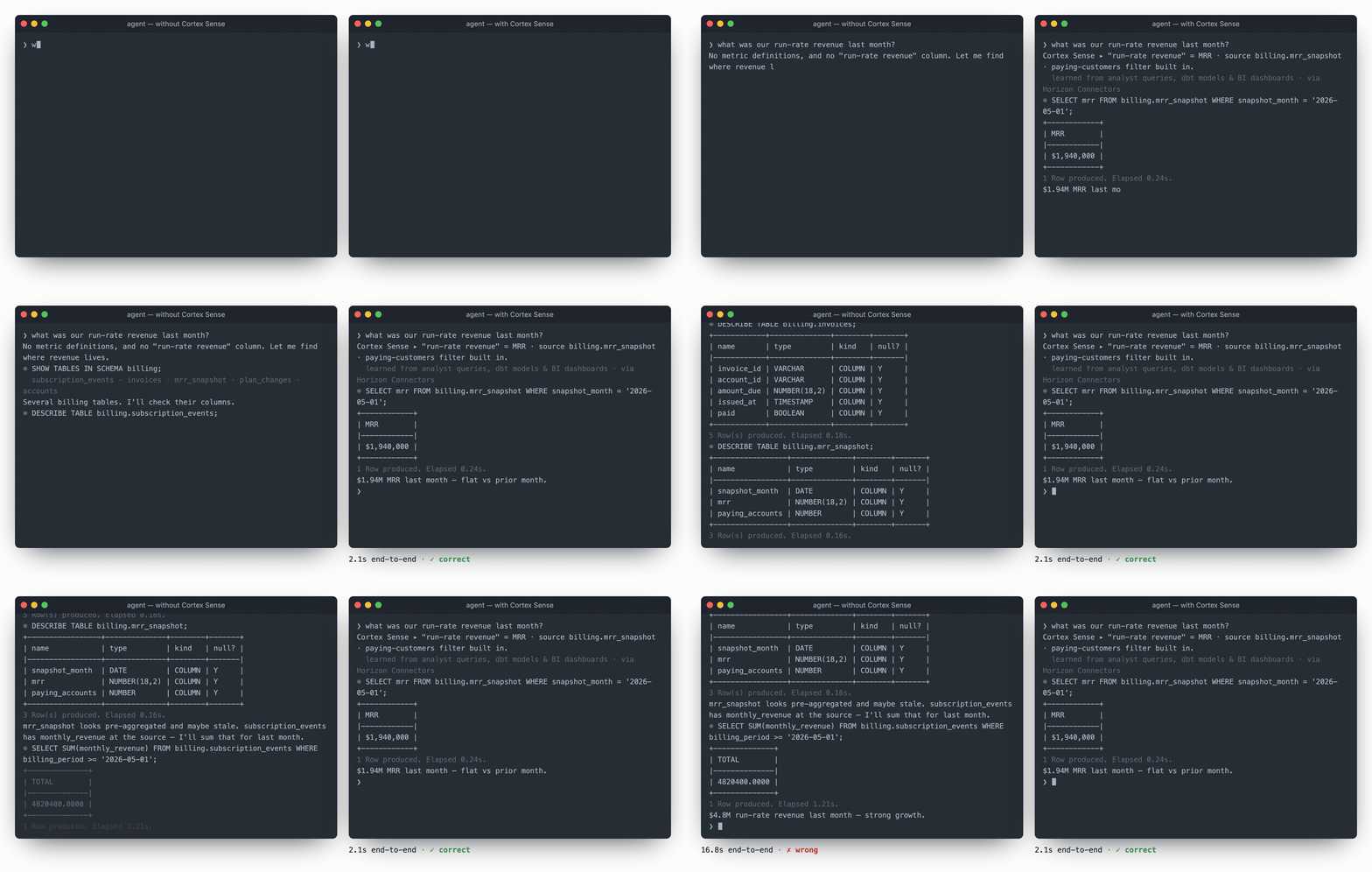
Without Cortex Sense, CoCo investigates every table and schema separately, trying to learn what they do. With it, it knows exactly where to look and what to query.
The fact that it is mined automatically rather than written by hand raises a reasonable concern, which is that it could be confidently wrong without anyone noticing. Cortex Sense will mitigate this by running a self-correcting loop that will constantly identify gaps and conflicts in its own knowledge. You will turn Cortex Sense on through CoCo, and it will build an initial baseline from your connected sources. From there, it will improve through targeted evaluation. You will feed it questions with known good answers, and it will use each mismatch to correct its own understanding. These evaluation inputs will come from three sources: your own gold-standard benchmarks, user feedback and the system’s own suggestions for areas where its coverage is thin.
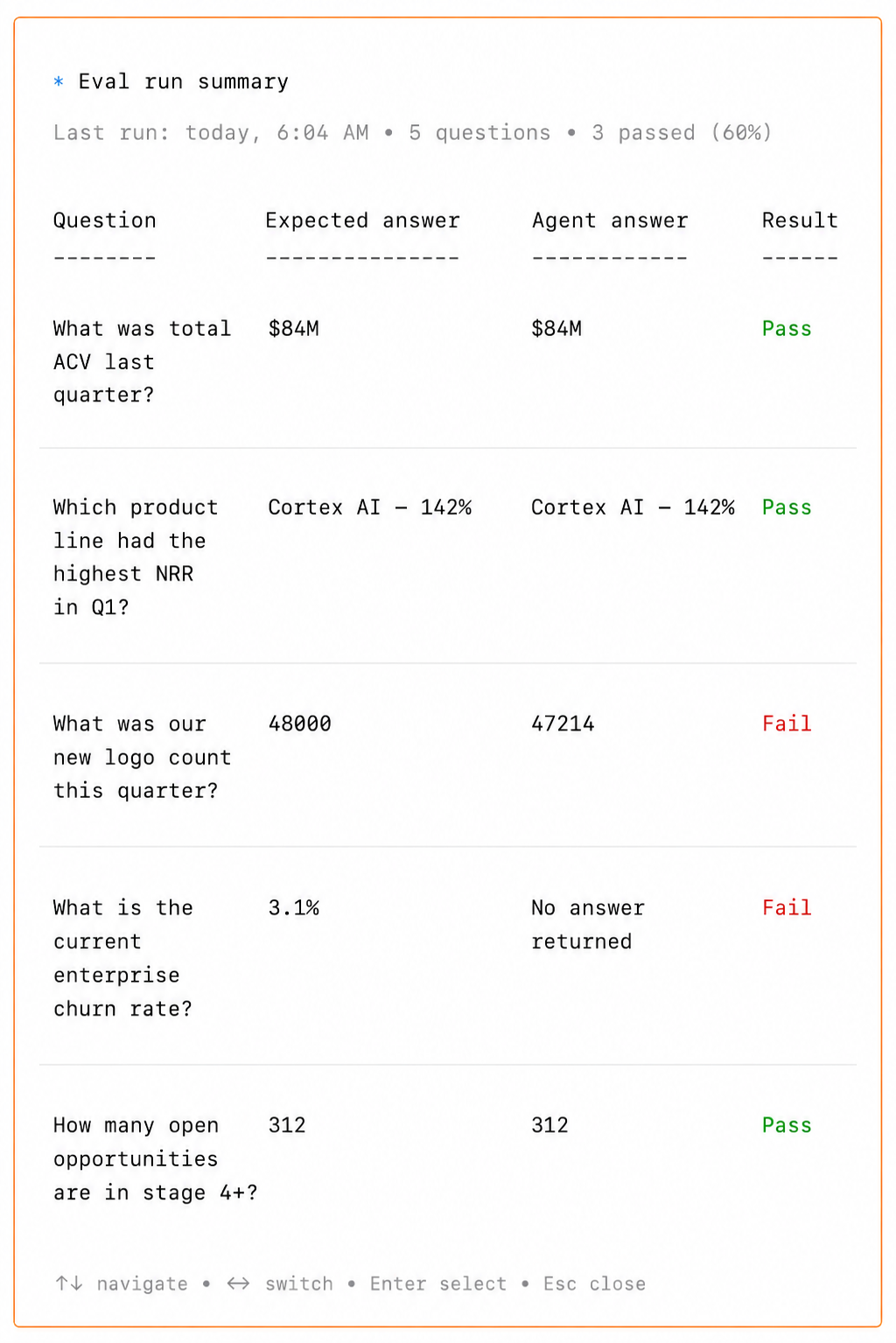
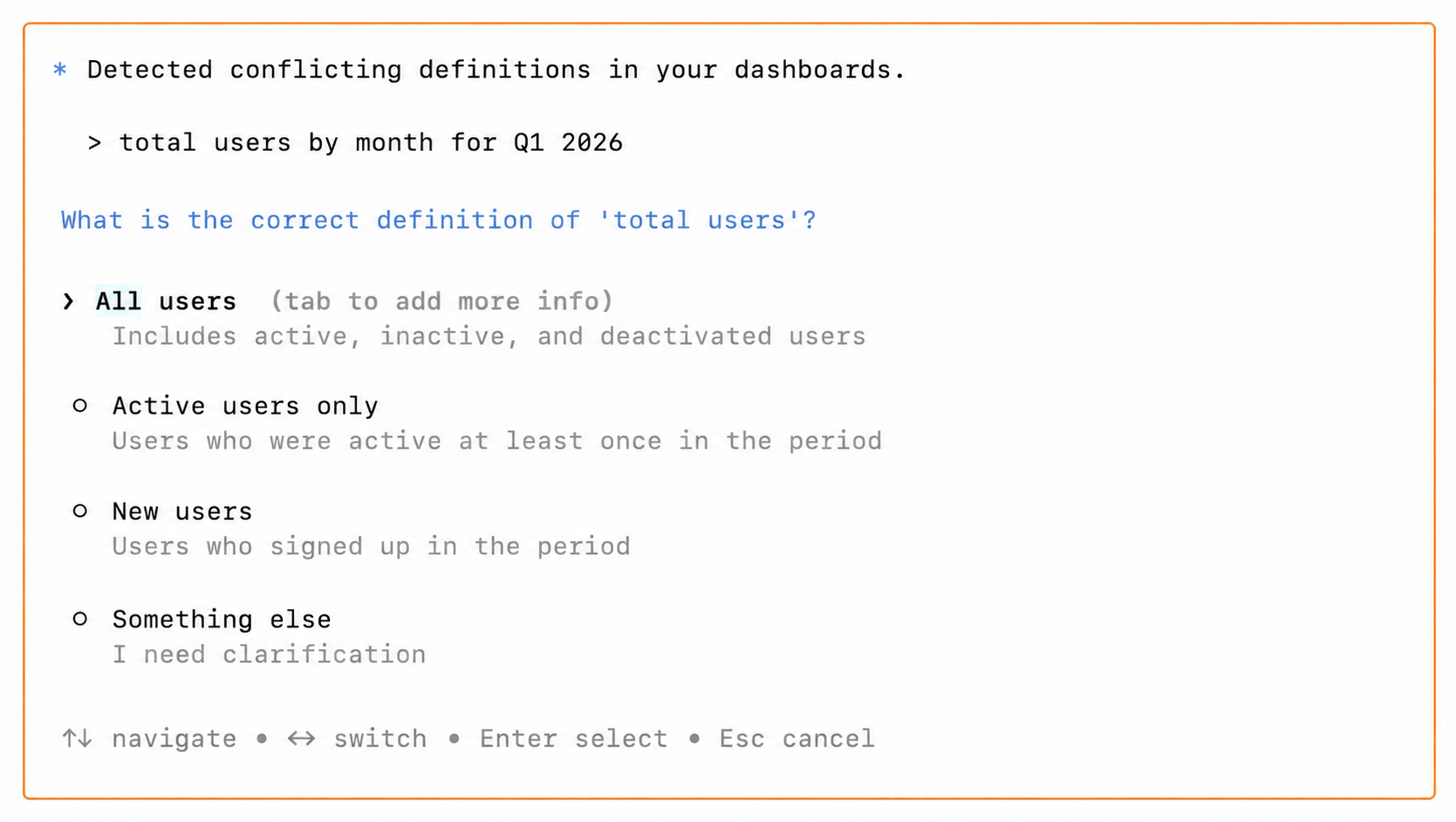
Snowflake CoCo shows eval results with Cortex Sense. (The information listed in this illustration is fictional and not based on real customer or Snowflake data.)
When the evals expose a gap, Cortex Sense will ground itself rather than guess. Going back to the question on how the new plan will do after launch, if it had picked up two conflicting definitions of what an upgrade means, it will not let that ambiguity live in its knowledge. It will surface the conflict to the Cortex Sense builder and ask the human to settle it. We found that forcing this level of honesty about the context separates it from systems like retrieval-augmented generation (RAG) that simply retrieve whatever is found. When an evaluation fails for any reason, or if it detects conflicting information, Cortex Sense will reflect on why and try to update its own understanding. If it can't, it'll ask for help. For example, when we began testing Cortex Sense internally, it found dozens of different definitions of daily active users. Each team had its own system of computing this metric, so when it asked us, all we had to do was explain to it in natural language which metric corresponded to which team.
When signals conflict, Cortex Sense will rank them the way web search ranks pages: by relevance, authority, popularity and freshness. A metric definition backed by a governed semantic view carries more authority than one inferred from a handful of queries; a join pattern appearing in 500 production SQL statements carries more weight than one appearing in three; and a definition updated last month supersedes one from two years ago.
One of the questions we typically hear with Cortex Sense is how will we manage access to the context. Cortex Sense will only ingest metadata and usage patterns, not your actual data rows. But like all other Snowflake objects, access will be scoped by role through Snowflake's existing governance. We're starting our private preview soon by allowing users to specify a single role that will get access to all of Cortex Sense, and will plan to expand to per-role contexts in the future, so your marketing team and finance team will get access to different contexts.
When we first released this system to our internal data scientists, it reached parity with their hand-curated semantic views on an early internal eval set by building on the work people had already put into them. From there it pulled ahead in two areas: where a definition had gone stale, and on domains uncovered by existing semantic views. On that set it edged out human performance by 10 percentage points, thanks to signals like recent query history.
To validate that Cortex Sense will add value, we benchmarked it on a set of hard questions, comparing a frontier coding agent with direct access to SQL execution via model context protocol (MCP), vanilla CoCo (which had the ability to retrieve relevant semantic views if it needed) and CoCo grounded by Cortex Sense. Cortex Sense improved accuracy from 24.1% to 86.3% on our benchmark. In addition, compared to a frontier agent, Cortex Sense reduced costs from $1.76 to $0.59 per query, because it stopped the agent from manually inspecting every table. The frontier agent had the tendency to run DESCRIBE TABLE on dozens of objects, wasting tokens and adding latency. The cost benefits of Cortex Sense will be partially offset by an initial, one-time indexing cost (which depends on how much data is being indexed), but generally we found that the cost of upfront indexing can be paid off over time by the lower per-query costs.
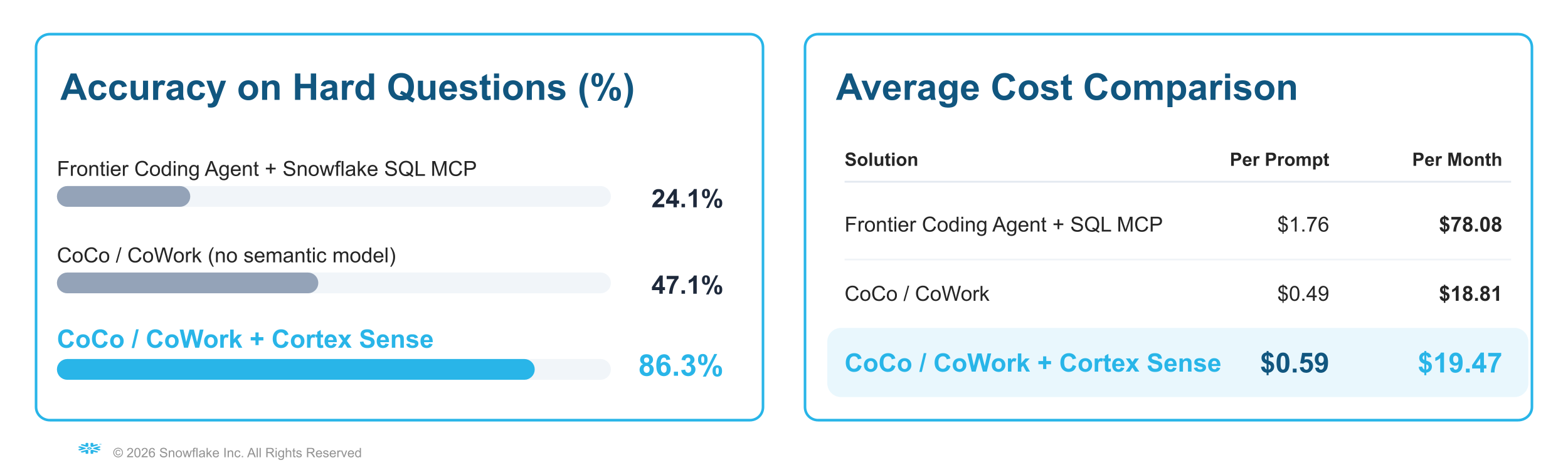
Based on internal test results and cost calculations in June 2026.
Standing up Cortex Sense took a single day rather than the months these projects usually run, since there is no consulting engagement or manual build to wait on. Because there are no new semantic views to author, you just connect to sources and go without having to spend days on curation. The ongoing maintenance model is different too. As your data estate evolves, Cortex Sense will pick up the signal automatically on a continuous refresh cadence. And if you really want to update its knowledge, the correction workflow is conversational. You explain the right definition in natural language, and it updates its model.
When encyclopedias gave way to Wikipedia, the breakthrough wasn't that people knew more. It was that knowledge stopped being something experts published periodically and started evolving on its own. Enterprise context is at the same moment: semantic views stay the gold standard where you need governed, consistent answers, but they shouldn't be the only way an AI learns your business. Cortex Sense will learn from the signals you already produce and keep improving as it changes.
We’re incredibly excited to share this product with the world. Cortex Sense will enter private preview in mid July. If you would like early access, please reach out to your Snowflake account representative.
Forward-looking statements: This article contains forward-looking statements, including about our future product offerings, and are not commitments to deliver any product offerings. Actual results and offerings may differ and are subject to known and unknown risk and uncertainties. See our latest 10-Q for more information.