Apr 22, 2026/4 min readFinancial Services
The Ecosystem Agent Framework: Orchestrating the Agentic Future of Finance


For decades, the financial services industry has optimized for access to data. But access was never the objective—it was a constraint on the real goal: enabling intelligent action.
The industry’s evolution has followed a clear progression: from acquiring data, to centralizing it, to making it usable through analytics and AI. Each phase reduced friction—not for its own sake, but to enable faster, higher-quality decisions.
The opportunity is not to replace human judgment, but to better allocate it. By stripping away non-differentiated work—data gathering, reconciliation, preparation—we increase the time and focus available for what drives outcomes: faster, higher-conviction decisions.
That same principle should apply to the systems themselves. AI platforms should not introduce new complexity—they should be invisible and frictionless to build on and operate within. Alpha isn’t guaranteed, but when both human effort and system design are optimized for simplicity, the conditions to generate it are materially improved.
We are now entering the next phase—where the goal is no longer just to understand data, but to act on it. This is the shift from insight to execution—from understanding to acting. This is the Agentic Era.
The Historical Gravity of Financial Data
Historically, critical financial outcomes depended on a manual integration of first-party institutional data and third-party market intelligence. In the pre-2015 era of friction, data delivery was archaic. SFTP transfers triggered massive, complex ingestion pipelines that were expensive to build and brittle to maintain.
The ‘data tax’ was a permanent fixture of the balance sheet—delaying and degrading the ability to act on information. Teams were forced to spend time stitching, transforming, and reconciling data just to reach a starting point for decision-making.
The paradigm shifted when the center of gravity moved to the cloud. Snowflake redefined how institutions manage and access data by replacing those legacy pipelines with direct, live data sharing.
By eliminating ETL, this was not just a shift in how data moved—it was a shift in how work happened. First- and third-party data can now coexist within the same environment, allowing engineering, analytics, and machine learning to operate directly on a shared foundation.
This convergence did more than reduce friction—it standardized the way financial workflows are built. Across asset management, banking, and insurance, critical workflows follow a common pattern: combining proprietary internal context with external market signals to drive decisions.
This consolidation wasn’t just a technical convenience; it was the necessary precursor to the Agentic Era. It created a high-velocity environment where context is already present at the point of execution, rather than something that must be assembled on demand.
Now, we have moved from an architecture that requires humans to manually bridge the gap between first-party and third-party data, to one where that integration is native—and therefore where Agentic Workflows can execute directly on top of it.
Snowflake provides the foundation for this shift by unifying data, governance controls and compute in a single environment. Because these elements now reside together, execution is no longer gated by data movement or reconciliation. What was previously a fragmented, manual process becomes a continuous, system-driven capability.
From "AI-Ready" to "Agent-Active"
Over the last 24 months, the industry has focused on making data "AI-ready"—essentially enabling natural language queries over structured data sets.
While valuable, even AI-ready data is just a raw ingredient, not the final deliverable. A "chat" might provide a quick insight, but it doesn't settle a trade, rebalance a portfolio, or process a complex insurance claim. Maximum value is only realized when data is no longer just a source for conversation, but is instead strung into a larger, multi-step workflow to drive a specific, autonomous outcome.
We are moving beyond the "Search and Summarize" phase of AI and into the "Orchestrate and Execute" phase—transitioning from data that is simply readable to data that is Agent-Active.
The Architecture of Orchestration: The Ecosystem Agent Framework
The unification of data access is what made Snowflake the natural environment for these workflows—and what now makes it the natural environment for agents to execute them.
Financial workflows are fundamentally built on combining first-party and third-party data. Within a single governance perimeter, Snowflake brings that data together with the primitives required to act on it.
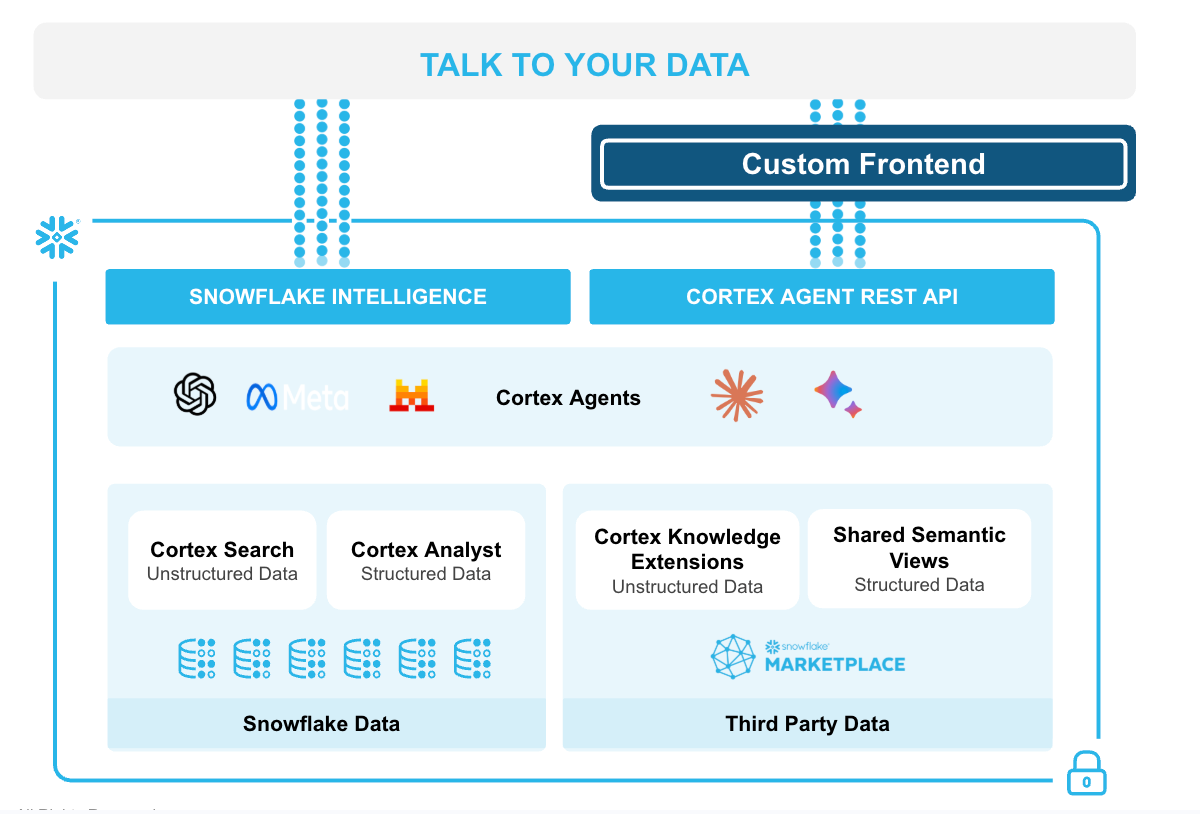
Through Cortex Analyst and Cortex Search, we provide world-class retrieval across structured and unstructured data—enabling agents to access the full context of a problem in real time. This is paired with AI-ready data products from our ecosystem, delivered as Shared Semantic Views and Cortex Knowledge Extensions, enabling both proprietary and external intelligence to be immediately usable.
On top of this foundation, Cortex Agents and Cortex Code provide the ability to build and execute workflows directly where that context lives.
This is the critical shift: agents are no longer stitching together context across systems—they are operating directly on top of it.
The result is an environment where data, context, and execution are unified. Enterprises can build agents that operate across first-party and third-party data with zero data movement, zero IP leakage, and governance capabilities—while maintaining complete lineage and evaluation.
In this model, agents don’t need to “reach” for data or tools. They are built where the data already lives, with the primitives required to retrieve, reason, and act.
That is what makes Snowflake a natural home for agentic workflows in financial services.
The Agent Ecosystem Architecture
A Note on MCP
While we support standards like MCP with our Snowflake-hosted MCP server, we view it as one of several approaches to enabling agents access to data.
MCP is well-suited for environments where data must remain distributed—though in many cases, that distribution reflects historical constraints rather than current necessity.
Advances in automation, AI-assisted development, and open table formats have made it significantly easier to unify access to data—without the overhead of the past and without introducing vendor lock-in, thanks to truly open, interoperable standards.
As a result, organizations have more flexibility to reduce fragmentation at its source rather than work around it.
Our perspective is simple: when unification is practical, the optimal path is to bring data, AI capabilities, governance, and agent primitives into a single, cohesive environment. This creates a direct, performant, and governable foundation for building and operating agents. When that isn’t possible, MCP serves as a valuable bridge across systems.
Given the central role of data, AI, and governance in this model, Snowflake provides a natural foundation for this unified approach.
In that sense, MCP is best viewed as an exception—not the default.
Real-World Execution: The Modern Analyst
Consider a global asset manager with an analyst covering the biopharma industry. Traditionally, this analyst spends their day manually sourcing signals to drive action. When news breaks, the research process is grueling: they check their internal investment thesis (unstructured first-party data), verify current positions and performance (structured first-party data), and perform a "look-through" to understand total exposure across ETFs and securities (combined first and third-party data).
In the Ecosystem Agent Framework, this entire process is orchestrated by a Cortex Agent. Rather than reactive, the process is continuous. What was previously a series of manual, time-bound tasks becomes a continuous, system-driven workflow. The agent constantly monitors ecosystem data for signals, cross-references internal and external data, and notifies the analyst not just with a summary, but with suggested hawkish, dovish, and neutral research notes complete with full context.
This is the critical shift that drives Operational Alpha: minimizing non-differentiated manual labor and maximizing the analyst's ability to perform higher-order, differentiated work.
Activating the Workforce
The gap between an "interesting AI demo" and a "production agentic workflow" is almost never the model. It is the data architecture underneath it.
The era of chatting with your data is over. The era of Orchestration has begun, and the architecture built to support it is Snowflake with the Ecosystem Agent Framework.
By choosing a foundation that prioritizes sovereignty and scale over short-term connectivity, we ensure the next generation of agentic systems doesn’t just function—it executes with speed, control, and intent.
Ready to learn more? Join us at Snowflake Summit and join me for my session The Financial Services AI, Apps and Data Guide with Snowflake.
